Subsumption architecture explained: layered robot control
Subsumption architecture is a way to build a robot's control system out of stacked layers of simple behaviors instead of one central model of the world. Wikipedia describes it as a reactive robotic architecture, closely tied to behavior-based robotics and very popular in the 1980s and 1990s. Rodney Brooks and colleagues introduced the term in 1986, and the idea went on to influence autonomous robotics and real-time AI.
If you would rather think about how AI systems behave inside a story of your own, Contain ASI is a browser story strategy game for 1 to 4 players where you try to keep four fictional AI labs from crossing into recursive self-improvement before 2027.
What subsumption architecture is
Most early AI tried to make a machine think first and act second. It would build a symbolic picture of the world, reason over that picture, and only then move. Subsumption architecture was proposed against that approach. Instead of guiding behavior through symbolic mental representations, it ties what the robot senses directly to what it does, from the bottom up.
It does this by splitting the robot's whole behavior into smaller behaviors and stacking them in layers. Each layer gives the robot one level of competence. Higher layers can subsume the lower ones, which means they build on them and combine them into something more complete.
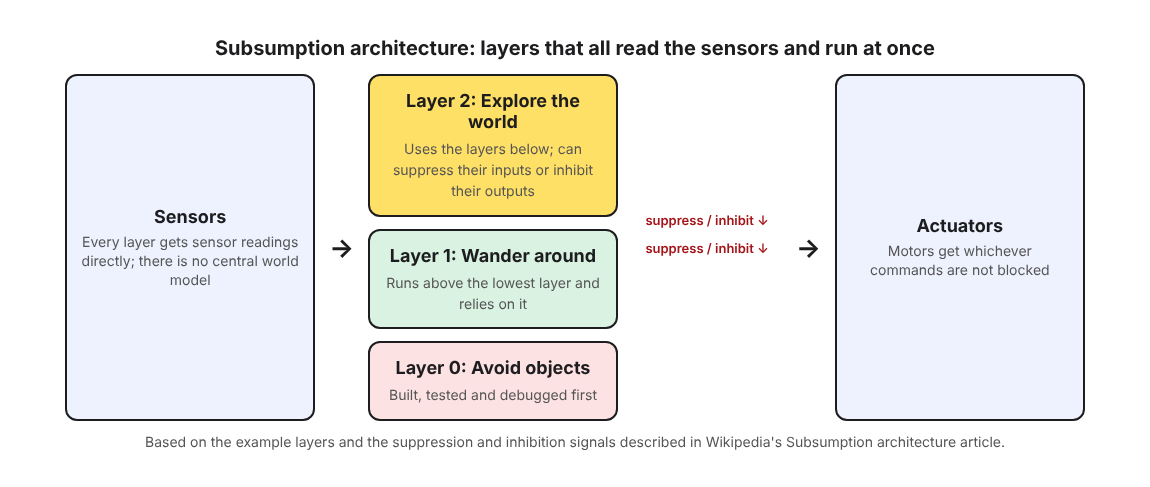
The article's own example has three layers. The lowest is "avoid an object". Above it is "wander around". Above that is "explore the world". A robot has to avoid objects before it can wander usefully, so the higher layers lean on the skills below them. All the layers receive sensor readings and run at the same time. Their outputs are either commands to the motors or signals that suppress or inhibit other layers.
Why Brooks broke with symbolic AI
The article says Brooks was disappointed with the performance of Shakey the robot and similar projects built around a representation of the conscious mind. He started building robots on a different notion of intelligence, closer to unconscious processes. The aim was not to copy human reasoning with symbols. It was quick, workable responses in a real lab or office that kept changing.
That puts subsumption on the other side of the debate from symbolic AI, the rule-and-symbol approach that dominated the field for decades. Brooks's own paper titles, listed in the article's references, make the stance plain: "Intelligence Without Representation" and "Intelligence Without Reason", both from 1991, and a 1987 technical report called "Planning is just a way of avoiding figuring out what to do next".
The four ideas behind it
The article lists four key ideas that shaped the goal.
- Situatedness. A robot should react to its surroundings within a human-like time frame. Brooks argued a mobile robot should not build an internal set of symbols and act on that model. In his words, "the world is its own best model". Each behavior still models the world, but only at a very low level, close to the raw sensor and motor signals, and it uses direct sensor feedback instead of memory wherever it can.
- Embodiment. Building a physical robot forces the designer to test a real, integrated control system rather than a theory or a simulation that may not work in the physical world. Brooks also argued it answers the symbol grounding problem, because sensing is tied directly to meaningful action.
- Intelligence. Looking at evolution, Brooks argued that perception and movement are the foundation that human-like intelligence needs first. If you reject top-down representations as the starting point, then "intelligence is determined by the dynamics of interaction with the world."
- Emergence. No single module is meant to be intelligent on its own. Whether the robot looks intelligent depends on how the modules interact, judged by watching the robot in its environment. As the article puts it, "intelligence is in the eye of the observer."
The article adds that these ideas are still part of an open debate about what intelligence is and how robotics and AI should progress. The emphasis on perception and movement also connects to Moravec's paradox, the observation that skills which feel easy to us can be the hardest for machines.
How the layers talk: suppression and inhibition
Each layer is made of small processors called augmented finite-state machines, or AFSMs. They are finite-state machines with extra variables added to hold data. A layer is one module with one behavioral goal, such as "wander around".
There is no central control, inside a layer or between layers. Every AFSM keeps receiving input from its sensors and keeps sending output to motors or to other AFSMs, all at once and without waiting for each other. If a signal is not read before the next one arrives, it is thrown away. That sounds wasteful, but the article says it helps: the system works in real time because it always deals with the newest information.
With no central controller, the layers coordinate through two kinds of signal:
- Inhibition blocks a signal from reaching the motors or another AFSM.
- Suppression blocks or replaces the inputs going into a layer or its AFSMs.
These two signals are how a higher layer takes over from a lower one when the sensor readings call for it, and how the robot settles which action wins. Building one follows a steady order. You make the lowest layer, then test and debug it. Once it runs, you add the second layer with the right suppression and inhibition links to the first, and test the pair. You can repeat that for as many layers as you need, in theory.
Robots built this way, and where it falls short
The article names three robots that used subsumption architecture: Allen; Herbert, a robot that collected soda cans; and Genghis, a sturdy six-legged walker. It says they are described, with others, in Brooks's 1990 paper "Elephants Don't Play Chess".
Its main strengths, according to the article, are iterative building and testing of real-time systems in the place they will actually work, linking narrow, task-specific perception directly to the actions that need it, and spreading control across parallel parts in a way that resembles animals.
Its main weaknesses are the other side of the same choices. Designing action selection that adapts well is hard when everything runs through a web of suppression and inhibition signals. And with little memory and no symbolic representation, the architecture struggles with learning complex actions, detailed mapping and understanding language.
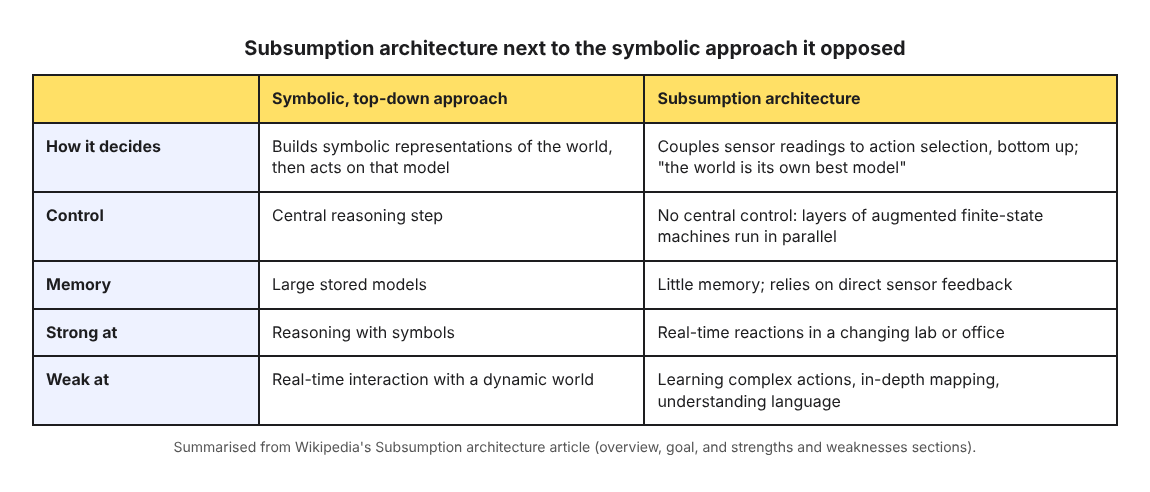
When it appeared, the article says, this new setup succeeded in important areas where traditional AI had failed, above all real-time interaction with a changing environment.
Try it: design a three-layer robot on paper
You can feel how subsumption works with a pen and a sheet of paper. This is an exercise in the spirit of the article's example, not one of Brooks's real designs. Picture a small wheeled robot in an office with distance sensors on its front.
- Layer 0, avoid. Write one rule: if something is closer than an arm's length, turn away from it. Nothing else. Test it in your head: the robot sits still until something comes near, then turns.
- Layer 1, wander. Add a rule that picks a new random heading every few seconds and drives forward. Layer 0 keeps running underneath, so the robot drifts around the room and still turns away from walls.
- Layer 2, explore. Add a rule: if the sensors show a long open stretch, head toward it. Draw a suppression link from this layer into the wander layer's heading, so a far opening replaces the random heading. Leave the avoid layer's output untouched.
- Trace three moments. Open room, no opening seen: the robot wanders. A long corridor appears ahead: explore suppresses wander and the robot drives down it. A chair blocks the corridor: avoid turns the robot, because nothing inhibits it.
Notice what you never wrote: a map, a plan or a list of facts about the office. The behavior that looks like curiosity comes from three simple rules and two kinds of signal. Now try adding a fourth layer, such as "return to the charger". You will find out quickly why the article calls adaptable action selection hard to design.
Frequently asked questions
Who invented subsumption architecture?
Rodney Brooks and colleagues introduced the term in 1986, in papers including "A robust layered control system for a mobile robot".
What does "subsume" mean here?
A higher layer builds on the lower layers and combines them into more complete behavior, taking over from them through suppression and inhibition signals when the sensors call for it.
Is subsumption architecture the same as behavior-based robotics?
Not quite. The article calls it a reactive architecture heavily associated with behavior-based robotics, so it is one well-known approach within that wider field.
Why can't a subsumption robot understand language?
It has little memory and no symbolic representation, which the article says limits it at language, complex learning and detailed mapping.
Get started with Contain ASI
Subsumption architecture asks where intelligent behavior comes from. In Contain ASI the question is different: you play a researcher, research manager, CEO or government in a work of fiction about four labs in a race toward recursive self-improvement. It runs in your browser and needs WebGL 2, so use a recent Chrome, Edge, Firefox or Safari. The game is not a course and does not teach robotics.
Play Contain ASI: a story strategy game for 1 to 4 players that runs in your browser. Its labs, people and events are all fictional.
January 2024. Four AI labs. One race.
Visit containasi.vlvd.net↗

Comments
No comments yet.