Sun Tzu's Art of War: What It Says and Who Wrote It
Sun Tzu's Art of War: what it says and who wrote it comes down to this. It is a Chinese military text in 13 short chapters, credited to a strategist called Sun Tzu, who lived around 500 BCE if he lived at all. Its core advice is to win through planning, information and deception, and to avoid costly fighting where you can. Who wrote it, and when, is still argued.
If you want to meet Sun Tzu next to the other people who shaped history, Learn 100 Influential People is a web app of short hands-on lessons on the 100 people who most shaped human history, and Sun Tzu is one of the Sages of Asia.
Sun Tzu's Art of War: what it says and who wrote it, in brief
The Art of War (Sunzi bingfa) is a treatise on how to prepare, mobilise, attack, defend and treat the defeated. World History Encyclopedia calls it one of the most influential texts in history, used by military strategists for over 2,000 years.
It is not a glorification of war. The book says several times that actual combat comes only when other ways of beating the enemy have failed, and that it is always a waste of men and resources. That is the surprise for most first-time readers: a war manual that mostly argues for not fighting.
Who was Sun Tzu?
Biographical details are scarce. He is said to have been born in the state of Qi and to have served as a commander in the southern state of Wu. The name "Sun Tzu" is not a personal name. It is a title that can be translated as "The Master", and the book keeps introducing its advice with "Sun-Tzu said".
The best-known story about him is one you may have met already. King Ho-Lu of Wu (also written Helu) wanted to test him, and told him to train 180 of the king's concubines as soldiers. Sun Tzu put the king's two favourites in command of two companies. The women laughed at his order, twice, so he had the two favourites executed and replaced. After that the women obeyed, and Ho-Lu hired him as a general.
Many historians do not take the story as fact. World History Encyclopedia notes it has been considered fiction since at least the 11th century CE, when the Song dynasty scholar Yeh Cheng-Tse first questioned whether Sun Tzu existed. Its own view is that, even if it never happened, the story shows the book's stress on discipline.
Who wrote The Art of War? Where scholars disagree
Our oldest accounts of Sun Tzu are the Spring and Autumn Annals and the Records of the Grand Historian by Sima Qian (written around 94 BCE). Scholars have criticised both for inaccuracies. World History Encyclopedia notes that the Annals are very brief and judges the Records mostly accurate, yet the case stays open. The main positions are these.
- A real general wrote it. Tradition says Sun Tzu served in the Wu-Chu wars of 512 to 506 BCE and wrote the book. His supporters point to the victory at the Battle of Boju (506 BCE).
- An unnamed genius inspired it. Because "Sun Tzu" is a title, it has been argued that a great military mind, whose name is lost, inspired a work written to record his strategies.
- A school wrote it. It has also been suggested that a student of the School of the Military, one of the schools of thought of the period, wrote it down to record the school's central idea that victory in war ensures peace.
The date is argued too. In 1972 an older version on bamboo strips was found in a tomb at Yinqueshan in Shandong, together with a separate Art of War by Sun Bin, a later strategist said to be his descendant. That find moved the usual date of the text back to the 5th century BCE, from the later Warring States period. Sceptics reply that it proves little, because the earlier text could still have been written by someone else. Other scholars point to the sophisticated language and the level of military development in the book as signs that it was put together later. The version we read today was edited by the warlord Cao Cao in the 3rd century CE.
Sources like these are exactly why it helps to know how to analyze a primary source: a text can be real and influential while its author stays uncertain.
The 13 chapters in one line each
Chapter names differ between translations. These follow World History Encyclopedia's summary.
- Initial Estimations: war is "the greatest affair of state", so weigh it carefully: the Way, yin and yang, terrain, generals and discipline.
- Waging War: supplies and cost. "No country has ever profited from protracted warfare."
- Planning Offensives: limit destruction. Sieges are a last resort, and the commander must know the enemy.
- Military Disposition: prepare first, and measure the enemy's strength.
- Strategic Military Power: meet the enemy with the orthodox and win with the unorthodox, with the force of boulders rolled down a mountain.
- Vacuity and Substance: force the enemy to react, hide where you will strike and find his weak points.
- Military Combat: keep troops together and with their supplies.
- Nine Changes: weigh gain against loss with every action.
- Manoeuvring the Army: take high ground, avoid ambush sites and read the enemy's signs.
- Configurations of Terrain: six kinds of ground, and the weaknesses of armies.
- Nine Terrains: nine more kinds of ground that decide what a general does.
- Incendiary Attacks: fire as a weapon, with timing and weather in mind.
- Employing Spies: knowing the enemy needs spies, of several types, who must be rewarded well.
Four ideas that last
Win without fighting
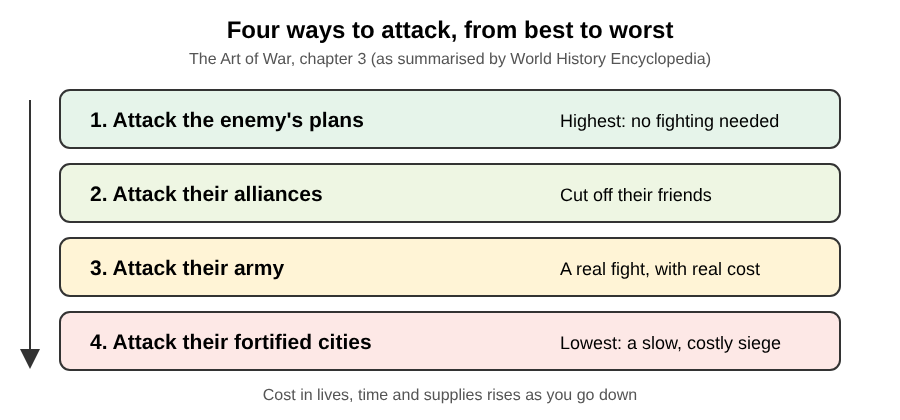
The best-known idea is in chapter 3: "The highest realisation of warfare is to attack the enemy's plans; next is to attack their alliances; next to attack their army; and the lowest is to attack their fortified cities."
Deception
"All warfare is based on deception" is cited from chapter 1. Followers of Confucianism objected to deception as contrary to gentlemanly conduct.
Speed and cost
Weapons dull, food runs out and soldiers tire, so the book argues for short campaigns. World History Encyclopedia adds that Sun Tzu's ideas broke with an older code in which war had been treated like a knightly contest, with rules both sides kept.
Know the enemy
Chapter 3 stresses knowing the enemy, and the book ends on spies. It also stresses the mind: commanders should energise the qi, the "breath" of life in Chinese thought, of their own troops and drain it from the enemy's.
Not everyone agreed. World History Encyclopedia says the philosopher Han Fei Tzu thought the work neglected discipline as a part of success, and he did not accept that a commander should always keep war's destruction in mind.
How the book was used
World History Encyclopedia argues that the book's ideas reached practice with the Qin statesman Shang Yang, whose reforms backed total war, and later the Qin king who united China in 221 BCE. At the Battle of Gaixia in 202 BCE, it says, the Han side followed the book in attacking without regard for the old rules and by singing songs of Chu to demoralise the enemy. Cao Cao wrote a commentary on the text. Napoleon is said to have used many of its principles, and Mao Zedong and Ho Chi Minh are named as readers who did.
Today it is read by business strategists, political advisers and others, though the book is about war. The World History Encyclopedia article on Sun-Tzu adds that whether he existed has stopped mattering much, because the work has made the name last. For another thinker the era shaped, see Confucius vs Laozi, and for a very different view of power, Machiavelli vs Hobbes.
A worked example: read chapter 3 in 20 minutes
Chapter 3 is the easiest way into the book, because its ladder fits any contest. Try this with a dispute you know, such as two clubs competing for the same hall booking. This is a reading exercise of ours, not something the book says in these words.
- Write the four rungs: plans, alliances, army, fortified cities.
- Next to each, write what it would mean in your case. Plans: what does the other side really want? Alliances: who else is involved, and whose support do they rely on? Army: a direct contest, such as a vote. Fortified cities: the slow, costly route, such as a formal appeal.
- Start at the top. The book suggests moving down a rung only when you must, because each rung costs more.
Frequently asked questions
Who wrote The Art of War?
Tradition credits Sun Tzu, a strategist said to have served the state of Wu around 500 BCE. Scholars disagree on whether he wrote it, whether he existed, and when the text took its form.
How many chapters does The Art of War have?
It has 13 chapters, from the first estimations of a war through terrain and fire to the use of spies.
What is the main idea of The Art of War?
Prepare well, know yourself and the enemy, use deception and avoid long wars. The best result is to defeat the enemy's plans, or break his resistance, without a battle.
Did Sun Tzu really exist?
Nobody can say for sure. The oldest accounts come from Sima Qian and the Spring and Autumn Annals, and scholars disagree about how far to trust them. "Sun Tzu" may be a title, "The Master".
Get started with Learn 100 Influential People
Sun Tzu is part of the Sages of Asia course, with the Buddha, Mahavira, Ashoka, Confucius and Laozi, at the Intermediate level. Lessons run about 9 minutes, and questions check you as you go. Every lesson lists its sources, and 38 cards set out where researchers disagree, as they do on Sun Tzu. You can read more on the about page. You sign in with your email and an emailed sign-in code, and you must be 13 or older.
Start Learn 100 Influential People: short hands-on lessons on the people who shaped history, with every side of the debate and the sources to read next.
100 people who shaped history, from Moses to the web.
Visit influentialpeople.vlvd.net↗


Comments
No comments yet.
Sign in or make an account to comment.