Thomas Jefferson and the Declaration of Independence: What He Wrote
Thomas Jefferson and the Declaration of Independence belong together because he was the man Congress asked to write it. In June 1776 the 33-year-old Virginian drafted the text, a committee edited it, and Congress adopted it on 4 July after cutting about a fifth of what he had written. What survives is an argument: people have rights, a government that wrecks them can be replaced, and King George III had given the colonies cause to do so.
If you want to see how the founders fit together, Learn 100 Influential People puts Jefferson in its Age of Revolutions course, in short hands-on lessons with questions that check what you remember and sources you can read next.
How Jefferson came to write the Declaration
Jefferson had been making the case against the Crown for two years. In 1774 he wrote A Summary View of the Rights of British America, which argued that the colonies had the right to govern themselves, that they were tied to the English king only through voluntary bonds, and that Parliament had no right to interfere. World History Encyclopedia says the pamphlet made him a Patriot leader in Virginia and led to his appointment as a delegate to the Second Continental Congress in spring 1775.
In Congress he was among the youngest and least distinguished members, and his shyness kept him from speaking much. Writing was another matter. On 7 June 1776 Richard Henry Lee of Virginia moved that Congress declare independence. The debate was so fierce that Congress put the motion off for three weeks and, in the meantime, named a committee of five to draft a declaration in case it passed: Benjamin Franklin, Robert R. Livingston, John Adams, Roger Sherman and Jefferson.
Jefferson did the writing, between 11 June and 28 June, on the second floor of a house he rented in Philadelphia. The other four committee members then revised his draft, and on 4 July Congress adopted the text.
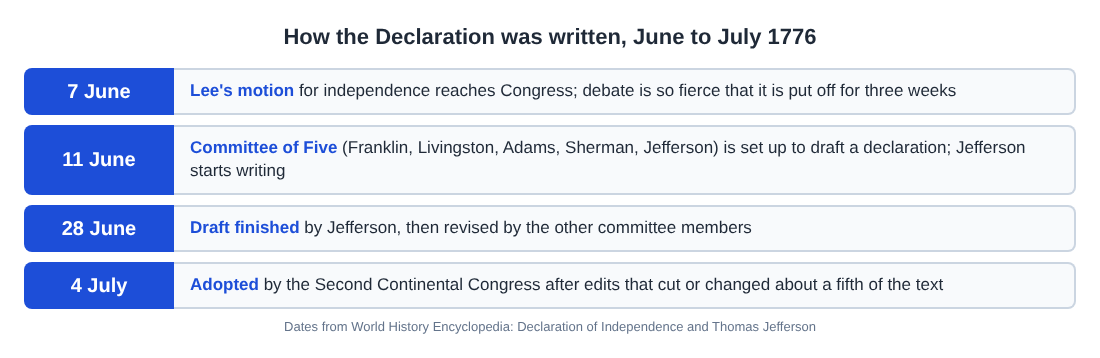
The weeks from Lee's motion to adoption, from World History Encyclopedia.
Thomas Jefferson and the Declaration of Independence: what he wrote in four moves
The Declaration is easiest to read as four moves, one after another, in the way a lawyer builds a case.
- Reason. It opens by saying that "a decent respect to the opinions of mankind requires" a people who separate to explain why.
- Principle. This is the passage most people know: "We hold these truths to be self-evident, that all men are created equal, that they are endowed by their Creator with certain unalienable Rights." Governments exist to secure those rights, and they get "their just powers from the consent of the governed". When a government turns "destructive toward these ends", the people may "alter or abolish it".
- Evidence. The longest part is a charge sheet against the king. It begins: "The history of the present King of Great Britain is a history of repeated injuries and usurpations."
- Verdict. The colonies are declared "Free and Independent States", and the signers "mutually pledge to each other our Lives, our Fortunes, and our sacred Honor."
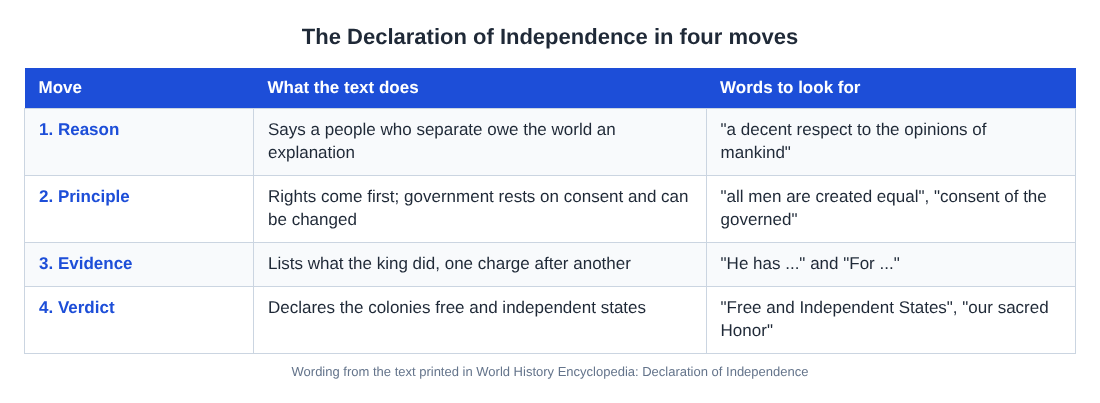
The four moves and the words that mark them.
World History Encyclopedia says Jefferson drew heavily on the Enlightenment ideas of John Locke, and that the Declaration puts the blame for independence largely on the king, whom it accuses of repeatedly violating the social contract. Independence is presented as a last resort, taken only after petitions to both king and Parliament were turned away.
The charges against the king
The third move is the one most readers skip, and it is the most revealing. It lists what the colonists counted as tyranny, and many items are about process: who makes the law, who judges and who pays. Among them:
- "He has refused to Assent to Laws, the most wholesome and necessary for the public good."
- "He has kept among us, in times of peace, Standing Armies without the Consent of our legislatures."
- "For quartering large bodies of armed troops among us."
- "For imposing Taxes on us without our Consent."
- "For depriving us in many cases, of the benefit of Trial by Jury."
Notice the target. The charges name the king, not Parliament, which fits the argument Jefferson had made in 1774. The text also includes a line about "the merciless Indian Savages" that the king is said to have stirred up on the frontier. It is part of the record, and it shows who the document's language of equality left out.
What Congress cut, and why it matters
Jefferson did not enjoy the editing. World History Encyclopedia says Congress's discussions made him squirm, and that a full one-fifth of the text was removed or revised to make it less radical. One cut was an entire section in which Jefferson blamed the king for the evils of the slave trade.
That cut points to the sharpest argument about him. Over his lifetime Jefferson owned approximately 600 enslaved people, most born into slavery on his property, and the same encyclopedia notes that the labor on his beloved Monticello was mostly done by people he enslaved. His administration did abolish the slave trade in 1808, but slavery itself lasted another half century.
People read this gap in different ways. One reading treats the Declaration's principle as hollow because its author did not live by it. Another points out that the same words were later cited in the push to abolish slavery and in many civil rights movements, which suggests the principle outgrew its author. World History Encyclopedia sums up the result by calling Jefferson both one of the most revered and one of the most controversial Founding Fathers. You can hold all of that at once without choosing a single verdict.
How to read the Declaration as a primary source
The text becomes much clearer when you test one line against the history around it. A worked example, in four steps, using the charge "For imposing Taxes on us without our Consent":
- Who speaks, and to whom? Congress speaks to "mankind", not only to Britain, as the opening says.
- What is claimed? That the king imposed taxes on the colonies without their agreement.
- What happened outside the text? Parliament, not the king alone, passed the Stamp Act in 1765 and the Townshend Acts in 1767 and 1768. The Declaratory Act of 1766 said Parliament could legislate for the colonies "in all Cases whatsoever". The colonists answered that they had no one representing them in Parliament.
- What does the gap tell you? The charge is aimed at the king although Parliament passed the taxes, so it is an argument as much as a report. That choice follows from Jefferson's view that the colonies owed allegiance to the Crown and not to Parliament.
For a method you can reuse on any document, see How to analyze a primary source document: 4 steps. For the thinker behind the second move, read Locke vs Rousseau: the social contract, explained simply, and for the man who led the army and then the new government, George Washington's presidency.
Frequently asked questions
Did Jefferson write the whole Declaration of Independence?
He was the primary author and wrote the first draft between 11 June and 28 June 1776. The other four members of the committee revised it, and Congress cut and changed it again before adopting it on 4 July.
How much of Jefferson's draft did Congress remove?
World History Encyclopedia says a full one-fifth of the text was removed or revised, including a section that blamed the king for the evils of the slave trade.
Was the Declaration famous at once?
Not as a founding text. World History Encyclopedia says it was not considered significant until more than 50 years after its signing, because it was first seen as a routine formality to accompany Congress's vote for independence.
When did Jefferson die?
He died on 4 July 1826, aged 83, the 50th anniversary of independence, and was buried at Monticello. He had served as governor of Virginia, minister to France, secretary of state, vice president and, from 1801 to 1809, president.
Get started
Reading the Declaration once gives you the argument. Studying it beside the people around it gives you the context. Learn 100 Influential People is a web app of short hands-on lessons on the 100 people who most shaped human history. Its Age of Revolutions course covers Jefferson with Washington, Napoleon, Bolivar, Toussaint Louverture and Lincoln. Each lesson takes about 9 minutes, where researchers disagree the site sets out each side, and every lesson lists its sources so you can read the original work. You sign in with your email and an emailed sign-in code. You can read more on the about page.
Start Learn 100 Influential People: short lessons on the people who shaped history, with every side of the debate and the sources to read next.
100 people who shaped history, from Moses to the web.
Visit influentialpeople.vlvd.net↗


Comments
No comments yet.