What is a Burmilla cat? Silver coat and make-up eyes
What is a Burmilla cat? It is a breed with a shimmering silver coat and "make up" lines around its eyes, nose and lips. The Cat Fanciers' Association (CFA), a cat breed registry, lists its coat length as "Longhair and Shorthair", its characteristics as "Sparkling silver coat, and distinctive make up lining the nose, lips and eyes" and its personality as "Sociable, playful, and affectionate". This guide follows the CFA's Burmilla breed page and its breed standard, opened for this post, and then shows how Cat Go handles the question "Which breed is it?"
Cat Go is a game you play in your browser: walk anywhere, photograph a real cat, lure it with food and catch it, and pick its breed from a list that has a mixed breed answer too.
What is a Burmilla cat? The short answer
The CFA calls the Burmilla one of the cat fancy's newer breeds, "a hybrid" that owes its shaded silver coat to Chinchilla Persian ancestors. It draws its intelligence and sociable nature from the other side of its family, the European Burmese. Here "hybrid" means a cross between two cat breeds, not a cross with another animal.
The CFA describes the personality as friendly and inquisitive, easy-going and laid-back, with a great love of play that lets the cat keep a kitten-like quality throughout its life. What people notice first is the coat: pale at the roots and tipped with color, so it seems to sparkle.
How the Burmilla began
According to the CFA, the Burmilla began with an accident in 1981. Baroness Miranda Von Kirchberg had bought a Chinchilla Persian male as a pet for her husband. Shortly before he was neutered, he met a precocious lilac European Burmese female.
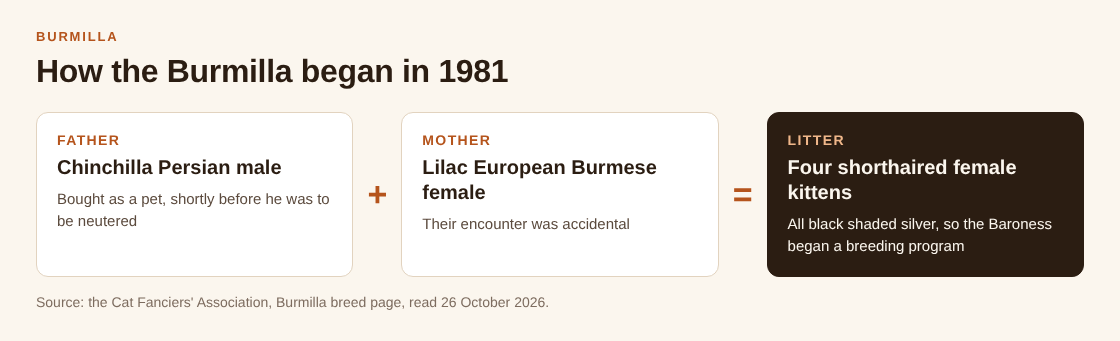
The 1981 litter that started the breed, as the CFA tells it.
The litter was four shorthaired female kittens, all black shaded silver. The kittens were so beautiful, the CFA says, that the Baroness started a breeding program to develop a new agouti cat, with a striking contrast between the colored tipping or shading and the white base of each hair.
Because of the Persian ancestry, both longhair and shorthair Burmillas were produced. The CFA says the longhair is a semi-longhair with an easy-care single coat. Both were accepted for CFA registration in 2011 and advanced to championship status in 2014.
The coat: chinchilla or shaded
The breed standard asks for a pure silver white ground color, shaded or tipped in the recognized colors. It describes two main patterns, and the difference is how much of each hair is colored:
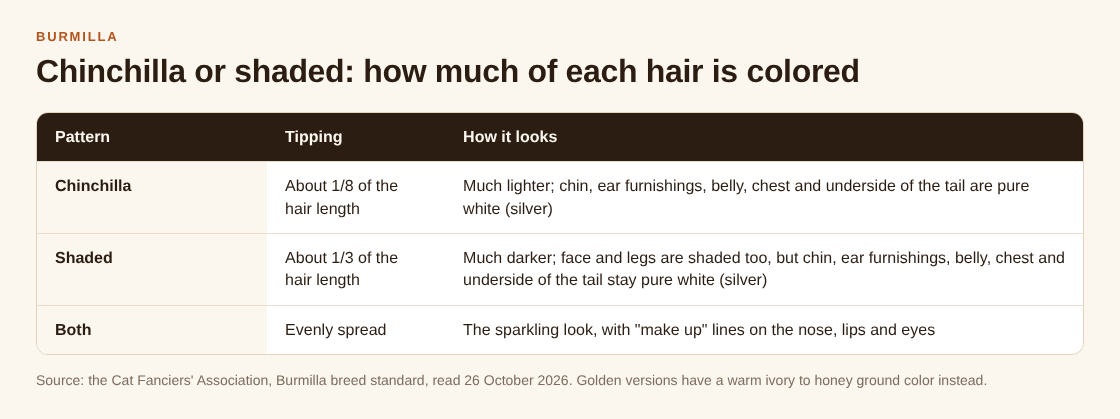
Chinchilla and shaded tipping in the CFA's Burmilla breed standard.
The standard lists many colors for both patterns, including black, seal sepia, blue, chocolate, lilac and caramel. There are also golden versions, where the ground color is a warm ivory to golden honey instead of silver white. In the show ring, the CFA says judges penalize tabby marks in the tipping, solid colored hairs, uneven tipping and a brown or yellow tinge in the coat.
The two coat lengths feel different. The standard says the shorthair coat is short with a silky texture, lying smooth with enough undercoat to give a slight lift. The longhair coat is fine and silky, medium long except over the shoulders, with no woolly undercoat, and ear tufts, furnishings and a full tail plume are preferred.
Face and body
The CFA describes a medium-sized cat with a muscular yet elegant body. Its standard lists these features:
- Head: a gently rounded top, tapering to a blunt wedge, with a firm chin of good depth. The profile shows a gentle dip in the nose.
- Eyes: large and set well apart at a slightly oblique angle. Adult eyes can be any shade of green, and the CFA accepts a yellow tinge in kittens and young cats under two years of age.
- "Make up": lines of color that outline the eyes, nose and lips, which the CFA says accent the coat.
- Legs and tail: slender legs with strong bones, neat oval paws and a medium to long tail that tapers slightly to a rounded tip.
- Size: the CFA says it is not unusual for a mature male to reach or exceed 10 pounds, while females are usually smaller.
Temperament: playful but not extreme
The CFA says the Burmilla mixes the outgoing, mischievous nature of the European Burmese with the mellow placidity of the Chinchilla Persian. The result is a personality "not extreme in any way". It describes a cat that is energetic but not hyperactive, happy to lounge on the couch for long naps after regular bursts of spirited play.
The breed is intelligent, so the CFA suggests lots of environmental enrichment, such as toys, things to climb and perches. Burmillas are people oriented and loving without being needy. They are gregarious but enjoy some independence, and the CFA says they can be left alone during your work day. They are not typically vocal or overly demanding, and the CFA says the breed gets along with dogs, other cats and children.
Grooming and health, as the CFA describes them
- Brushing: relatively simple for either coat length. Like essentially all cats, the Burmilla sheds, so the CFA says to groom at least once a week with a stainless-steel comb or small slicker brush.
- Other care: regular nail trims, ear cleanings and dental care.
- Baths: most do not need regular bathing. If you plan to bathe your cat, the CFA says to consult your breeder for the right products, since every coat is slightly different.
- Health: typically healthy, but Burmillas may be subject to some health issues found in their parent breeds. The CFA says responsible breeders test their breeding cats. For your own cat, ask your vet.
- Gene pool: the CFA says it is small, so responsible breeders keep adding unrelated cats, through new lines, outcrosses and imports from other countries.
The CFA calls the Burmilla a minority breed that is growing in popularity. It says the best way to meet a breeder is to visit a cat show, after contacting the sponsoring club to ask whether any Burmillas are entered, and it points to a Find-A-Breeder website.
How to check a silver-tipped cat on a walk
Here is a worked example. On a walk you see a cat with a silvery, sparkling coat and colored outlines around its eyes, and you wonder whether it is a Burmilla.
- Look at the coat. A Burmilla coat is pale at the roots and tipped with color toward the ends. The CFA describes it as silky and sparkling.
- Look at the face. The CFA mentions "make up" lines around the nose, lips and eyes, and green eyes.
- Look at the build. Medium size, muscular but elegant, with slender legs.
- Allow for look-alikes. Chinchilla and shaded coats also appear in other cats. Our posts on the chinchilla coat and the smoke cat cover related coat patterns, and one on the Persian covers one of the parent breeds.
- Do not stop at the coat. Only papers can settle a breed. Our post on telling whether a cat is mixed breed gives the longer checklist.
At the end you have a guess, not an answer.
Where Cat Go comes in
After a cat is spotted, Cat Go asks "Which breed is it?" and gives you a list with a search box. The game also says "Most cats you meet are mixed breed. Rarer breeds are warier." and "Mixed breed is always a safe pick."
That fits what you just read. A silvery cat can be a Burmilla or something else, and you choose the breed yourself. The game counts 34 breeds, and every catch is saved to your Catdex with its breed and the place you found it. It needs the camera and location allowed in your browser, and its camera screen says to fit the whole cat in the frame, which helps here, since the coat and the face are the clues and they need to be in the photo.
Frequently asked questions
Is the Burmilla a hybrid?
The CFA calls it a hybrid, meaning a cross between two cat breeds: the Chinchilla Persian and the European Burmese.
Do Burmillas have long or short hair?
Both. The CFA says both longhair and shorthair Burmillas were produced because of the Persian ancestry, and the longhair is a semi-longhair with an easy-care single coat.
Are Burmillas noisy?
The CFA says they are not typically vocal or overly demanding.
Do Burmillas need much grooming?
The CFA calls grooming relatively simple: a weekly brush with a stainless-steel comb or small slicker brush, plus regular nail trims, ear cleanings and dental care.
Can you tell a Burmilla from a photo?
Not reliably. A silver tipped coat and outlined eyes are clues, but they are not proof of a breed, and most cats you meet are mixed breed.
Get started
You do not need a pedigreed cat to enjoy looking at cats. Play Cat Go in your browser: walk anywhere, photograph a real cat, lure it with food and catch it. The game needs your camera and location allowed in the browser. Each catch is saved to your Catdex with its breed and the place you found it.
Walk anywhere, find a real cat, and catch it.
Visit catgo.vlvd.net↗


Comments
No comments yet.
Sign in or make an account to comment.