What is a Chartreux cat? Blue coat, history and nature
What is a Chartreux cat? It is a shorthaired, blue-coated French breed with a medium woolly coat and a calm, adaptable nature. The Cat Fanciers' Association (CFA), a cat registry, lists it as "blue only, well muscled". This guide uses the CFA's Chartreux page to show where the breed came from, how to recognize one, and what the CFA says about its nature, grooming and health.
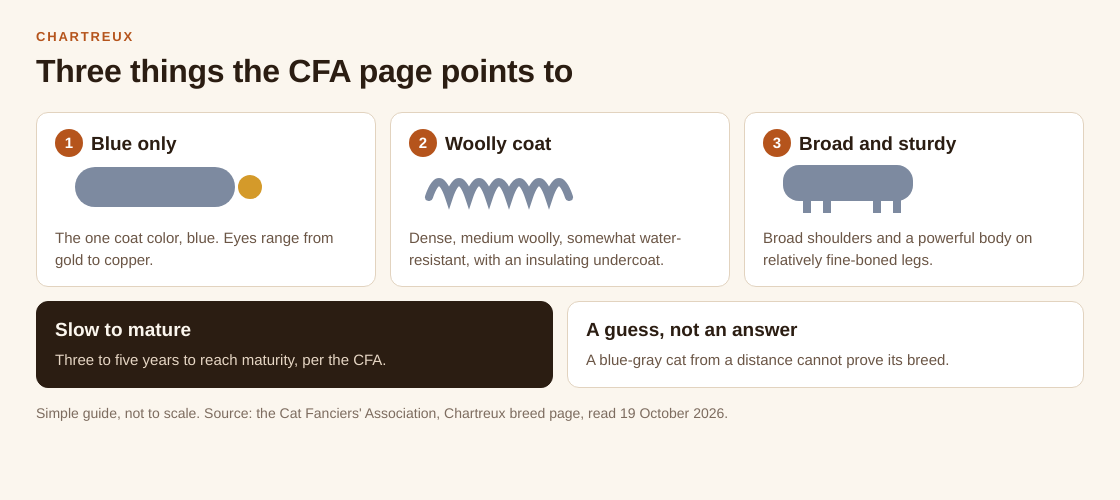
Three things the CFA's Chartreux page points to: the blue coat, the woolly texture and the build.
What is a Chartreux cat, in one picture?
The CFA gives the coat length as shorthair. Its short summary of the breed is "blue only, well muscled, medium woolly coat", and its personality line is "even-tempered and adaptable".
The picture above shows the three clues the page leans on. The coat is one color, blue. It is dense and woolly rather than silky. And the body is broad and powerful, though the legs are relatively fine-boned. The CFA also says the rounded, expressive eyes range from gold to copper.
Where the Chartreux came from
A popular legend says these blue cats lived in French monasteries and took a vow of silence like the monks. The CFA calls the idea of cats taking a vow "clearly a charming myth". It does say the breed is quieter than most and has a calm, cheerful dignity.
The written record is older than the legend suggests. The CFA says references to the blue cats of France appear in literature as early as the 16th century. The name was once thought to come from the Carthusian monks, but it may instead come from a type of Spanish wool, well known to traders, that resembled the woolly quality of the cat's blue fur.
Selective breeding in France began in the 1920s. The foundation came from natural colonies of French blue cats that showed consistent type. The CFA says early breeders praised the cats for their mild temperament and robust health despite harsh natural conditions. Chartreux were first imported to North America in 1970, and the CFA says they have stayed relatively unchanged since, thanks to breeders focused on preservation.
One small tradition survives from France. The CFA says breeders in North America name kittens born in a given year beginning with a specific letter. They use only 20 letters, leaving out K, Q, W, X, Y and Z.
How to recognize a Chartreux
Start with the coat, then the build, then the face. None of these proves a breed, but together they show what the CFA is describing.
Coat and color
The CFA describes a dense, woolly coat that is somewhat water-resistant, with an insulating undercoat that helps protect the cat from cold winter weather. The color is blue only, which in cat terms means a gray-blue shade.
Body, head and eyes
- Body: broad-shouldered and powerful, in contrast with relatively fine-boned legs and feet.
- Head: broad and rounded, tapering to a narrow muzzle. The whisker pads give the cat what the CFA calls a hint of a smile.
- Ears: erect and medium in size, set high on the head.
- Eyes: rounded and expressive, from gold to copper.
Size and growing up
The CFA says Chartreux take between three and five years to reach maturity. Males may weigh as much as 14 pounds, and females may be significantly smaller. A young cat can therefore look lighter than the adult it will become.
Chartreux personality: quiet, loyal and a little doglike
The CFA calls Chartreux intelligent cats with lightning-fast reflexes. It also calls them "known for their dog-like behavior": some enjoy walks on a leash or retrieve toys, and many learn to respond to their names.
It says they enjoy close, affectionate relationships with their owners, yet they are polite and not demanding. They are creatures of habit who develop rituals and routines, and they often follow their owners from room to room.
The voice is the surprise. Many Chartreux have a tiny voice that they use only rarely, and others are mute. The CFA still calls them expert communicators, using murmurs and chirps, expressive eyes and subtle body language. It gives two examples: a paw touch as a request to get into your lap, and bringing you a toy to ask for play.
They are not couch statues, either. The CFA says to toss a toy in the direction of a Chartreux and you are likely to find yourself in play that continues until the cat's energy flags.
Coat care, health and finding a Chartreux
The CFA says these cats are seasonal shedders who need more grooming in fall and spring, when shedding is heaviest. Occasional combing with a wide-spaced metal comb can stop mats before they form, prevent hairballs and reduce the hair in your home. Most do not need regular bathing, and the CFA warns that the water-resistant coat is hard to wet through. It adds that, because of the abundant woolly undercoat, Chartreux are not recommended for allergy sufferers.
On health, the CFA calls it generally a healthy breed. Weight gain can be a problem for some mature cats, so it says a Chartreux should feel solid and muscular and suggests asking the breeder for diet recommendations. It also names patellar luxation, a heritable condition that can affect mobility, which has been seen in some Chartreux. Kittens and cats can be screened by a vet. The CFA says those with mild patellar luxation are unlikely to develop mobility issues but should not be used for breeding, and that breeders in the United States try to keep a diverse gene pool. For a question about one cat, a vet is the right person.
The CFA says a cat show is the best way to learn about breeds and meet breeders. Because the Chartreux is one of the rarer breeds shown in the CFA, it suggests checking with the sponsoring club to see whether any are expected at your local show.
If a blue coat catches your eye, our guides to the Korat and the British Shorthair sit beside this one. You can read the breed page itself on the CFA's Chartreux page.
A worked example: is that blue-gray cat a Chartreux?
Say you spot a blue-gray cat with orange eyes on a walk. Keep your distance and let the cat decide how close to come. Then use five looks, taking no more than a minute.
- Color. Is the coat one even blue-gray, with no stripes or patches? The CFA allows blue only.
- Texture. If you can see it, does the coat look dense and woolly rather than flat and silky?
- Build. Does the cat look broad through the shoulders, with legs that seem fine for its size?
- Face. Is the head broad and rounded, with a narrow muzzle and a faint smile?
- Eyes. In good light, are they gold to copper?
Even with five matches, you have a guess. Many blue-gray cats are not Chartreux at all, and plain gray cats with the same shade turn up in mixed-breed families too. If you have a pet cat and wonder about its breed, our post on how to tell if a cat is a mixed breed sets out the checks.
Naming a cat in Cat Go
If you like trying to name the cats you meet, Cat Go turns it into a game. It plays in your browser: you walk anywhere, photograph a real cat, lure it with in-game food and catch it. Every catch keeps its breed and where you found it.
The camera screen says "Fit the whole cat in the frame". After the cat is spotted, the game asks "Which breed is it?" and you pick from a list. There is a search box with the hint "Search breeds, like Siamese or curly". The player makes the call, not the game.
The screen also says "Most cats you meet are mixed breed" and "Mixed breed is always a safe pick". That is a good rule for a blue-gray cat too, since a photo rarely settles a breed.

Cat Go's map. The game needs your location to record where each cat was caught.
Frequently asked questions
What is a Chartreux cat?
It is a shorthaired French breed with a blue-only, medium woolly coat and an even-tempered, adaptable nature, according to the CFA.
Are Chartreux cats really silent?
Not quite. The CFA says the monk legend is a myth, but many Chartreux have a tiny voice they use rarely and some are mute. They still communicate with murmurs, chirps and body language.
What color is a Chartreux?
Blue only, per the CFA. Its eyes range from gold to copper.
Do Chartreux cats need a lot of grooming?
The CFA says occasional combing with a wide-spaced metal comb is enough, with more in fall and spring when they shed most. Most do not need regular baths.
Does Cat Go tell me if a cat is a Chartreux?
No. Cat Go asks "Which breed is it?" and you pick from its list. It also says mixed breed is always a safe pick.
Get started
Allow your camera and location in the browser, walk to a treat stop, collect some in-game kibble and tuna, then photograph a real cat from a respectful distance. Play Cat Go in your browser: walk anywhere, photograph a real cat, lure it with food and catch it.
Comments
No comments yet.
Sign in or make an account to comment.