What is a Devon Rex cat? Wavy coat, big ears, origin
What is a Devon Rex cat? It is a small to medium cat with a soft, wavy coat, huge low-set ears and a mischievous face. The Cat Fanciers' Association (CFA), a cat breed registry, lists its coat as "Naturally curly, wavy" and its personality as "Pixie like". This guide follows the CFA's Devon Rex breed page and its breed standard, opened for this post, and then shows how Cat Go handles the question "Which breed is it?"
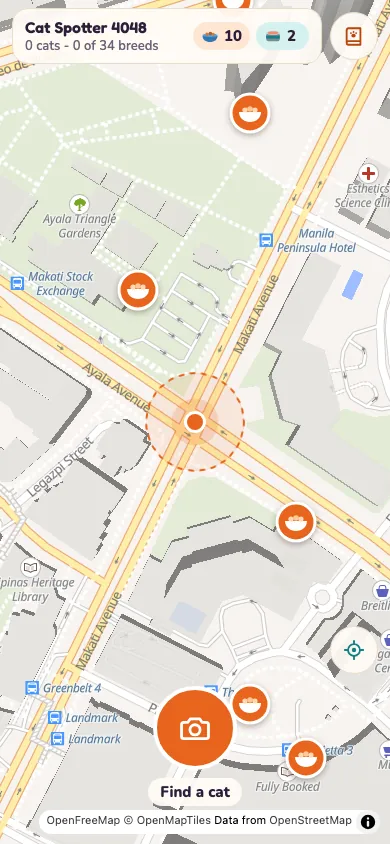
Cat Go is a game you play in your browser: walk anywhere, photograph a real cat, lure it with food and catch it, and pick its breed from a list that has a mixed breed answer too.
What is a Devon Rex cat? The short answer
The Devon Rex is a pedigreed shorthair breed with a wavy coat. The CFA opens its page with a joke: "If you could cross a cat and an elf, you'd most likely have a Devon Rex." It says it is virtually impossible to talk about these cats without the words "elfin" or "pixie", and that they look so unusual that at first glance people wonder whether they are truly looking at a cat.
The CFA's standard names the effect: large eyes, a short muzzle, prominent cheekbones and "huge, low-set ears" create a characteristic elfin look. The CFA says the breed comes in many colors and patterns, and the standard allows any genetically possible color and pattern.
Where the Devon Rex comes from
The CFA tells the story in one paragraph. In 1959 a single curly-haired male kitten turned up in a litter born in a garden in Devon, England. His unusual look, amusing antics and loving nature earned him a home with Beryl Cox, who named him Kirlee.
At first Kirlee was thought to be another example of the Cornish Rex mutation, a different curly breed. Test breedings proved that idea "completely incorrect". Kirlee was bred to his own offspring to produce more wavy-coated kittens, which gave a very different look from the tighter curl of the Cornish Rex coat.
The breed then grew as Kirlee's descendants were out-crossed with several other breeds over the years. The CFA says that is why Devons offer one of the broadest varieties of colors and patterns of any breed known today.
The look: ears, cheekbones and a surprising build
The CFA describes large, expressive eyes, large ears set low on the side of the head, wide cheekbones and a mischievous expression. Devons are small to medium cats, but the CFA says their bodies have a "surprising heft and muscularity". The chest is broad, the neck is slender, and the front legs are often held in a "bulldog" stance. Typical adult weights range from six to nine pounds, and males may be somewhat larger.
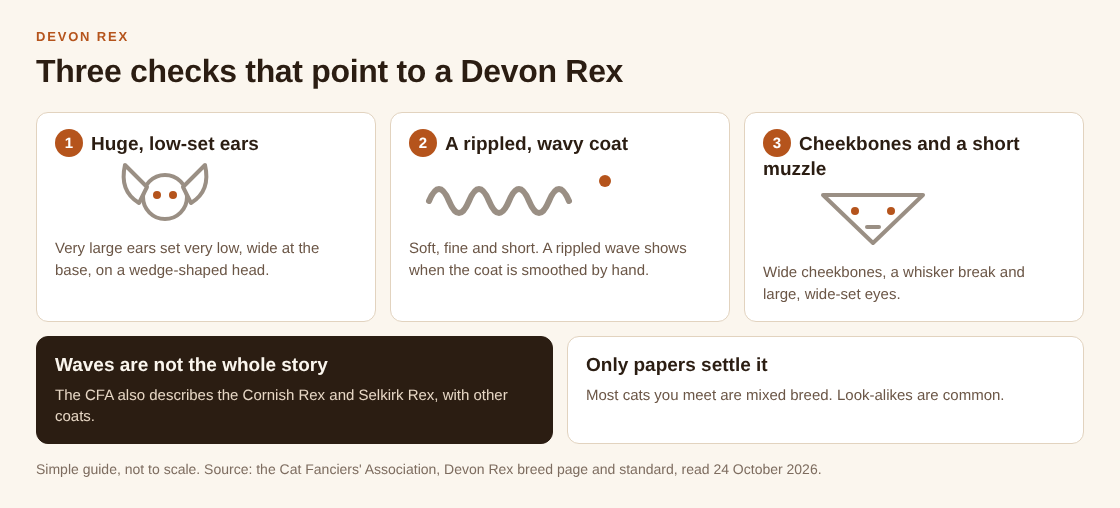
Three checks that point to a Devon Rex, from the CFA's description.
The breed standard, revised in 2025, adds detail:
- Head: a modified wedge, broad but slightly longer than it is broad, full-cheeked with pronounced cheekbones and a whisker break.
- Eyes and ears: large, wide-set, oval eyes. The ears are "strikingly large", set very low and very wide at the base, with or without earmuffs and ear-tip tufts.
- Body: hard and muscular, lithe and of medium length, with long, slim legs, small oval paws and a long, fine, tapering tail.
- Whiskers: curly but fragile. The CFA says eyebrows and whiskers may break off, leaving only bent stubs.
The wavy coat, and how it differs from other rex cats
The standard calls the coat soft, fine, full-bodied and "rexed", meaning it appears to have no guard hairs. It is short on the back, sides, upper legs and tail, and very short on the head, ears, neck, paws, chest and abdomen. It should show a rippled wave effect when you smooth it with your hand, most visible on the body and tail.
The CFA's grooming notes explain the difference from the Cornish Rex: the Cornish has no outer guard hairs, while Devons have some that are very sparse, short and rexed. The coat has an open wave and varies in density, texture and length. It may also be somewhat fragile, leading to occasional bare or "sueded" areas. The standard adds that down on the underparts should not be mistaken for baldness, though bare patches are a serious fault in an adult show cat.
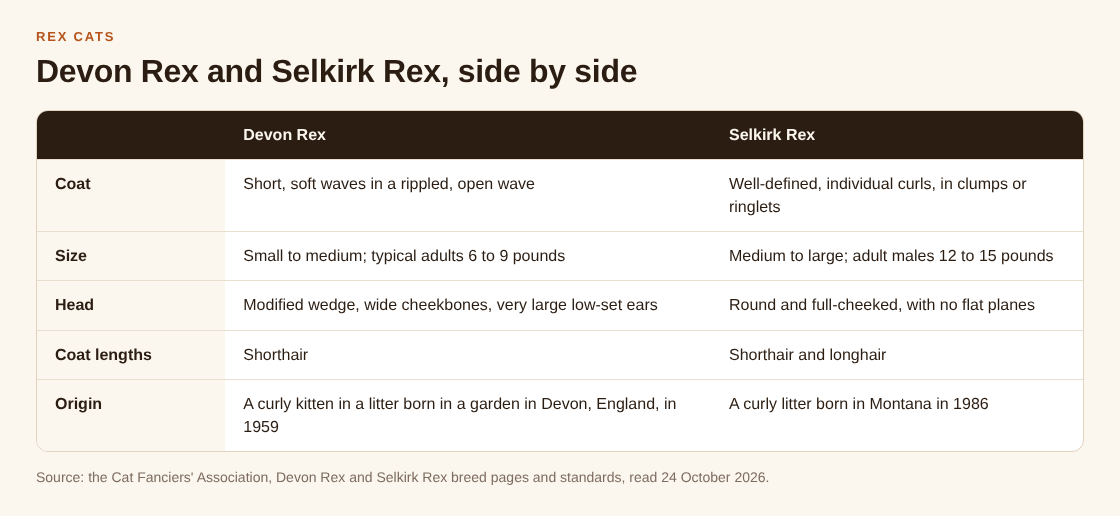
Two rex breeds side by side, from the CFA's breed pages.
The CFA's Selkirk Rex page draws the same line from the other side: unlike the tight marcel wave of a Cornish Rex or the soft waves of a Devon Rex, the Selkirk has well-defined, individual curls. Our post on the Selkirk Rex covers that breed, and our guide to cat breeds with curly fur sets the curly breeds side by side.
Temperament: part court jester, part soulmate
The CFA uses those words: "Part court jester, part soulmate". It calls Devons very intelligent, cats that learn to respond to their names, follow their people everywhere in the house and often snuggle up next to them in bed. It adds that they are fascinated by their owners' every activity, and you should not be surprised if one tries to join you in the shower.
They are talkative but not noisy, the CFA says, with soft chirps, trills and peeps along with contented purrs. They readily accept dogs and other animals as companions, and get along very well with children, tolerating dress-up or tea-party games. The CFA also says they have a robust appetite, and some have exotic tastes: fruit and vegetables may be as appealing as chicken or fish.
One warning from the CFA: they are intensely loyal and become deeply attached to their owners, and they dislike being left alone for long periods. It says the breed is for someone comfortable "being owned by a cat, not the other way around".
Grooming, shedding and health, as the CFA describes them
On shedding, the CFA says that while all cats shed, Devons shed less than most. It calls them "easy-care, wash-and-wear cats" that may be well tolerated by people sensitive to cats. Then it adds: "Contrary to popular belief, though, they are not hypoallergenic." If allergies matter to you, that last sentence is the one to keep.
On health, the CFA says that with such a varied genetic background you would expect few health concerns. It still says genetic testing is essential for breeders, because the gene pool has a high incidence of blood type B. If an "A" male is bred to a "B" female, parental blood type incompatibility can kill the kittens unless they are hand-raised at first.
The CFA says the breed has ranked among its top ten breeds for several years, and has recently been named the most popular of all shorthaired breeds, based on CFA registration statistics. A cat show is the best way to meet a breeder, and finding a kitten may take time. Retired adults are sometimes available, and the CFA says they may be less expensive than kittens. For questions about your own cat's health, ask your vet.
How to check a wavy-coated cat on a walk
Here is a worked example. On a walk you see a cat with a wavy coat and big ears, and you wonder whether it is a Devon Rex.
- Look at the ears first. Very large ears set very low on the sides of the head, wide at the base, are the most striking feature in the CFA's description.
- Look at the face. Wide cheekbones, a short muzzle and large, wide-set eyes give the elfin look.
- Look at the coat. A short, soft coat with a rippled wave fits the standard. A coat that is merely fluffy or messy does not.
- Look at the frame. A small to medium cat with a broad chest, slim legs and surprising muscle fits the description.
- Do not stop at the wave. The CFA also describes the Cornish Rex and Selkirk Rex, which have other coats. Our post on telling whether a cat is mixed breed gives the longer checklist.
- Watch from where you are. Let the cat go about its day.
At the end, you have a guess, not an answer. A wavy coat and big ears do not prove a breed, and only papers can settle it.
Where Cat Go comes in
After a cat is spotted, Cat Go asks "Which breed is it?" and gives you a list with a search box, so you can type something like "Siamese" or "curly". The game also says "Most cats you meet are mixed breed" and "Mixed breed is always a safe pick."
That fits what you just read. A cat with big ears and a wavy coat can be a Devon Rex or something else, and you choose the breed yourself. The game counts 34 breeds, and every catch is saved to your Catdex with its breed and the place you found it. It needs the camera and location allowed in your browser, and says to fit the whole cat in the frame.
Frequently asked questions
What is a Devon Rex cat known for?
It is known for its soft wavy coat, huge low-set ears and a people-loving, playful nature. The CFA says the breed began with a curly kitten born in a garden in Devon, England, in 1959.
Is a Devon Rex hypoallergenic?
No. The CFA says Devons shed less than most cats and may be well tolerated by people sensitive to cats, but "they are not hypoallergenic".
How big is a Devon Rex?
The CFA says it is a small to medium cat. Typical adult weights range from six to nine pounds, and males may be somewhat larger.
How is a Devon Rex different from a Cornish Rex?
The CFA says the Devon's coat has an open wave, while the Cornish has a tighter curl. Devons also have some very sparse, short guard hairs, and the Cornish has no outer guard hairs.
Can you tell a Devon Rex from a photo?
Not reliably. Huge low-set ears and a rippled coat are clues, but they are not proof of a breed, and most cats you meet are mixed breed.
Get started
You do not need a pedigreed cat to enjoy looking at cats. Play Cat Go in your browser: walk anywhere, photograph a real cat, lure it with food and catch it. The game needs your camera and location allowed in the browser. Each catch is saved to your Catdex with its breed and the place you found it.
Walk anywhere, find a real cat, and catch it.
Visit catgo.vlvd.net↗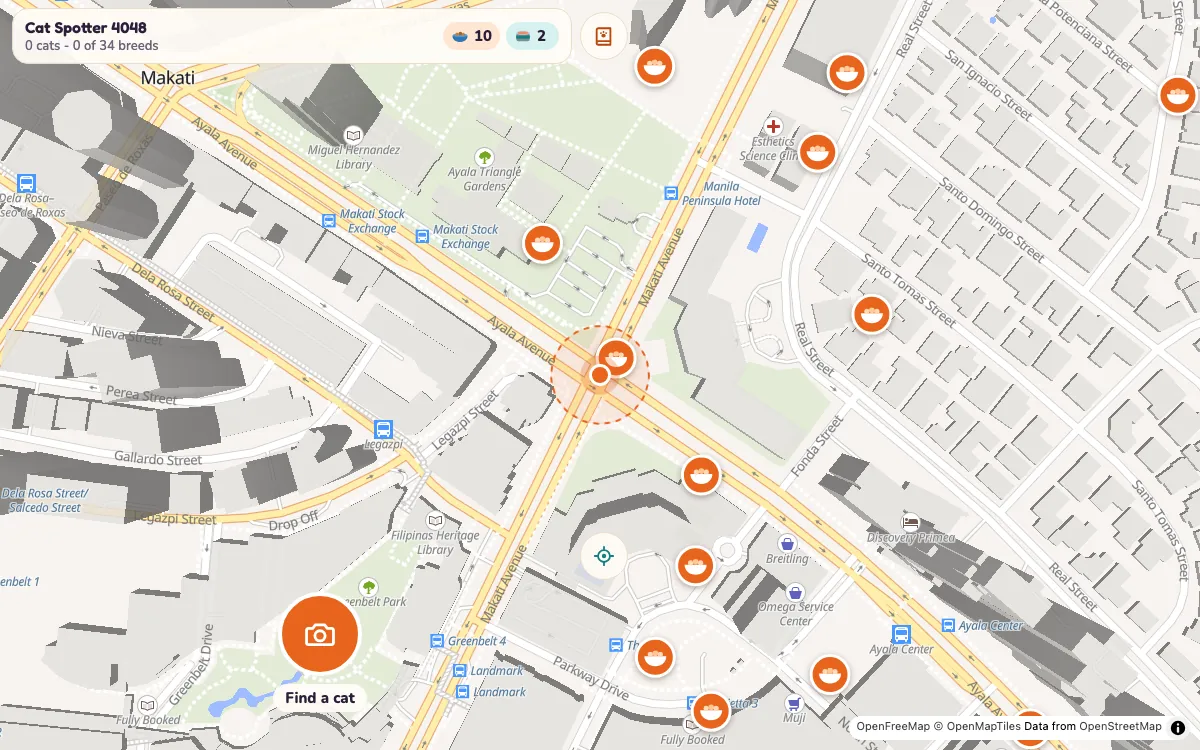

Comments
No comments yet.
Sign in or make an account to comment.