What is a Selkirk Rex cat? Look, history and care
What is a Selkirk Rex cat? It is a medium to large, heavy-boned cat with a curly coat, a round face and a taste for laps. The Cat Fanciers' Association (CFA), a cat breed registry, lists its coat as "Naturally curly" and its personality as "Quiet". This guide follows the CFA's Selkirk Rex breed page and its breed standard, opened for this post, and then shows how Cat Go handles the question "Which breed is it?"
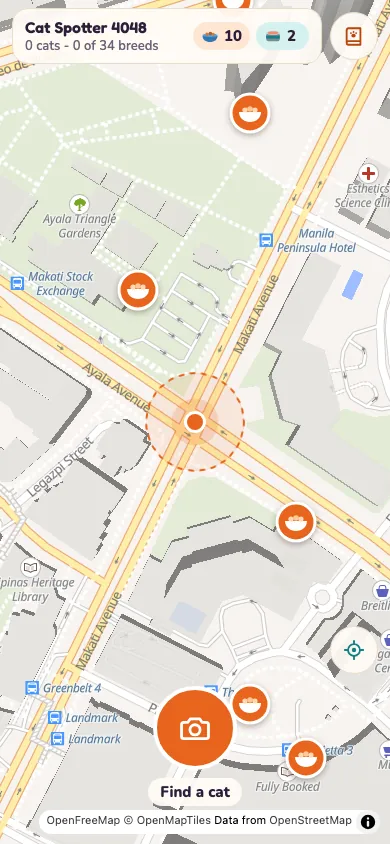
Cat Go is a game you play in your browser: walk anywhere, photograph a real cat, lure it with food and catch it, and pick its breed from a list that has a mixed breed answer too.
What is a Selkirk Rex cat? The short answer
The Selkirk Rex is a pedigreed breed whose coat curls because of a gene. The CFA's standard calls it "a dominant, spontaneous mutation that causes each hair (guard, down and awn) to have a gentle curl". Dominant means a kitten can get the curl from one curly parent.
The CFA's page sums up the coat this way: judges joke that Selkirks are the original "bad hair day" kitties, because the little ringlets seem to go every which way. It also calls the breed "the cat in sheep's clothing". Under the curls the cat is round and solid, a "stocky body" in the CFA's words.
The breed comes in two coat lengths, shorthair and longhair. The CFA says any genetically possible color is allowed, and any eye color.
Where the Selkirk Rex comes from
The CFA tells the story in one paragraph. The breed came from a spontaneous mutation found in a litter born in Montana in 1986. The foundation female had curly whiskers and a coat that looked as if it had been permed. Persian breeder Jeri Newman adopted her and named her Miss DePesto of NoFace.
Newman bred her to a black Persian male. Three of the six kittens had curly coats, which showed that this new rex gene was dominant. Newman then took her stepfather's family name, Selkirk, for the breed. The CFA notes that it is the only breed of cat named after a person.
The CFA accepted the breed for registration in 1992, and it reached championship status in 2000. British Shorthairs and Exotics were used in building the breed and are still allowed outcrosses, which the CFA mentions again under health. Our posts on the British Shorthair and the Exotic Shorthair cover those two.
The look: curls, a round head and a heavy frame
The CFA describes a medium to large cat with solid, muscular bodies and boning to match. Adult males weigh between 12 and 15 pounds, with females somewhat smaller. The standard says the weight is surprising for the size, and that the torso is more rectangular than square, but not long.
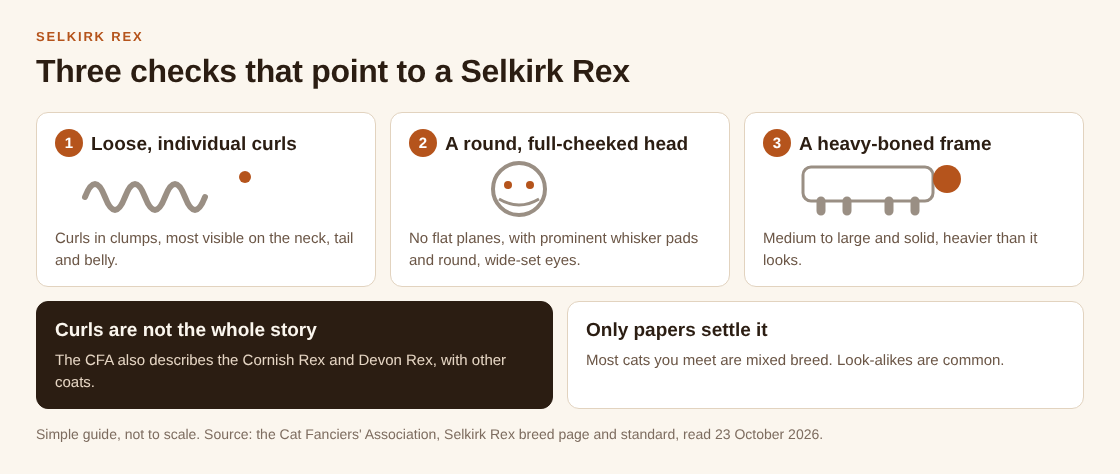
Three checks that point to a Selkirk Rex, from the CFA's description.
Here is what the CFA says to look for:
- Head: round, broad and full-cheeked, with no flat planes. Prominent whisker pads give the muzzle an illusion of squareness.
- Eyes and ears: round eyes set well apart, which the standard says should not look almond or oval. The medium ears are set well apart too.
- Feet and tail: large, round, firm feet with five toes in front and four behind. The tail is medium length, heavy at the base and neither blunt nor pointed.
- Whiskers: curly and fragile, and they tend to break off. The CFA says Selkirks navigate fine without them.
The curly coat, and how it differs from other rex cats
The CFA separates the Selkirk's curls from two other rex breeds. The Cornish Rex has a tight marcel wave, and the Devon Rex has soft waves. The Selkirk has well-defined, individual curls, which may be short and slightly crisp or long and like dreadlocks. Our guide to cat breeds with curly fur sets the curly breeds side by side.
The standard describes a random, unstructured coat of loose, individual curls. On a shorthair they sit in clumps rather than as an all-over wave. On a longhair they may look like clumps or ringlets. The curls show most around the neck, on the tail and on the belly, and the coat should stand out from the body, not lie flat.
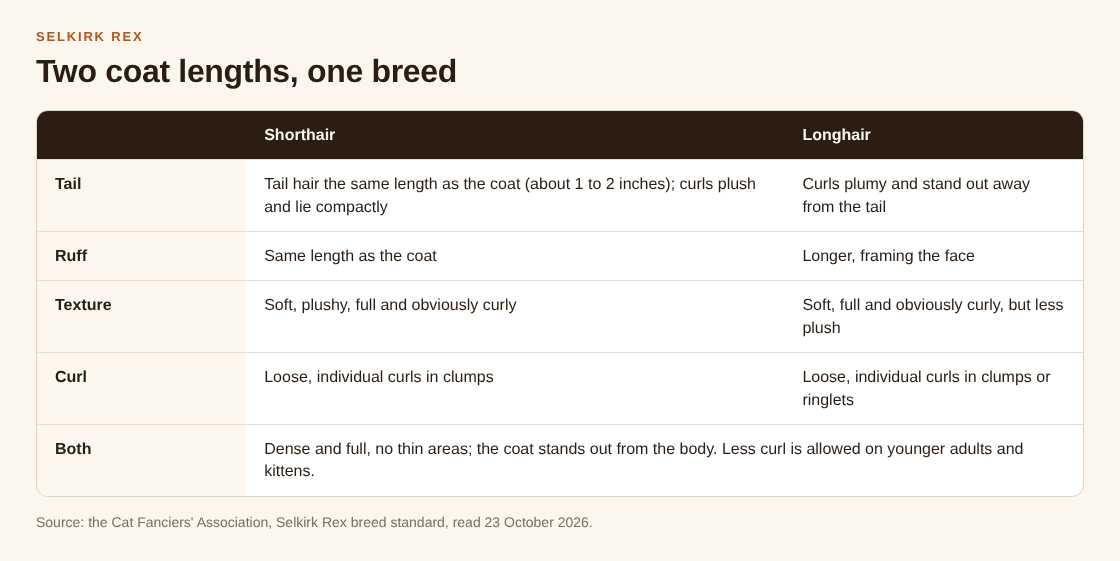
The two coat lengths, as the CFA's Selkirk Rex standard sets them out.
The standard also allows for less curl on younger adults and kittens. A kitten photo is not a fair test of the coat. The same standard disqualifies a cat with no evidence of curl, so the curl is central to the breed.
Temperament: a pest for attention, in the nicest way
The CFA ties the temperament to the foundation cat. Miss DePesto "earned her name because she was a pest for attention", and her descendants often do the same. They politely ask for your time and your love, then jump into a lap or onto a bent back if their needs are not soon met.
The CFA says they combine intelligence with a silly streak, and calls them "more interactive than active". Their idea of "kitty heaven is a warm lap". They are most comfortable with all four feet on the floor, but can charge through the house after a toy.
They are not particularly vocal, but they are responsive: if you start a conversation, they "talk" back. They do well with children and other animals, but the CFA says children need to understand that the cat must be handled gently.
Grooming and health, as the CFA describes them
The CFA says no special tools are needed. Use your fingers in a gentle scratching motion to fluff up the curls. These cats do not mat easily, but a good combing once or twice a month is recommended to remove dead hair. For longhairs, a hair pick can help separate large clumps of curls.
On health, the CFA says Selkirks are known for robust good health and not for any breed-specific health concerns. But because British Shorthairs and Exotics were used in the breed and are allowable outcrosses, breeders typically screen for conditions known in those breeds: polycystic kidney disease, hip dysplasia and hypertrophic cardiomyopathy. Blood type incompatibility can also occur, so most breeders test blood type before breeding.
The CFA adds that the breed is increasingly popular but still relatively rare. A cat show is the best place to meet a breeder. If cost is a concern, the CFA suggests a straight-coated Selkirk, which it says can offer the same personality at a more economical price. For vet questions about your own cat, ask your vet.
How to check a curly cat on a walk
Here is a worked example. On a walk you see a cat with a curly coat, and you wonder whether it is a Selkirk Rex.
- Look at the curls. Individual loose curls in clumps, most visible on the neck, tail and belly, fit the standard. A coat that is merely fluffy or messy does not.
- Look at the whiskers. Curly, brittle whiskers are a clue, since the CFA says Selkirk whiskers are curly and tend to break off.
- Look at the face and frame. A round, full-cheeked head with round eyes and a heavy, solid body fits the description.
- Do not stop at the curl. The CFA also describes the Cornish Rex and Devon Rex, which have different coats. Our post on telling whether a cat is mixed breed gives the longer checklist.
- Leave the cat alone. Look from a distance and let it go about its day.
At the end, you have a guess, not an answer. A curly coat does not prove a breed, and only papers can settle it.
Where Cat Go comes in
After a cat is spotted, Cat Go asks "Which breed is it?" and gives you a list with a search box, so you can type something like "Siamese" or "curly". The game also says "Most cats you meet are mixed breed" and "Mixed breed is always a safe pick."
That fits what you just read. A curly cat can be a Selkirk Rex or something else, and you choose the breed yourself. The game counts 34 breeds, and every catch is saved to your Catdex with its breed and the place you found it. It needs the camera and location allowed in your browser, and says to fit the whole cat in the frame.
Frequently asked questions
What is a Selkirk Rex cat known for?
It is known for its curly coat and its fondness for laps. The CFA says the curls come from a dominant mutation found in a Montana litter in 1986.
Why is it called a Selkirk Rex?
Breeder Jeri Newman named it for her stepfather's family name, Selkirk. The CFA says it is the only breed of cat named after a person.
How big is a Selkirk Rex?
The CFA says it is a medium to large cat. Adult males weigh between 12 and 15 pounds, with females somewhat smaller.
How often should you groom a Selkirk Rex?
The CFA recommends a good combing once or twice a month, and says the coat does not mat easily. Gentle scratching with your fingers fluffs the curls.
Can you tell a Selkirk Rex from a photo?
Not reliably. Curls and curly whiskers are clues, but a curly coat is not proof of the breed, and kittens may show less curl.
Get started
You do not need a pedigreed cat to enjoy looking at cats. Play Cat Go in your browser: walk anywhere, photograph a real cat, lure it with food and catch it. The game needs your camera and location allowed in the browser. Each catch is saved to your Catdex with its breed and the place you found it.
Walk anywhere, find a real cat, and catch it.
Visit catgo.vlvd.net↗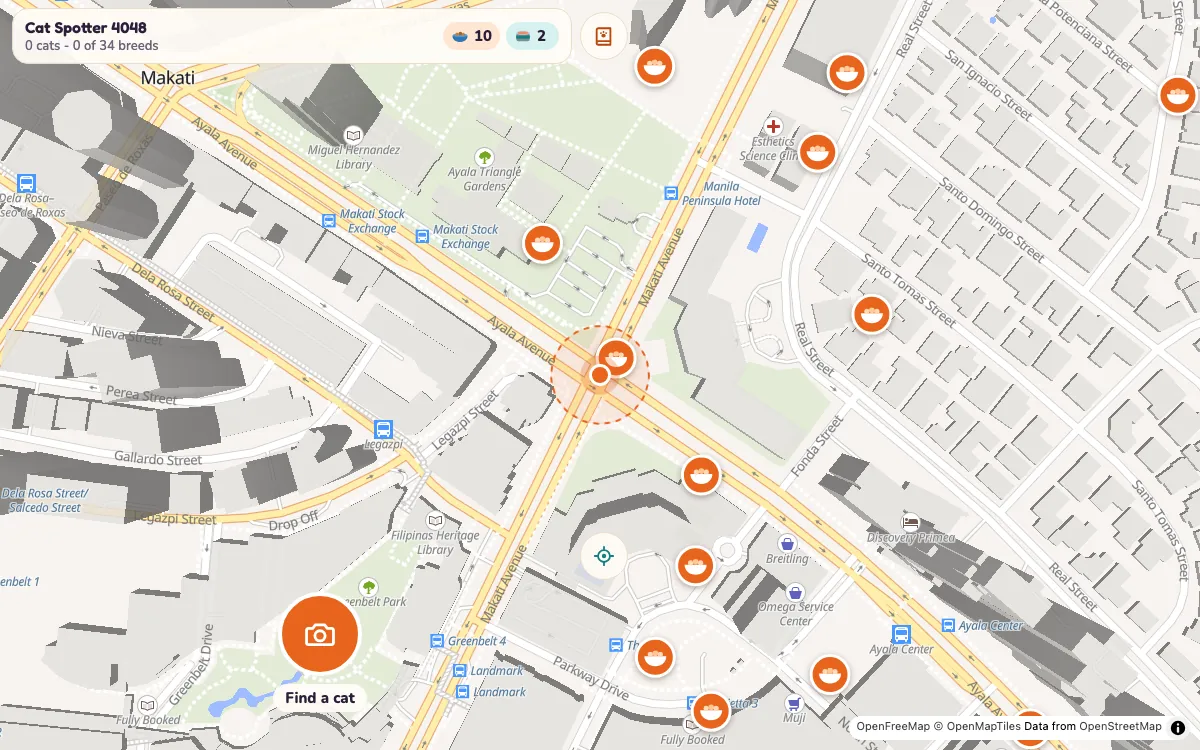
Comments
No comments yet.
Sign in or make an account to comment.