What is a feral cat? Why ferals fear people and how they live
What is a feral cat? It is a cat of the same species as a pet cat that was never socialised to people, so it lives like a wild animal and treats humans as a threat. Cats Protection, the UK cat charity, says ferals have little or no contact with humans and cannot be tamed. This guide covers why a cat grows up feral, how feral colonies live, and how people help them without trying to turn them into pets.
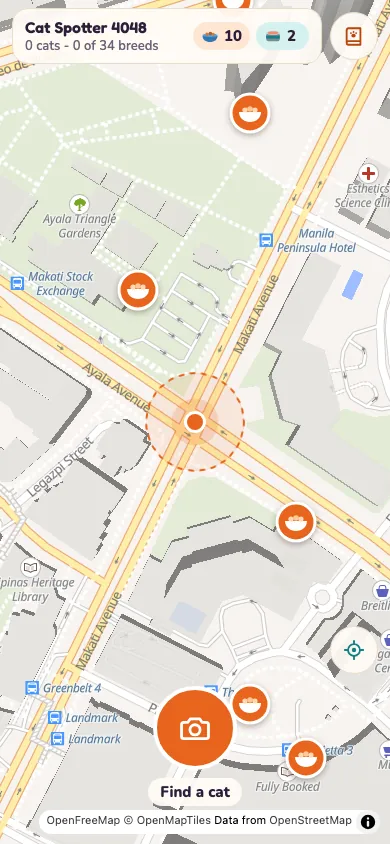
If you like spotting the cats on your street from a respectful distance, Cat Go is a browser game where you photograph a real cat you meet, say which breed it is and keep it in your Catdex with the place you found it, without ever touching the cat.
What is a feral cat? The plain meaning
The word "feral" means a member of a domesticated species that has gone back to living as a wild animal. Cats Protection uses it in exactly that sense on its feral cat page, which this guide draws on throughout.
Three points keep the meaning clear:
- Same species, different upbringing. A feral cat is not a wildcat. It is the same kind of cat as the one asleep on a sofa. What differs is how it was raised.
- Not the same as a stray. Ferals are often mistaken for strays. A stray is a domestic cat that is lost or was abandoned. A feral has had little or no contact with people at all.
- No look marks a cat as feral. Coat, colour and size tell you nothing. Behaviour does.
Because ferals are not socialised to humans, they find people naturally threatening. In the charity's words, they won't come close, even with encouragement.
Why some cats grow up feral: the socialisation period
Kittens learn what is normal very early, in what is called the socialisation period. Between two and six weeks old, a kitten can learn to enjoy human contact, form a bond with people and become a good pet.
Feral cats are usually the offspring of stray, feral or abandoned cats. They missed that early experience, so they grow up wary of humans. Nothing about the kitten itself was different. It simply met no kind people during the weeks when it mattered.
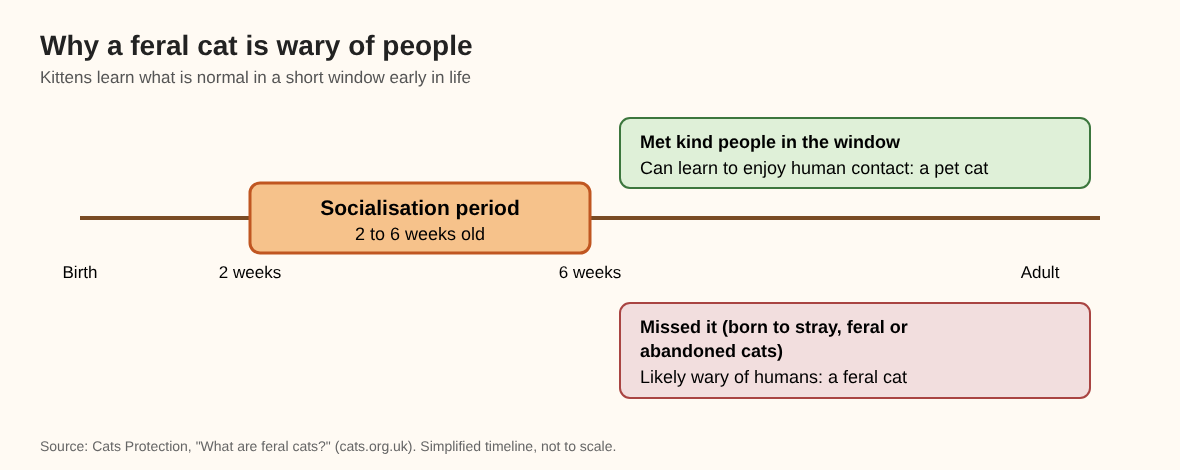
The socialisation window, from Cats Protection's feral cat page.
This is also why the line between stray and feral matters to rescuers. A stray once lived with people and may warm to them again. A feral never learned to.
Feral, stray or owned: how to tell at a glance
Cats Protection lists signs for each, and none of them is proof on its own. A feral cat is likely to:
- live alone or with other feral cats, sometimes in a colony;
- keep away from people and have a hiding spot away from busy areas;
- hold a long-term territory, so you see it in the same places;
- have no microchip;
- have the tip of one ear missing, if it has been neutered.
A stray, by contrast, may approach cautiously given time, is more often found in gardens or near homes, may have appeared only recently and may look unkempt or underweight. Our full guide on how to tell if a cat is a stray or has a home sets out all three side by side.
How feral cats live: colonies, territory and farm cats
Many ferals live in colonies with other feral cats. A colony can grow quickly, because unneutered cats keep breeding. The cats are resourceful at finding food, though Cats Protection says it is good to keep an eye on them in winter.
Ferals settle into long-term territories, often with a hiding place away from where people gather. That is why a colony cat tends to turn up at the same corner, wall or yard week after week.
You may also hear of farm cats or barn cats. These are usually feral cats living on agricultural land, outdoors with access to shelter, where they help with rodent control. The charity says such cats need independence, space to keep away from people, plenty of outdoor space, and a kind human who makes sure they have shelter and, if needed, food, water and medical help. They should never be confined to a traditional pet home.
How feral colonies are helped: trap, neuter and return
It can seem simplest to remove a colony. Cats Protection says this is not a long-term solution: a new colony will often move in. Ferals are also equally protected in law as domestic cats in the UK, and they are more prone to disease.
The charity's answer is trap, neuter and return (TNR). The aim is to neuter every cat in the colony in as short a time as possible. Neutered cats go back to their own territory, the colony stops growing, and the scheme can help to limit disease.
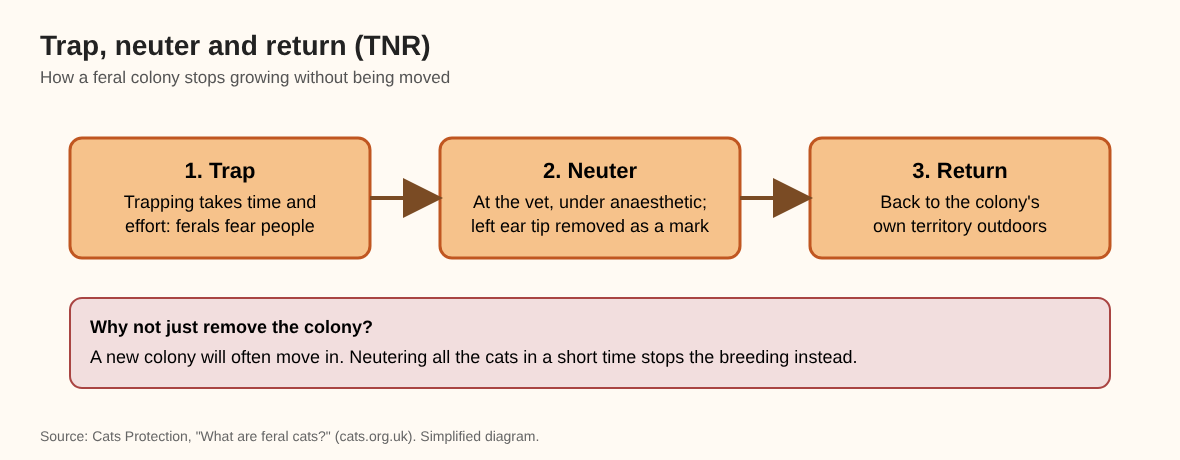
Trap, neuter and return, as Cats Protection describes it.
Trapping is stressful for the cat and for the trapper, and it can take a lot of time and effort. So that a neutered cat is never trapped again, a vet removes between half a centimetre and one centimetre from the tip of its left ear while it is under anaesthetic. The cut heals quickly and leaves a flat top you can see from a distance. Our post on why the tip of a cat's ear is missing explains ear tipping in full.
If you find feral cats living near you, or one looks sick or injured, the charity asks you to contact it rather than act alone. A sick feral can be trapped and taken to a vet by people who know how.
Can a feral cat or kitten become a pet?
For an adult feral, Cats Protection's answer is no. Ferals are wild animals and find contact with humans very stressful, so a feral cat cannot be domesticated. It is better for their welfare to be trapped, neutered and returned to their home outdoors. The charity also notes that cats generally do not need company.
Feral kittens can sometimes be socialised, but only early and by a professional. It takes time, effort and know-how, and trying can upset kittens and cause them a lot of stress. The charity says it would never recommend trying to socialise feral kittens yourself.
So the kind thing for a feral cat you see is usually to let it be, and to tell a rescue group if the colony is not yet neutered.
A worked example: the colony cat behind the shops
Say you walk past a row of shops each evening and notice a grey cat by the bins. It is there most days. When you slow down, it slips under a fence. On the third evening you see a second cat with it, and you notice the grey cat's left ear has a flat top.
Put together, those signs point to a neutered feral in a small colony: a fixed territory, no wish to come close, and a tipped ear. Here is how you could keep a record of it in Cat Go without bothering it:
- Open Cat Go in your browser with location on. The game uses it to find treat stops and to record where each cat was caught.
- Stay where you are. Do not follow the cat or try to coax it out. Tap the camera and fit the whole cat in the frame from your spot on the path.
- At "Which breed is it?", pick mixed breed. The game itself says most cats you meet are mixed breed, and mixed breed is always a safe pick.
- Choose how much in-game kibble and tuna to bring, then lure the cat in the game. Tuna works much better on wary cats, and food you don't use comes back. None of this is real food.
- Once caught, the cat is saved to your Catdex with its breed and the place you found it. You could name it after the street.
The real cat never notices any of it. If you want more practice keeping your distance, read how to approach a cat you don't know, and with a feral, simply stop at step one: watch, do not approach.
Frequently asked questions
Is a feral cat the same as a stray cat?
No. A stray is a domestic cat that is lost or was abandoned and may warm to people again. A feral was never socialised to people, so it avoids them and cannot be tamed.
Why are feral cats scared of people?
They missed the socialisation period, between two and six weeks old, when kittens learn to enjoy human contact. Without it, people seem threatening.
Why not just remove a feral colony?
Cats Protection says removal is not a long-term solution, because a new colony will often move in. Neutering every cat in the colony and returning them stops the breeding instead.
Can I adopt a feral kitten?
Feral kittens can sometimes be socialised, but only early and by a professional. Cats Protection would never recommend trying it yourself, so contact a rescue group.
Get started
Once you know what a feral cat is, you start to notice the colony cats on your routes, and the tipped ears that show someone is looking after them. Cat Go turns each sighting into a record you keep: the photo, the breed you picked and where you met the cat, counted toward the game's 34 breeds in your Catdex.
Play Cat Go in your browser: walk anywhere, photograph a real cat, lure it with food and catch it.
Walk anywhere, find a real cat, and catch it.
Visit catgo.vlvd.net↗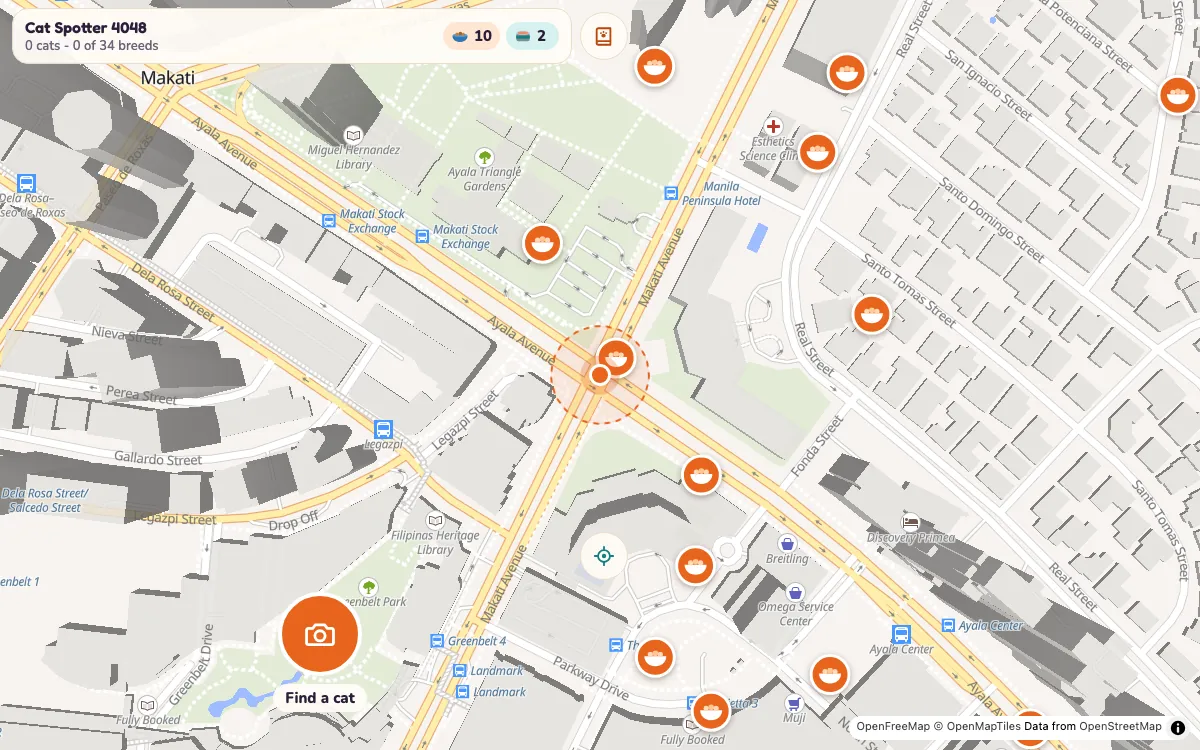
Comments
No comments yet.