What is a Havana Brown cat? Chocolate coat and history
What is a Havana Brown cat? It is a shorthaired breed with a solid, rich brown coat, vivid green eyes and a head shape unlike any other. The Cat Fanciers' Association (CFA), a cat registry, sums it up as "chocolate brown" with a "busy, affectionate" personality. This guide uses the CFA's Havana Brown page to cover where the breed came from, how to recognize one, and what the CFA says about its nature and care.
Cat Go is a game that plays in your web browser: walk anywhere, photograph a real cat you meet, say which breed it is, lure it with food and keep it in your Catdex.

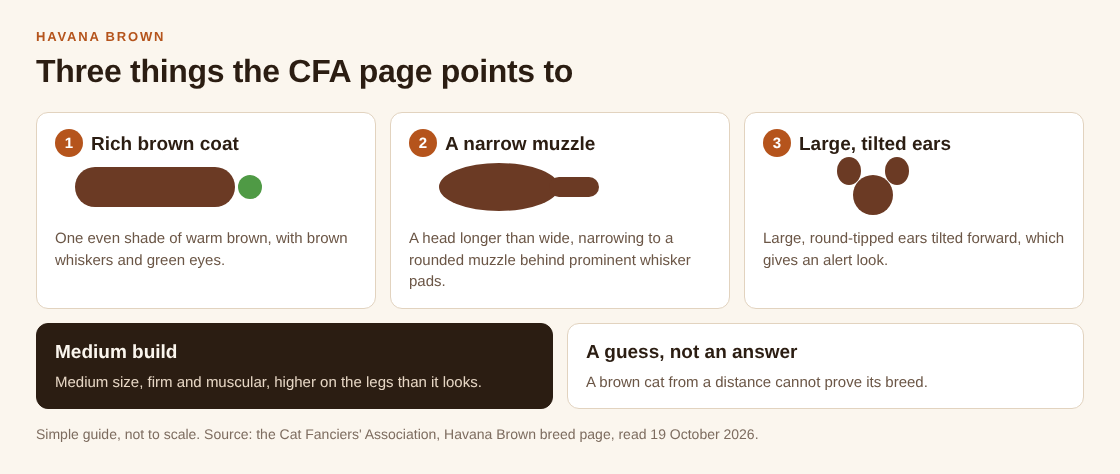
Three things the CFA's Havana Brown page points to: the brown coat, the muzzle and the ears.
What is a Havana Brown cat, in one picture?
The CFA gives the coat length as shorthair. The coat is one even shade of rich, warm brown, and the CFA says the same sound shade should run through the whole hair shaft. Even the whiskers are brown. The eyes are any vivid, level shade of green, and the deeper the better.
The picture above shows the three clues the page leans on. The coat is a single brown. The head narrows to a rounded muzzle. And the ears are large and tilted forward. Breeders nickname the cats "Brownies", a nod to the Scottish folklore "Brownie", a helpful but sometimes mischievous household spirit that likes to live close to people.
Where the Havana Brown came from
The CFA calls the Havana Brown a hybrid breed, the result of years of planned breeding with a specific vision in mind. Solid brown cats of Siamese type are known to have lived in the United Kingdom and Europe in the late 1800s. They fell out of favor as the pointed, blue-eyed Siamese became popular.
Interest came back after World War II. The CFA says English cat fanciers began crossing Siamese with black domestic shorthairs, hoping to produce a "self-brown" cat, which means a cat of one solid brown color. Some of these early crosses were exported to the United States, where breeders worked to keep the look while building a larger gene pool. The CFA accepted the Havana Brown for registration in 1959, and it reached Championship status in 1964.
How to recognize a Havana Brown
Start with the color, then the head, then the ears. None of these proves a breed, but together they show what the CFA is describing.
Coat, eyes and whiskers
The CFA's standard asks for a smooth, lustrous coat, short to medium in length, that should not look open or have an undercoat. The color is any even shade of rich, warm brown, with no preference for lighter or darker. The nose leather is brown with a rosy flush, the paw pads are rosy, and the whiskers are brown. Kittens and young adults may show faint ghost tabby markings, which the standard allows for.
The head
This is the feature the CFA calls most distinctive. It quotes two descriptions of the head: "a corncob stuck into an orange" and "a lightbulb". Seen from above, the head is a little longer than it is wide and narrows to a rounded muzzle, with a definite break on either side behind very prominent whisker pads. In profile there is a noticeable stop at the eyes, and the end of the muzzle looks almost square.
Ears, body and legs
- Ears: large, round-tipped and wide-set, tilted forward so the cat looks alert, with little hair inside or out.
- Body: medium in size and structure, firm and muscular, and more substantial than the lean, tubular bodies of its Siamese ancestors.
- Legs: the standard says the ideal cat stands relatively high on its legs, with straight legs and oval, compact paws.
Havana Brown personality: curious, busy and people-loving
The CFA expects high intelligence, curiosity and inquisitiveness from a Havana, but not so much as to be intrusive. It gives an example: a Havana will be very interested in what is hiding in a cupboard, but is more likely to wait and watch until you open it than to find a way in on its own.
Many use their paws to show affection, reaching out to touch you or to investigate something new. The CFA also says there is a great deal of variation from one cat to the next. Some tend toward shyness and devote themselves mainly to one member of the family, while others are extremely outgoing and seek to be everybody's best buddy.
They are moderately active, playful and compatible with other family pets. The CFA says curling up to sleep in a tangled pile with another cat, or even a dog, is this breed's idea of heaven. That is one reason it says it may make sense to get two Havana Browns rather than one. If you decide on only one, it says breeders typically recommend a female rather than a male.
Coat care and the breed's future
The CFA calls the short, silky coat easy to groom, and not prone to heavy shedding. It suggests a soft boar-bristle brush for daily grooming. Two or three times a month, use a soft rubber brush for a full-body rubdown, then buff with a soft chamois cloth or a silk scarf for a glossy shine. Most Havanas enjoy the routine and come to look forward to it. Regular bathing is not usually needed unless the cat is being shown.
The CFA says a very dedicated group of breeders is working to increase the diversity of the breed's gene pool. In 2019 a carefully regulated outcrossing program was put in place. It allows pure Havanas to be bred to certain colors of Oriental Shorthair, to seal point or chocolate point Siamese, or to unregistered black or blue domestic shorthairs. If kittens from one of these crosses are bred back to pure Havanas, any resulting offspring that meet the breed standard may be registered as Havanas. The CFA says genetic testing of all breeding cats has become essential, and that it is helping to produce a healthier, more diverse breed. For a question about one cat's health, a vet is the right person.
The CFA says cat shows are the best place to connect with a breeder. Because the breed is rare, it adds, you may not find a Havana Brown breeder at a show near you, and suggests its Find-A-Breeder website as another route.
If a solid-colored shorthair catches your eye, our guides to the Burmese and the Oriental sit beside this one. You can read the breed page itself on the CFA's Havana Brown page.
A worked example: is that brown cat a Havana Brown?
Say you spot a brown cat with green eyes on a walk. Keep your distance and let the cat decide how close to come. Then use five looks, taking no more than a minute.
- Color. Is the coat one even, warm brown from root to tip, with no patches? The CFA allows ghost tabby markings only in kittens and young adults.
- Eyes. In good light, are they a vivid green? The CFA's standard disqualifies any other eye color.
- Whiskers. If you can see them, are they brown too, matching the coat?
- Head. Is it a little longer than wide, narrowing to a rounded muzzle, with a break behind prominent whisker pads?
- Ears. Are they large, round-tipped and tilted forward?
Even with five matches, you have a guess. The breed is rare, and many brown cats are mixed breed. If you have a pet cat and wonder about its breed, our post on how to tell if a cat is a mixed breed sets out the checks.
Naming a cat in Cat Go
If you like trying to name the cats you meet, Cat Go turns it into a game. It plays in your browser: you walk anywhere, photograph a real cat, lure it with in-game food and catch it. Every catch keeps its breed and where you found it.
The camera screen says "Fit the whole cat in the frame". After the cat is spotted, the game asks "Which breed is it?" and you pick from a list. There is a search box with the hint "Search breeds, like Siamese or curly". The player makes the call, not the game.
The screen also says "Most cats you meet are mixed breed" and "Mixed breed is always a safe pick". That is a good rule for a brown cat too, since a photo rarely settles a breed.

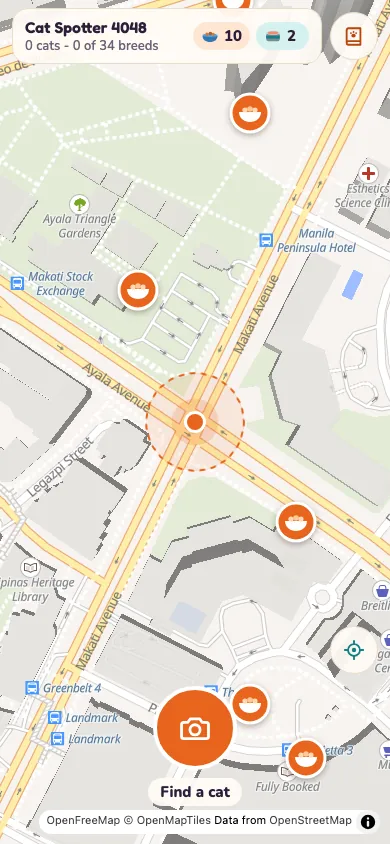
Cat Go's map. The game needs your location to record where each cat was caught.
Frequently asked questions
What is a Havana Brown cat?
It is a shorthaired breed with a solid, rich brown coat, green eyes and a distinctive head shape, according to the CFA.
What color is a Havana Brown?
Any even shade of rich, warm brown, per the CFA, with brown whiskers. The eyes are a vivid green.
Where does the Havana Brown come from?
The CFA says it came from English fanciers crossing Siamese with black domestic shorthairs after World War II. It was accepted for CFA registration in 1959.
Do Havana Brown cats need a lot of grooming?
No. The CFA calls the short, silky coat easy to groom, with daily brushing suggested and little bathing needed.
Does Cat Go tell me if a cat is a Havana Brown?
No. Cat Go asks "Which breed is it?" and you pick from its list. It also says mixed breed is always a safe pick.
Get started
Allow your camera and location in the browser, walk to a treat stop, collect some in-game kibble and tuna, then photograph a real cat from a respectful distance. Play Cat Go in your browser: walk anywhere, photograph a real cat, lure it with food and catch it.

Comments
No comments yet.
Sign in or make an account to comment.