What is a Toybob cat? Tiny size, bobbed tail, origin
What is a Toybob cat? It is a naturally small cat with a short, kinked or bobbed tail, developed in Russia. The Cat Fanciers' Association (CFA), a cat breed registry, lists its coat length as "Longhair and Shorthair", its characteristics as "Naturally small, bobtailed cat originating in Russia" and its personality as "Affectionate, active, playful and agile". This guide follows the CFA's Toybob breed page and its breed standard, opened for this post, and then shows how Cat Go handles the question "Which breed is it?"
Cat Go is a game you play in your browser: walk anywhere, photograph a real cat, lure it with food and catch it, and pick its breed from a list that has a mixed breed answer too.
What is a Toybob cat? The short answer
The CFA says the naturally small size of a Toybob gives it a kittenish charm that it will never outgrow. It calls the breed "diminutive", and one of the smallest known cat breeds. The look is a kinked, bobbed tail and large, soulful eyes. The breed standard says the name has two parts: "Toy" describes a playful small-sized cat, and "bob" refers to the bobbed tail.
The CFA says the Toybob is most frequently seen in the pointed pattern, but it may be any possible color. It says the size and shape of the breed are what is important, rather than the color.
Where the Toybob comes from
According to the CFA, the Toybob's story started in Russia in 1983. Elena Krasnichenko bred two stray cats, one with a short, kinked tail and one with a curled bobtail.
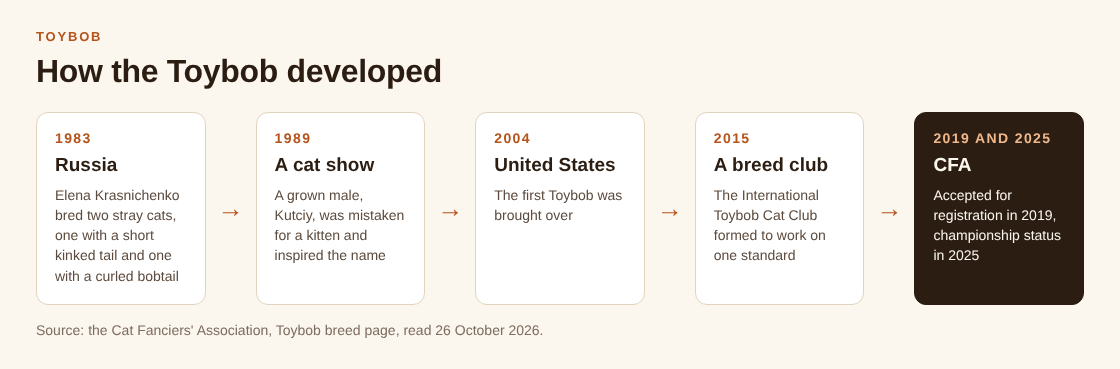
How the Toybob developed, as the CFA tells it.
One of the offspring, a male named Kutciy, was taken to a cat show in 1989. Although he was fully grown, he was mistaken for a kitten, which inspired the name "Toybob". Development of the breed continued in Russia throughout the 1990s, with some breeders broadening the gene pool by adding in carefully chosen domestic cats.
The first Toybob was brought to the United States in 2004. The CFA says the formation of the International Toybob Cat Club in 2015 brought breeders from across the country together, working closely to create a unified standard and win recognition of the breed. The CFA accepted Toybobs for registration in 2019 and advanced the breed to championship status in 2025.
The standard says the bobbed tail is unique to the breed and due to a spontaneous natural mutation, or mutations, that appeared in feral cats native to Russia. Two other short-tailed breeds have their own stories: the Japanese Bobtail and the Manx.
The tail and the body
Despite their small size, the CFA says these cats do not look or feel delicate. Their bodies are compact and muscular, with a broad ribcage and strong boning. The standard lists these features:
- Tail: bobbed, with kinks and curves in any combination, though it may also be almost straight. The minimum length is two vertebrae and the maximum is down to the hock. The CFA says the bobbed tail does not affect the cat's agility or health.
- Head: a medium-sized modified wedge with rounded contours, slightly longer than it is broad. Rounded cheekbones curve inward to create a slight whisker pinch and end in a short, gently rounded muzzle. Jowls are prominent in adult males.
- Eyes: large to very large, expressive and rounded, with a slight upward slant. The standard says the big-eyed expression gives the Toybob its sweet-faced look.
- Body: small and compact with a solid chest and a short, thick, almost no-neck appearance. The standard says a primordial pouch is common and may look prominent on the compact body, and is not a sign of obesity.
- Size: the standard says Toybobs reach full maturity at 1.5 years, with little to no size difference between the sexes, and ideally keep a kitten-like appearance as adults.
The coat: short or semi-long
The CFA says the coat may be either short or semi-long, both with a dense, plush texture. The standard gives each its own description, and the show ring judges them under one standard:
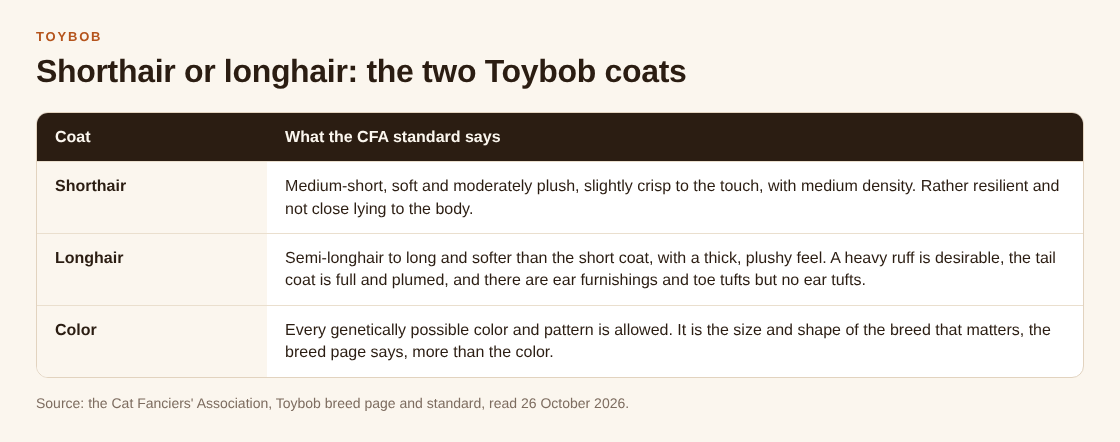
The two coats in the CFA's Toybob standard.
The standard allows every genetically possible color and pattern, and says small white spots such as buttons and lockets are allowed without penalty. Eye colors are related to coat color: for example, the standard allows blue eyes in solid white, calico, bi-color, van and pointed cats.
Temperament: playful and sociable
The CFA describes a perky, playful cat that is interactive but not overly active. It may sometimes choose to stay snuggled in your lap rather than chase a toy. Once you get up, however, it will follow you anywhere with a gentle touch of supervising curiosity. These cats are intelligent, docile and affectionate, and the CFA calls them a wonderful pet for families with children and for senior citizens.
They enjoy their creature comforts, such as soft pillows and warm blankets, and may sleep under the covers with you. Because they are so sociable, Toybobs typically get along well with other pets. The CFA says they do not like being left alone for long periods, so if no one will be home during the day, you may wish to consider a pair. They are not particularly vocal, but have a large repertoire of unique sounds, including chirps, trills and purrs, as well as the occasional meow.
Grooming and health, as the CFA describes them
- Brushing: Toybobs are not heavy shedders but do change their coats seasonally, so the CFA says it is wise to accustom them to regular grooming. The shorthair coat should be brushed once a week. The longhair coat, which rarely mats or tangles, also benefits from weekly attention and is best groomed with a steel comb.
- Baths: bathing should not be necessary unless your cat is being shown.
- Health: the CFA says the breed enjoys a very high level of genetic diversity and that, to date, no breed-specific health issues have been identified. Most breeders are committed to managing the health of their breeding cats and kittens. For your own cat, ask your vet.
The CFA says the Toybob is still relatively new to the cat show scene but is being seen more often at CFA shows. It suggests visiting a show to meet a breeder, after checking with the sponsoring club to see whether any Toybobs are expected. Since the number of breeders is rather small, you may have a wait for a kitten, though the CFA says locating one should not be a challenge.
How to check a small bobtailed cat on a walk
Here is a worked example. On a walk you see a small cat with a very short, kinked tail, and you wonder whether it is a Toybob.
- Look at the tail. A Toybob tail is bobbed, with kinks and curves, at least two vertebrae long and never past the hock. Look from a distance: the standard measures the tail by gentle handling, which is not something to try on a cat you do not know.
- Look at the size. A naturally small, compact, muscular cat, with a broad chest and strong bones.
- Look at the face. Large, round, expressive eyes and a short, rounded muzzle.
- Allow for look-alikes. Short tails occur in other breeds and in mixed cats. Our post on telling whether a cat is mixed breed gives the longer checklist.
- Do not stop at the tail. Only papers can settle a breed.
At the end you have a guess, not an answer.
Where Cat Go comes in
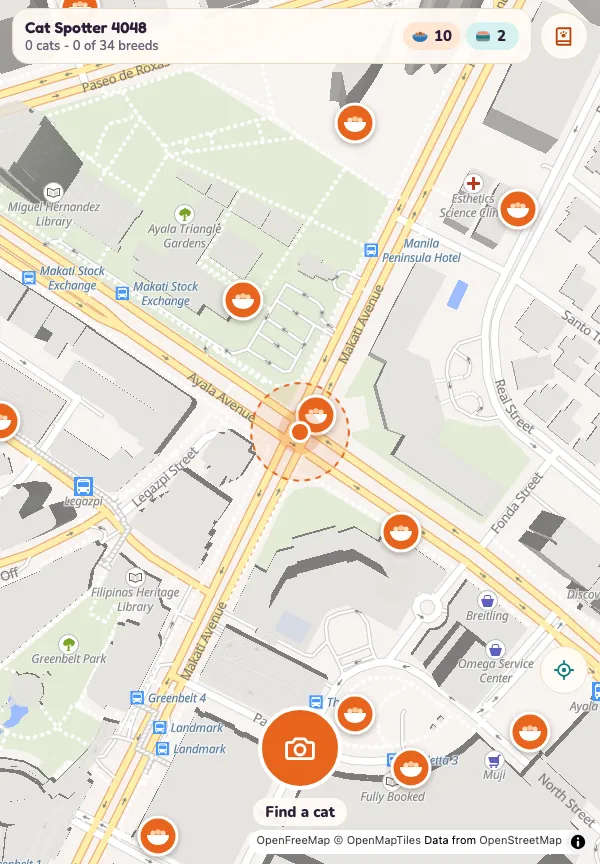
After a cat is spotted, Cat Go asks "Which breed is it?" and gives you a list with a search box. The game also says "Most cats you meet are mixed breed. Rarer breeds are warier." and "Mixed breed is always a safe pick."
That fits what you just read. A small cat with a short tail can be a Toybob, or a cat of another breed, or a mixed breed, and you choose the breed yourself. The game counts 34 breeds, and every catch is saved to your Catdex with its breed and the place you found it. It needs the camera and location allowed in your browser, and its camera screen says to fit the whole cat in the frame, which helps here, since the tail and the size are the clues and they need to be in the photo.
Frequently asked questions
Why is it called a Toybob?
The CFA says the name comes from "Toy", a playful small-sized cat, and "bob", the bobbed tail. It also says a fully grown male named Kutciy was mistaken for a kitten at a 1989 cat show, which inspired the name.
How small is a Toybob?
The CFA calls it one of the smallest known cat breeds. Its standard says Toybobs reach full maturity at 1.5 years, with little to no size difference between the sexes.
Do Toybobs come in long hair?
Yes. The CFA says the coat may be short or semi-long, both with a dense, plush texture.
Can a Toybob be left alone?
The CFA says they do not like being left alone for long periods, and suggests a pair if no one will be home during the day.
Can you tell a Toybob from a photo?
Not reliably. A small body and a bobbed tail are clues, but they are not proof of a breed, and most cats you meet are mixed breed.
Get started
You do not need a pedigreed cat to enjoy looking at cats. Play Cat Go in your browser: walk anywhere, photograph a real cat, lure it with food and catch it. The game needs your camera and location allowed in the browser. Each catch is saved to your Catdex with its breed and the place you found it.
Walk anywhere, find a real cat, and catch it.
Visit catgo.vlvd.net↗
Comments
No comments yet.
Sign in or make an account to comment.