What is an American Wirehair cat? Crimped coat, origin
What is an American Wirehair cat? It is a breed with a crimped, springy coat that stands off the body, said to have begun with a mutation in a litter of barn cats in 1966. The Cat Fanciers' Association (CFA), a cat breed registry, lists its coat length as "Shorthair", its characteristics as "Crimped, springy coat; available in a variety of colors and patterns" and its personality as "Even temperament". This guide follows the CFA's American Wirehair breed page and its breed standard, opened for this post, and then shows how Cat Go handles the question "Which breed is it?"
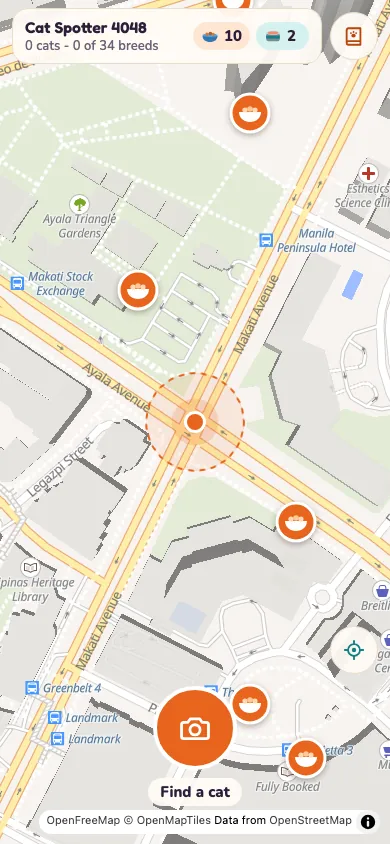
Cat Go is a game you play in your browser: walk anywhere, photograph a real cat, lure it with food and catch it, and pick its breed from a list that has a mixed breed answer too.
What is an American Wirehair cat? The short answer
The CFA describes the coat as the breed's most distinctive feature: take "the coarse, stiff texture of steel wool" and turn it into a crisp, fuzzy coat that stands off the cat's body. It pairs that coat with an easy-going, amiable personality and an overall look that reminds you of the American Shorthair. The CFA calls the breed "an American original", because the mutation has not occurred again in any other country that it knows of.
The breed standard backs up how much the coat matters. It gives the coat 45 of the 100 points, which the CFA says is more weight than the coat of any other breed gets.
How the American Wirehair began
According to the CFA, the coat first appeared in 1966, in a litter of barn cats in upstate New York. Sadly, only one of the four original wire-haired kittens survived infancy.
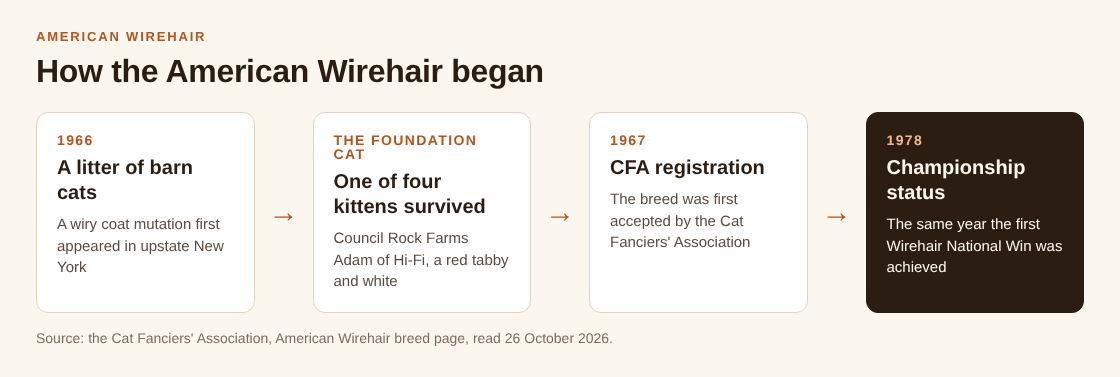
From the 1966 litter to championship status, as the CFA tells it.
That survivor grew up to be the breed's foundation cat. He was Council Rock Farms Adam of Hi-Fi, a red tabby and white, noted for his unusual coat and his mellow, even-tempered personality. Mrs. Joan O'Shea bought him and worked to establish the breed. Adam produced both wired and straight-coated offspring.
The CFA says it was soon established that the wiry coat is dominant but "semi-penetrating". In a breeding between a wired cat and a straight-haired one, on average half of the kittens will be wired. Breeding two Wirehairs, naturally, produces a higher percentage of wired kittens. The CFA first accepted the breed in 1967 and granted championship status in 1978, the same year the first Wirehair National Win was achieved.
The coat: wired or straight
The CFA says coats vary in texture from one cat to another. They may feel soft, wooly and dense, or be harder and sparser. Even the whiskers and the hair inside the ears should be crimped or bent. The standard describes two versions of the breed, and it lets both be shown in their own classes with the same point allocation:
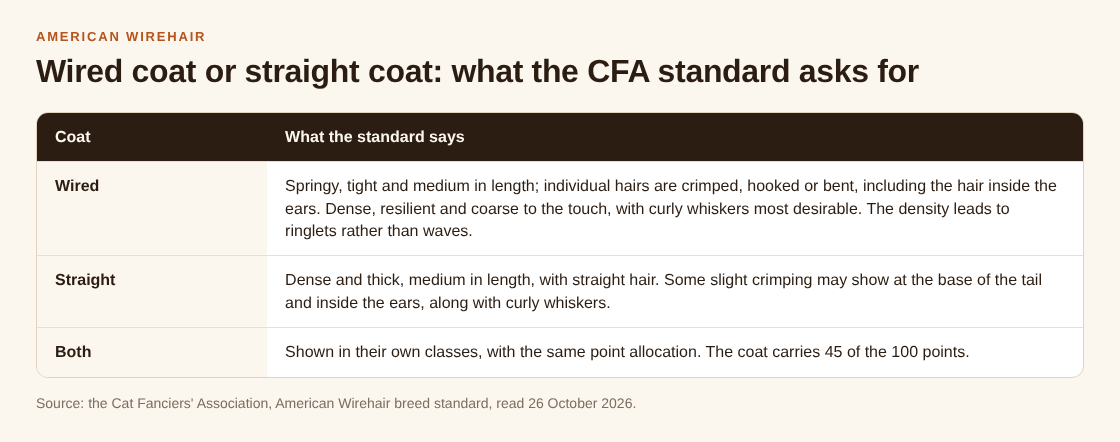
The two coats in the CFA's American Wirehair standard.
The standard also says the overall appearance of wiring, with its coarseness and resilience, matters more than the crimping of each single hair. The density of the wired coat leads to ringlets rather than waves. In the show ring, the CFA lists a close lying coat and a deep nose break as faults, and it disqualifies an incorrect coat and long or fluffy fur.
The coat comes in many colors. The page lists white, black, blue, red and cream, and chinchilla silver, shaded silver and shell cameo among others. Our post on cat breeds with curly fur sets the Wirehair beside the other breeds with a crimped or curly coat.
Face and body
Since the American Shorthair is used as an outcross for this breed, the CFA says Wirehairs should appear structurally similar to the Shorthairs, with strong, powerful bodies and well-developed muzzles. Its standard lists these features:
- Head: in proportion to the body, with round underlying bone structure, prominent cheekbones and a well-developed muzzle and chin. In profile the nose shows a gentle concave curve.
- Eyes: large, rounded, bright and clear, set well apart, with a slight upward tilt. The CFA says the more prominent cheekbones help accentuate them.
- Ears: medium in size, slightly rounded at the tips and set wide.
- Body: medium to large, with a level back and a well-rounded torso. Males are larger than females.
- Legs and paws: medium in length and bone, well muscled, with firm, full, rounded paws and heavy pads.
- Tail: tapering from the well-rounded rump to a rounded tip, neither blunt nor pointed.
Temperament: even and self-sufficient
The CFA says these cats may have a favorite person, but they make time for everyone in the home, and each family member can count on regular head butts and enthusiastic purrs. They are independent and self-sufficient enough to be left alone during the day.
Wirehairs take great interest in what their humans are doing, but the CFA says they are more likely to supervise or observe than to join in. It adds that some are mechanically gifted and can learn to open cabinets or drawers, especially ones that might hold food. They adapt easily to other pets and are gentle with children. They are not particularly vocal, though they may greet you with a questioning mew after a long absence. Strong and athletic, they can become quite enthusiastic once a game with a toy begins, and the CFA warns you might not get the toy back.
Grooming and health, as the CFA describes them
- Grooming: the CFA calls the Wirehair one of the easiest of all breeds to groom.
- Shedding: they do shed, and an occasional bath can help reduce it. Blow-drying is not necessary: the CFA says to towel dry the cat and keep it in a warm room until it is no longer damp.
- Lint collector: some owners have found that running a rolling lint collector over the coat is almost as effective as a bath.
- Health: the CFA says there is no record of any health problems being characteristic of the breed, despite the close line breeding used to create it. Most breeders rely on genetic testing and may also test breeding cats with an echocardiogram to help prevent hypertrophic cardiomyopathy, which the CFA says reflects breeder diligence rather than health issues. For your own cat, ask your vet.
The CFA still considers the Wirehair a minority breed, and says that because it is relatively rare, finding one may be a challenge. It suggests attending a cat show to meet a breeder, asking people with other breeds, especially American Shorthairs, for introductions, and being prepared to travel. It also suggests adopting a "retired" adult or a straight-haired kitten, since there may be a long wait for wire-haired kittens.
How to check a crimped-coat cat on a walk
Here is a worked example. On a walk you see a short-haired cat whose coat looks rough and crimped, and you wonder whether it is an American Wirehair.
- Look at the coat. A Wirehair coat is medium in length, springy and coarse, and the hair stands off the body. The CFA says even the whiskers should be crimped or bent.
- Look at the shape. A strong, powerful body, prominent cheekbones and large, round eyes, like an American Shorthair with a different coat.
- Allow for look-alikes. Our post on the American Shorthair covers the breed the Wirehair resembles, and the LaPerm covers a curly-coated breed with a different story.
- Do not stop at the coat. Only papers can settle a breed. Our post on telling whether a cat is mixed breed gives the longer checklist.
At the end you have a guess, not an answer.
Where Cat Go comes in
After a cat is spotted, Cat Go asks "Which breed is it?" and gives you a list with a search box. The game also says "Most cats you meet are mixed breed. Rarer breeds are warier." and "Mixed breed is always a safe pick."
That fits what you just read. A rough-coated cat can be a Wirehair, a rare breed the CFA says is hard to find, or something else, and you choose the breed yourself. The game counts 34 breeds, and every catch is saved to your Catdex with its breed and the place you found it. It needs the camera and location allowed in your browser, and its camera screen says to fit the whole cat in the frame, which helps here, since the coat is the clue and it needs to be in the photo.
Frequently asked questions
Why is it called a Wirehair?
Because of its coat. The CFA describes it as springy, dense, resilient, coarse and hard to the touch, and says it distinguishes the breed from all others.
Are all American Wirehairs wired?
No. The CFA says the breed can be shown in either a wired version or a straight-haired version, and that a wire-to-straighthair breeding gives wired kittens about half the time.
Are American Wirehairs hard to groom?
The CFA calls them one of the easiest of all breeds to groom. They do shed, and the CFA says an occasional bath can help reduce it.
Are American Wirehairs healthy?
The CFA says there is no record of any health problems being characteristic of the breed. Many breeders still test breeding cats, and your vet can advise on your own cat.
Can you tell a Wirehair from a photo?
Not reliably. A crimped coat is a clue, but it is not proof of a breed, and most cats you meet are mixed breed.
Get started
You do not need a pedigreed cat to enjoy looking at cats. Play Cat Go in your browser: walk anywhere, photograph a real cat, lure it with food and catch it. The game needs your camera and location allowed in the browser. Each catch is saved to your Catdex with its breed and the place you found it.
Walk anywhere, find a real cat, and catch it.
Visit catgo.vlvd.net↗
Comments
No comments yet.
Sign in or make an account to comment.