What is a LaPerm cat? Curls, origin, traits
What is a LaPerm cat? It is a medium-sized cat whose coat curls, from loose waves to fine ringlets. The Cat Fanciers' Association (CFA), a cat breed registry, lists its coat length as "Longhair and Shorthair" and its personality as "Affectionate, gentle and while very active, enjoy sitting in a comfortable lap". This guide follows the CFA's LaPerm breed page and its breed standard, opened for this post, and then shows how Cat Go handles the question "Which breed is it?"
Cat Go is a game you play in your browser: walk anywhere, photograph a real cat, lure it with food and catch it, and pick its breed from a list that has a mixed breed answer too.
What is a LaPerm cat? The short answer
The LaPerm is a pedigreed breed with a curly coat that comes in two lengths. The CFA says the coat is soft yet springy, and so touchable that most owners find they cannot keep their hands off the cat. It adds that the breed is extremely interactive and affectionate, and that many LaPerms crave human contact.
The CFA describes the breed as the result of a natural mutation. It can occur in any genetically possible color, so color will not tell you the breed.
Where the LaPerm comes from
The CFA tells the story from a farm. The breed began with one unusual kitten born on an Oregon farm in 1982. The kitten, called "Curly", was completely bald at birth, with large, wide-spaced ears and what looked like a tabby pattern on her skin. By four months of age she had a full, curly coat.
She had one litter of five, all initially bald and eventually curly. The owner, Linda Koehl, was not knowledgeable about cats, but as the number of curly-haired cats on the farm grew, she realized she was dealing with a new breed. She began to confine the cats, control the breeding and came up with the name LaPerm. The CFA says she was unprepared for the excitement her cats caused when she brought them to a cat show.
Recognition took time. The CFA accepted the breed for registration in 2000 and advanced it to championship status in 2008.
The coat: waves, ringlets and corkscrews
The coat is the breed's defining feature, and the standard gives it 40 of its 100 points: 20 for texture and length and 20 for curl or waviness. The CFA says it can be anything from undulating waves to fine, tight ringlets or corkscrews. The tightest curls typically sit on the throat, the underside and the base of the ears.
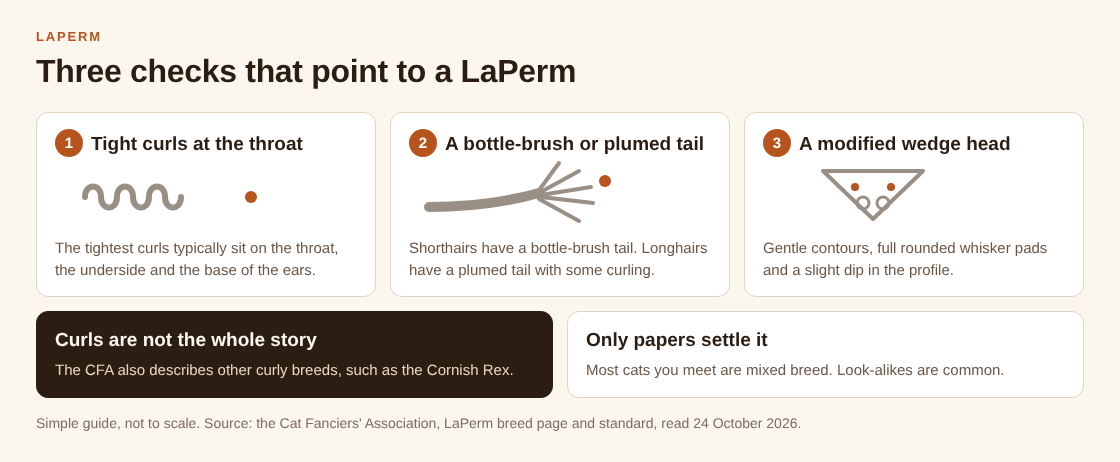
Three checks that point to a LaPerm, from the CFA's description.
The two lengths look different, and the standard describes each:
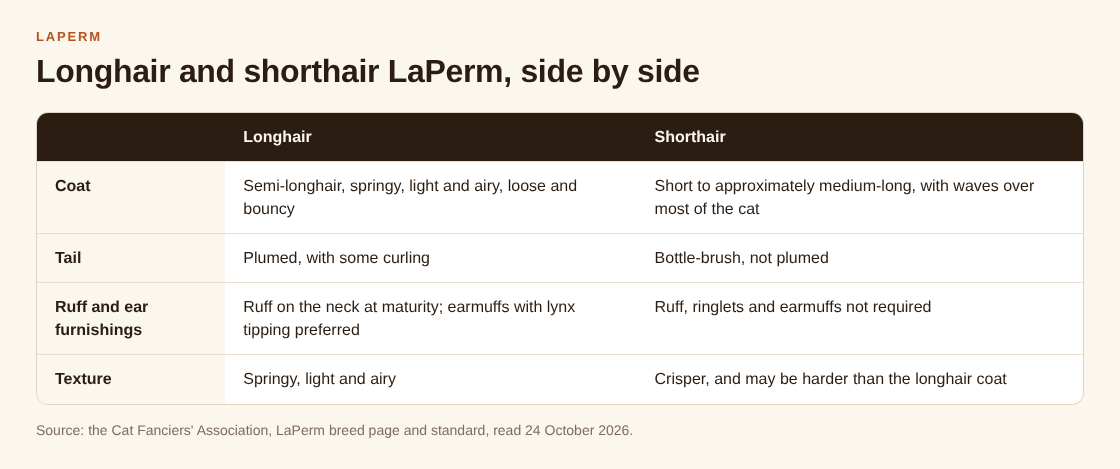
Longhair and shorthair LaPerm side by side, from the CFA's breed standard.
In both, the coat is springy, light and airy and stands away from the body. The standard says a longhair coat is light enough to part with a breath, with an almost unkempt look it calls the "Gypsy Shag". At times either coat parts naturally down the middle of the back. The coat may also vary in length and fullness with the season and the cat's age, so a LaPerm can look curlier at some times than at others.
The look: a modified wedge head, cupped ears and almond eyes
Beyond the curls, the CFA describes a medium-sized cat in "moderate type", with a build that seems to have surprising weight for its size. Here is what the standard lists:
- Head: a modified wedge, slightly rounded with gentle contours. The whisker pads look full and rounded, and the whiskers are long and flexible.
- Profile: a slight dip just below the bottom of the eye, then straight to the nose tip. The standard says the dip must be felt for, because it can look straight.
- Ears: medium to large, slightly flared and cupped, continuing the line of the wedge.
- Eyes: medium large and expressive, almond shaped at rest and rounder when alert, set well apart. Any eye color is allowed, with no link to coat color.
Our guide to cat breeds with curly fur sets the LaPerm beside other curly breeds, and our posts on the Selkirk Rex and the Devon Rex cover two more.
Temperament: affectionate, active and happy on a lap
The CFA ties the nature to the breed's farm background. As protectors of the farm, it says, LaPerms have a strong hunting instinct and are very intelligent. They are also inquisitive, affectionate and people-oriented, and drawn to human faces. The CFA says they reach for your face with their paws and rub their faces against your head, neck and face.
They are not demanding, but they show appreciation by purring as soon as they see you coming.
They are considered an active breed, yet quite content to be your lap cat. The CFA says that if a LaPerm is busy playing and you sit down to relax, you can simply pick it up and it will stay in your lap. It says they get along well with other pets and with children, and are generally not vocal.
Grooming, sun and health, as the CFA describes them
The CFA says the curls hold the hair, much like a Poodle's coat, so shedding is minimal and the coat usually does not mat. It still recommends regular combing, with a comb made with rolling teeth, which gently removes hair that is ready to come out and leaves the rest of the coat intact.
- Baths: some coats may become oily and benefit from an occasional bath. The CFA says to ask your breeder for the bathing procedure and products, since human shampoos should not be used on cats.
- Sun: because the coat may vary in length and fullness through life, the CFA says to monitor the cat's exposure to the sun, as bare spots and sparser areas can sunburn.
- Health: the CFA calls the LaPerm a minority breed with a genetically diverse background and says no specific health problems have yet been noted. For your own cat, ask your vet.
How to check a curly-coated cat on a walk
Here is a worked example. On a walk you see a medium-sized cat with a springy, curly coat, and you wonder whether it is a LaPerm.
- Look at the throat and ear bases. The CFA says the tightest curls typically sit there. A cat with curls only on the back fits less well.
- Look at the tail. A plumed tail with some curling points to a longhair. A bottle-brush tail points to a shorthair.
- Look at the coat's stance. It should stand away from the body, light and airy, not lie flat and sleek.
- Look at the head. A modified wedge with full, rounded whisker pads fits the standard.
- Do not stop at the curl. The CFA also describes the Cornish Rex, whose coat is close-lying and has no guard hairs, in our post on the Cornish Rex. Our post on telling whether a cat is mixed breed gives the longer checklist.
At the end you have a guess, not an answer. A curly coat does not prove a breed, and only papers can settle it.
Where Cat Go comes in
After a cat is spotted, Cat Go asks "Which breed is it?" and gives you a list with a search box. Its hint in the box reads "Search breeds, like Siamese or curly", so a word like "curly" is the natural way to narrow the list. The game also says "Most cats you meet are mixed breed" and "Mixed breed is always a safe pick."
That fits what you just read. A curly cat can be a LaPerm or something else, and you choose the breed yourself. The game counts 34 breeds, and every catch is saved to your Catdex with its breed and the place you found it. It needs the camera and location allowed in your browser, and its camera screen says to fit the whole cat in the frame, which helps here, since the throat, ears and tail all matter.
Frequently asked questions
What is a LaPerm cat known for?
It is known for its soft, springy, curly coat and its affectionate, people-oriented nature. The CFA says the breed began with a bald kitten born on an Oregon farm in 1982.
Does a LaPerm shed?
The CFA says shedding is minimal and the coat usually does not mat. It still recommends regular combing with a rolling-teeth comb, and it makes no claim about allergies on its breed page.
Do LaPerm kittens have curls from birth?
Not always. The CFA says the first LaPerm kitten, Curly, was completely bald at birth and had a full, curly coat by four months, and her first litter of five were all initially bald and eventually curly.
What is the difference between a longhair and a shorthair LaPerm?
The CFA says longhairs often have full ruffs and plume-like tails, while shorthairs have bottle-brush tails and a crisper texture. Both have a springy, wavy or curly coat.
Can you tell a LaPerm from a photo?
Not reliably. Curls at the throat and ear bases are clues, but they are not proof of a breed, and most cats you meet are mixed breed.
Get started
You do not need a pedigreed cat to enjoy looking at cats. Play Cat Go in your browser: walk anywhere, photograph a real cat, lure it with food and catch it. The game needs your camera and location allowed in the browser. Each catch is saved to your Catdex with its breed and the place you found it.
Walk anywhere, find a real cat, and catch it.
Visit catgo.vlvd.net↗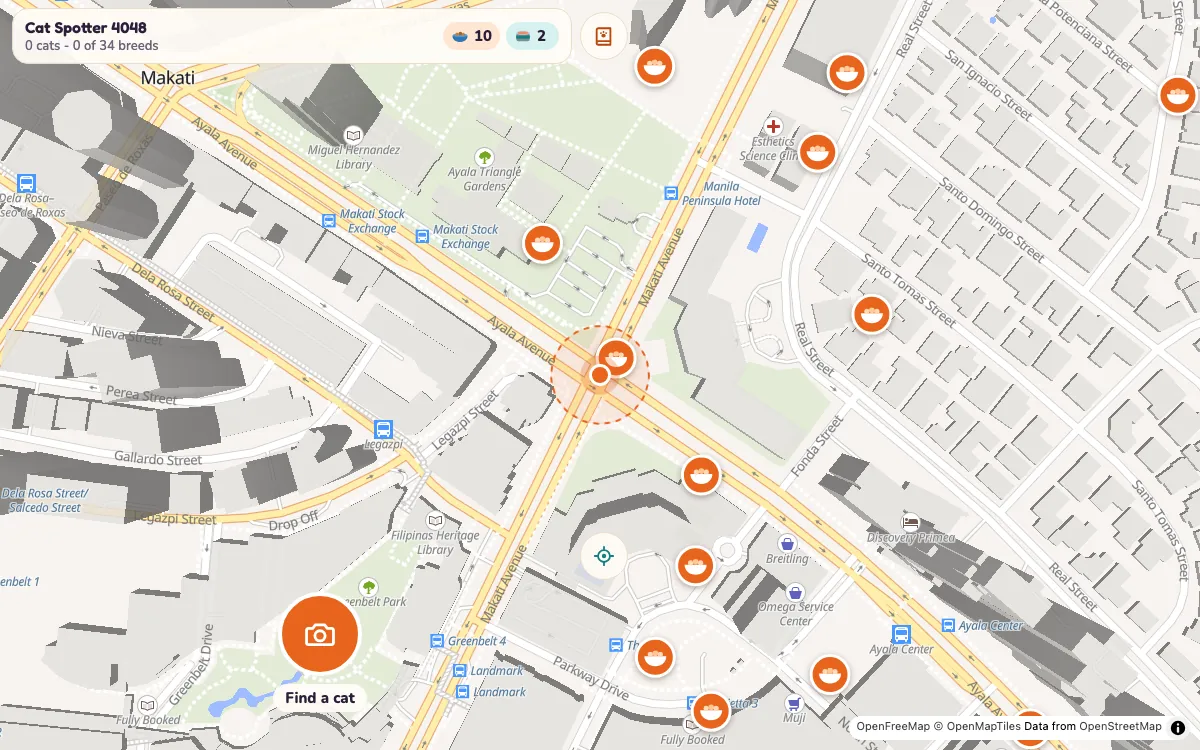

Comments
No comments yet.
Sign in or make an account to comment.