What is an Exotic Shorthair cat? Look, history and care
What is an Exotic Shorthair cat? It is a Persian in a plush coat: the same round head and sturdy body, with fur that is easier to care for. The Cat Fanciers' Association (CFA), a cat breed registry, now calls the breed simply the Exotic. This guide follows the CFA's Exotic breed page and standard, opened for this post, and then shows how Cat Go handles the question "Which breed is it?"
Cat Go is a game you play in your browser: walk anywhere, photograph a real cat, lure it with food and catch it, and pick its breed from a list that has a mixed breed answer too.
What is an Exotic Shorthair cat? The short answer
The CFA describes the Exotic as having the body and head type of a Persian but with a short plush coat, in the same colors and patterns as the Persian. Its personality is given as sweet, affectionate and quiet.
The CFA page puts it this way: if you love the look of a Persian but do not have time for extensive grooming, this is the breed for you. In the CFA's words, the Exotic has every characteristic that makes a Persian so appealing, minus the longer-coat challenge.
One small puzzle: the name still says "Shorthair" in many places, but the CFA lists the coat length as longhair and shorthair. It treats Exotics as longhair cats because they are structurally identical to a Persian. The history below explains the name.
Where the breed comes from
The CFA says that in the 1950s several West Coast Persian breeders crossed their cats with American Shorthairs. Short hair is dominant over long hair, so the result was a number of shorthaired kittens with the rounded heads, round eyes and short cobby bodies of Persians. If the American Shorthair is new to you, our post on the American Shorthair covers that side of the cross.
The CFA says these hybrids were considered extremely controversial back then, but they proved so popular that in 1966 CFA decided to establish them as a breed. Many of the new shorthairs were shaded silver or chinchilla, colors that did not yet exist in any shorthair breed, so the name chosen was Exotic Shorthair. The word "Shorthair" caused confusion and was eventually dropped. Today the breed is simply known as the Exotic.
The look: round head, cobby body, plush coat
The CFA says the standard written for the Exotic is identical to the Persian's, apart from the coat. That is why the two cats look so alike. Here is what the standard asks for:
- Head: round and massive, with a round face and round underlying bone structure, on a short, thick neck.
- Nose: short, snub and broad, with a "break" centered between the eyes.
- Eyes: large, round and full, set level and far apart, which gives the face a sweet expression.
- Ears: small and round tipped, tilted forward, set far apart and low on the head.
- Body: cobby, low on the legs, broad and deep through the chest, medium to large, with quality counting more than size.
- Legs and paws: short, thick and strong legs, with large, round, firm paws.
- Tail: short but in proportion to the body, carried without a curve and lower than the back.
- Coat: dense, plush and soft, even in length, with a thick undercoat that helps it stand off the body.
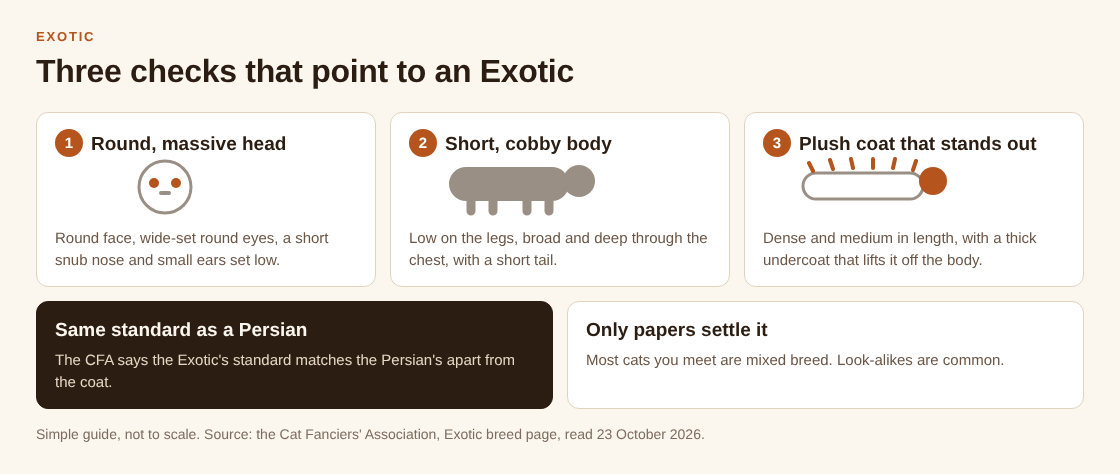
Three checks that point to an Exotic, from the CFA's description.
The CFA says the plush coat is medium in length, which it compares to a fluffy teddy bear. The standard's point score shows what matters most: head is worth 30 points and color 20, with body type 20, eye color 10, coat 10, balance 5 and refinement 5. Balance and refinement, it says, are the essence of the breed, where all parts come together in a harmonious whole.
On color, the Exotic is shown in seven divisions, the same as the Persian: solids, tabbies, silver and golden, parti-color, shaded and smoke, calico and bi-color, and pointed. Two earlier posts explain coats you will meet there, the chinchilla coat and the smoke coat.
Exotic and Persian, side by side
The two breeds were bred together after the first cross. The CFA says Exotics were consistently bred back to Persians rather than to their shorthaired ancestors, which explains why there is now practically no difference between the two when it comes to personality and intelligence. Our post on the Persian covers the longer coat.
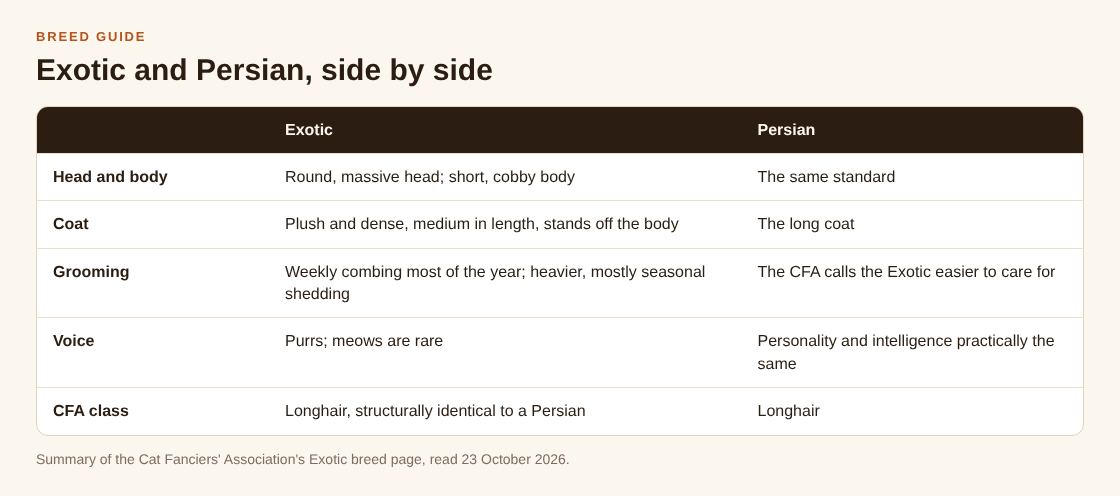
The Exotic and the Persian, as the CFA's Exotic page sets them out.
Temperament: quiet, loyal and easygoing
The CFA describes Exotics as quiet, loyal companions: devoted but not intrusive, and content to remain close to you without needing to be part of everything you do.
- Activity: some people consider Exotics a bit more active and playful than Persians. The CFA suggests this may be because they do not need to be trained to sit still for lengthy grooming sessions.
- Adaptable: endearing and easygoing, an Exotic can fit into a new home at any age.
- Children and other animals: the CFA calls the breed an excellent choice as a pet for young children. It may be initially shy with other animals but soon learns to coexist with dogs and other cats.
- Voice: Exotics speak to you with their large eyes rather than their voices. You may hear purrs, but meows will be rare.
These are the CFA's words about the breed in general. Each cat is its own cat, and a mixed breed cat may act quite differently.
Grooming and health, as the CFA describes them
The CFA says that, compared with the Persian, Exotics are heavier, mostly seasonal shedders. They need regular bathing and grooming, but the time commitment is not burdensome. Combing with a steel or Teflon-coated comb manages the shedding and keeps the coat in good condition.
- Most of the year: a weekly combing is usually enough.
- Shedding season: a bath may be needed to remove the accumulated undercoat.
- Mats: uncommon, but they may occur if the coat is neglected.
- Patience: with their Persian heritage, Exotics tend to be patient and tolerant of both grooming and bathing.
On health, the CFA says that even with a large gene pool, genetic screening remains of paramount importance for the cats used in breeding, and that most breeders are diligent about it. If you are thinking of getting one, ask a breeder what they test for, and ask your vet about anything to do with your own cat.
How to check a plush, round-faced cat on a walk
Here is a worked example. On a walk you see a cat with a very round face and a thick, plush coat, and you wonder whether it is an Exotic.
- Look at the head. The standard describes a round, massive head with a short, snub nose and large, round eyes set far apart.
- Look at the body. It should be cobby: low on the legs, broad through the chest, with a short tail carried lower than the back.
- Look at the coat. Dense and plush, with an undercoat that makes it stand off the body. If the hair is long and flowing, the cat is closer to a Persian.
- Do not use color as proof. The Exotic comes in the same colors and patterns as the Persian, so color tells you little.
- Leave the cat alone. Look from a distance and let it go about its day. Our post on telling whether a cat is mixed breed gives the longer checklist.
At the end, you have a guess, not an answer. Many round-faced cats are mixed breed, and only papers can settle it. If you want to meet the breed for real, the CFA says the Exotic is one of the breeds you are most likely to see at a CFA cat show, and that visiting a show is the best way to connect with a breeder.
Cat Go and breeds
After a cat is spotted, Cat Go asks "Which breed is it?" and gives you a list with a search box, so you can type something like "Siamese" or "curly". The game also says "Most cats you meet are mixed breed" and "Mixed breed is always a safe pick."
That fits what you just read. A round-faced, plush cat can be an Exotic or a mixed breed cat, and you choose the breed yourself. The game counts 34 breeds in total, and every catch is saved to your Catdex with its breed and the place you found it.
Cat Go needs the camera and location allowed in your browser. When you take the photo, the game says to fit the whole cat in the frame.
Frequently asked questions
Is an Exotic Shorthair the same as a Persian?
Not quite. The CFA says the Exotic's breed standard is identical to the Persian's except for the coat, and that Exotics have practically no difference from Persians in personality and intelligence. The Exotic has a plush, dense, medium-length coat instead of the long one.
Why is it called an Exotic and not an Exotic Shorthair?
The CFA says the name Exotic Shorthair was first chosen because many of the new shorthairs were colors that did not yet exist in shorthair breeds. The word "Shorthair" caused confusion and was eventually dropped.
Do Exotics need a lot of grooming?
The CFA says the time commitment is not burdensome. A weekly combing is usually enough for most of the year, and a bath may be needed in shedding season. They shed more than Persians, mostly seasonally.
Are Exotics good with children?
The CFA calls the breed an excellent choice as a pet for young children. It adds that an Exotic may be shy with other animals at first but soon learns to coexist with dogs and other cats.
Are Exotics vocal?
The CFA says they speak with their large eyes rather than their voices. You may hear purrs, but meows will be rare.
Get started
Ready to try the "Which breed is it?" question on a real cat? Play Cat Go in your browser: walk anywhere, photograph a real cat, lure it with food and catch it.
Walk anywhere, find a real cat, and catch it.
Visit catgo.vlvd.net↗

Comments
No comments yet.
Sign in or make an account to comment.