What is computational intelligence in AI?
Computational intelligence is the branch of computer science that builds systems able to behave intelligently in complex, changing environments, mostly with methods borrowed from nature: neural networks, fuzzy logic and evolution. Wikipedia's article on computational intelligence describes these systems as able to learn or adapt to new situations, to generalize, to abstract, and to discover and associate. This post explains what the field covers, how it differs from classic AI, where the name came from, and walks you through a small fuzzy logic example you can work on paper.
If you would like to think about where learning machines could lead inside a story, Contain ASI is a browser story strategy game for 1 to 4 players where you try to keep four fictional AI labs from crossing into recursive self-improvement before 2027.
What computational intelligence means
Wikipedia defines computational intelligence, or CI, as the concepts, paradigms, algorithms and implementations of systems designed to show intelligent behavior in complex and changing environments. Such systems recognize and interpret patterns, control processes, support decisions, or steer vehicles and robots through places they do not know.
CI aims at a particular kind of problem: the ones where traditional mathematical modeling does not fit. The article lists the reasons a problem can be like that:
- the process cannot be described exactly, because nobody has complete knowledge of it;
- it is too complex for mathematical reasoning;
- it holds uncertainty, such as unforeseen changes in the environment or the process itself;
- or it is simply random by nature.
In short, CI is for processes that are ill-defined, complex, nonlinear, changing over time or random. Methods inspired by nature play a key role.
The three pillars and the rest of the toolbox
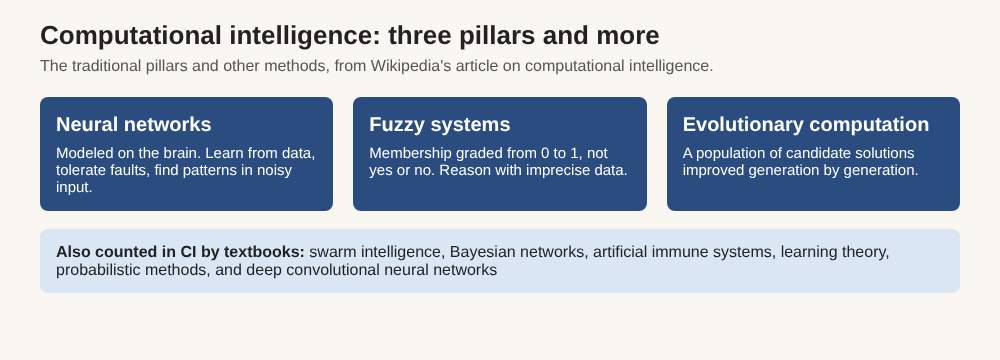
A definition from the IEEE Computational Intelligence Society calls CI the theory, design, application and development of biologically and linguistically motivated computational paradigms. Traditionally it rests on three pillars:
- Neural networks, modeled on biological ones. Their main strengths are fault tolerance, recognizing patterns even in noisy images, and the ability to learn from experience.
- Fuzzy systems, where belonging to a set is graded from 0 to 1 instead of a yes or no. Fuzzy logic suits decisions with imprecise data, though on its own it has no ability to learn.
- Evolutionary computation, a family of optimization methods that work on a population of candidate solutions and are inspired by biological evolution, such as genetic algorithms and genetic programming.
Textbooks also count swarm intelligence (simple agents whose local interactions produce a global behavior with no central control), Bayesian networks, artificial immune systems, learning theory and probabilistic methods. The article adds that deep learning, in particular deep convolutional neural networks, has seen an explosion of research and has become the core method of AI, and that some of the most successful AI systems are based on CI.
Computational intelligence vs artificial intelligence
The two terms are close enough to confuse, and the article says most researchers who work on the question treat them as distinct fields. Three views exist: CI is an alternative to AI, AI includes CI, or CI includes AI.
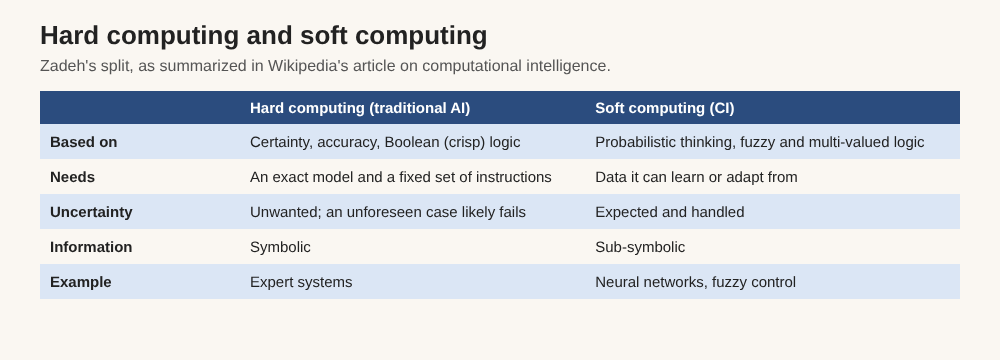
The first view goes back to Zadeh, the founder of fuzzy set theory. He split machine intelligence into hard computing, used in traditional AI such as symbolic AI and expert systems, and soft computing, which is where CI lives.
- Hard computing is built on certainty and accuracy. It needs an exact analytical model and a fixed set of instructions, uses Boolean or "crisp" logic, where something is in a set or not, and is likely to fail when a situation comes up that the model does not include.
- Soft computing starts from the fact that the human mind can store and use information that is imprecise and uncertain. It draws on probabilistic thinking, fuzzy logic and multi-valued logic, and its methods are usually random processes that can be analyzed statistically but not with precision.
Another common distinction is that AI represents information as symbols, while CI techniques work below the level of symbols, in numbers and weights. The same split appears in the long argument between neats and scruffies and in attempts to join the two sides, such as neurosymbolic AI.
Where the name came from
The article traces the idea of intelligent computers back to Alan Turing's test of 1950. The term computational intelligence itself was first used as the title of a journal in 1985. It was then taken up by the IEEE Neural Networks Council, founded in 1989 by researchers interested in biological and artificial neural networks. The council helped organize the first IEEE World Congress on Computational Intelligence in Orlando, Florida, in 1994, and became the IEEE Neural Networks Society in 2001 and the IEEE Computational Intelligence Society two years later, after adding fuzzy systems and evolutionary computation.
At that 1994 congress Bezdek gave the first clear definition: a system is computationally intelligent when it deals only with numerical, low-level data, has pattern-recognition parts, does not use knowledge in the AI sense, and begins to show adaptivity, fault tolerance, speed close to a human's and error rates close to human performance. Bezdek also noted that AI and CI are catchy terms that get hyped by researchers, science managers and journalists.
The open problem: results you cannot check
One line in the article matters for anyone who thinks about AI risk. It says that so far the results of some CI methods, such as deep learning, cannot be verified, and it is not clear what they are based on. The article calls this an important scientific issue for the future.
This is the soft computing trade in plain terms. A hard computing system fails loudly on a case its model did not foresee. A soft computing system handles the messy case, but you may not be able to say why it gave the answer it gave. That gap is what the field of explainable AI tries to close.
Try it: a fuzzy thermostat on paper
Fuzzy logic is the easiest CI pillar to try with a pencil. The article explains that a membership function gives each element a number from 0 to 1 for how much it belongs to a set, and that fuzzy control is used in household appliances. Here is a small thermostat to work through yourself; the numbers are only for practice.
- Define two sets. "Cold" has membership 1 at 15 degrees and falls in a straight line to 0 at 21 degrees. "Warm" is 0 at 18 degrees and rises to 1 at 24 degrees.
- Read a temperature. Say the room is 19.5 degrees. Cold is (21 minus 19.5) divided by 6, which is 0.25. Warm is (19.5 minus 18) divided by 6, which is also 0.25. The room is a little of both.
- Write two rules. If cold, heater power 100 percent. If warm, heater power 0 percent.
- Blend the rules. Weight each rule by its membership: (0.25 times 100 plus 0.25 times 0) divided by (0.25 plus 0.25) gives 50 percent power.
- Compare with crisp logic. A Boolean thermostat with one cut-off at 20 degrees would switch fully on at 19.5 and fully off at 20.1. Try 17 and 23 degrees and see how the fuzzy output glides instead of jumping.
What you just built has no learning ability, which matches the article's point about fuzzy logic. Joining it to a neural network that tunes the sets from data is the kind of hybrid the article says real applications usually use.
Frequently asked questions
What are the three pillars of computational intelligence?
Neural networks, fuzzy systems and evolutionary computation. Textbooks also add swarm intelligence, Bayesian networks, artificial immune systems, learning theory and probabilistic methods.
Is computational intelligence the same as artificial intelligence?
Not quite. Most researchers treat them as distinct fields, and they disagree on whether CI is an alternative to AI, part of AI, or the wider field. CI usually works with numbers below the level of symbols, while classic AI works with symbols.
What is the difference between hard and soft computing?
Hard computing needs an exact model and crisp yes or no logic, and fails on cases it did not foresee. Soft computing, the home of CI, accepts imprecision and uncertainty and works with probabilities and degrees.
Who defined computational intelligence?
Bezdek gave the first clear definition at the IEEE World Congress on Computational Intelligence in 1994. The term had first appeared as a journal title in 1985.
Is Contain ASI a forecast of the future of AI?
No. Contain ASI is a game, and its page says all its labs, people and events are fictional. It is inspired by the AI 2027 scenario, and it is a story, not a forecast.
Get started with Contain ASI
Computational intelligence asks how machines can learn and adapt when no exact model exists. In Contain ASI you face that kind of uncertainty as fiction: playing a researcher, research manager, CEO or government, you try for three years to keep four fictional AI labs from reaching recursive self-improvement before 2027. It runs in the browser and needs WebGL 2.
Play Contain ASI: a story strategy game for 1 to 4 players that runs in your browser. Its labs, people and events are all fictional.
January 2024. Four AI labs. One race.
Visit containasi.vlvd.net↗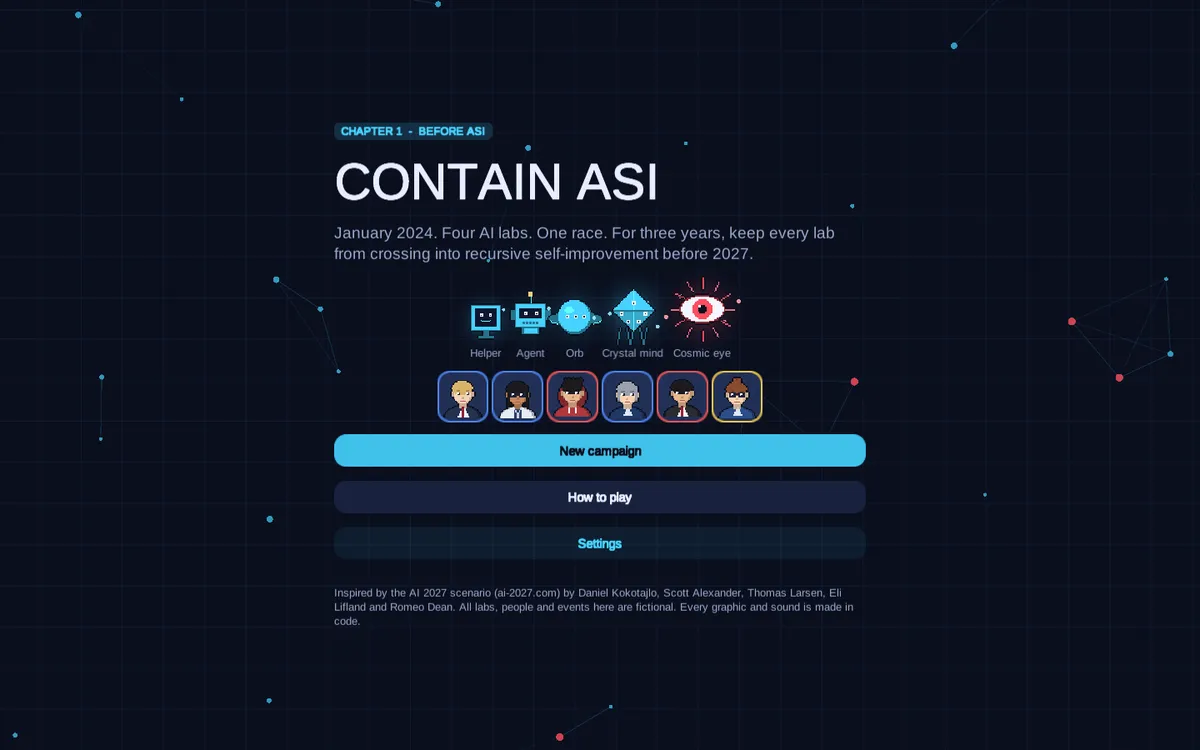

Comments
No comments yet.