Neats and scruffies: the two camps of AI research
Neats and scruffies are the two camps that split AI research in the 1970s and 1980s: neats built intelligence on one formal method they could prove correct, and scruffies used whatever mix of methods made a program behave. Wikipedia's article on neats and scruffies says the distinction was made in the 1970s and argued over until the mid-1980s, and that modern AI carries traces of both. This post explains each side, who stood where, how the argument moved, and gives you a simple test to sort any AI project into a camp.
If you want to think about how AI is built and where it could go inside a story of your own, Contain ASI is a browser story strategy game for 1 to 4 players where you try to keep four fictional AI labs from crossing into recursive self-improvement before 2027.
What neats and scruffies mean
The two words describe a style of research more than a single theory.
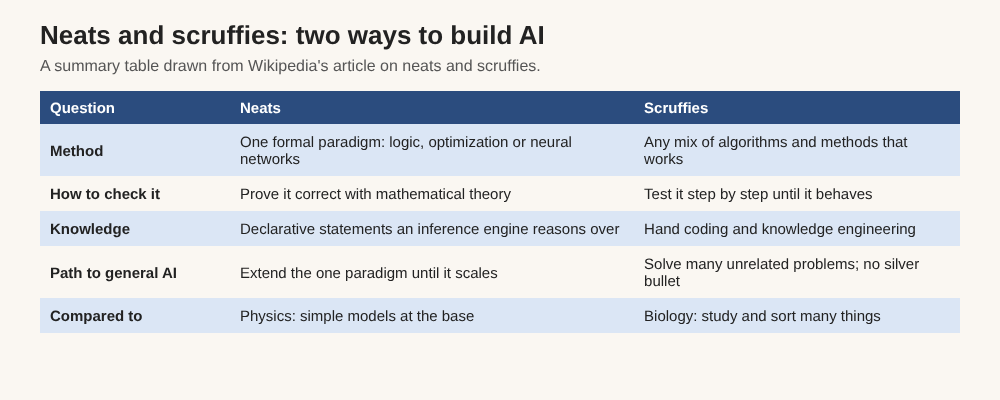
- Neats use algorithms based on one formal paradigm, such as logic, mathematical optimization or neural networks. They check that their programs are correct with rigorous mathematical theory, and they tend to hope that this one paradigm can be extended until it reaches general intelligence and even superintelligence.
- Scruffies use any number of different algorithms and methods to get intelligent behavior, and they check their programs by testing them step by step. Their work needs a lot of hand coding and knowledge engineering. Scruffy researchers have argued that general intelligence can only come from solving a large number of mostly unrelated problems, and that there is no silver bullet that lets a program develop it on its own.
The article quotes the writer John Brockman, who compared the neat approach to physics, because it builds on simple mathematical models, and the scruffy approach to biology, because much of the work is studying and sorting many different things.
Where the names came from
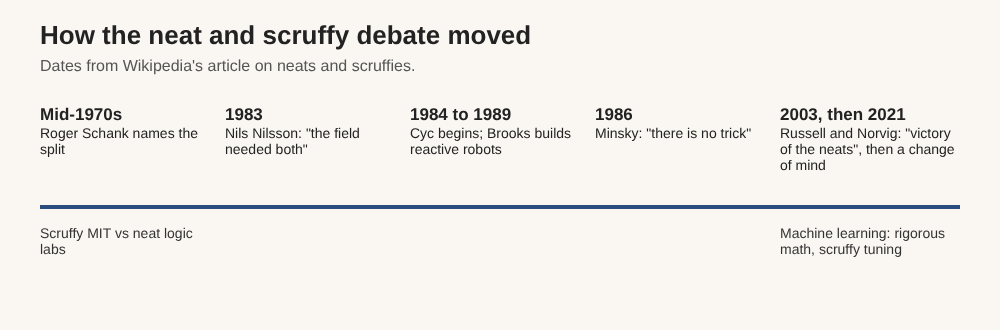
The split was named in the mid-1970s by Roger Schank. He used the terms to set his own work on natural language processing, which stored commonsense knowledge in large, loose semantic networks, apart from the work of John McCarthy, Allen Newell, Herbert A. Simon, Robert Kowalski and others, whose work rested on logic and formal extensions of logic. Schank called himself a scruffy.
The divide was partly geographic. Wikipedia says scruffy habits were typical of AI research at MIT under Marvin Minsky in the 1970s, where researchers often spent long hours fine-tuning a program until it did what they wanted. Two well-known programs from there were ELIZA, which behaved as if it spoke English without any formal knowledge, and Terry Winograd's SHRDLU, which answered questions and moved objects in a simple world of blocks and a robot arm. SHRDLU worked, but it could not be scaled into a useful language system because it lacked a structured design: it was, in the article's words, too scruffy to be extended.
Other labs, the largest being Stanford, Carnegie Mellon University and the University of Edinburgh, built on logic and formal problem solving. They backed the work of John McCarthy, Herbert Simon, Allen Newell, Donald Michie, Robert Kowalski and other neats. This is the tradition the symbolic AI post describes.
Procedures versus declarations
The same contrast was also described as a procedural versus declarative split. A program like SHRDLU was built as an agent that carried out actions: it ran procedures. Other programs were built as inference engines that worked on formal statements, or declarations, about the world, and turned the results into actions.
In his 1983 presidential address to the Association for the Advancement of Artificial Intelligence, Nils Nilsson argued that the field needed both. He wrote that much of the knowledge we want programs to have "can and should be represented declaratively in some kind of declarative, logic-like formalism", while ad hoc structures still have their place. Two other researchers, Alex P. Pentland and Martin Fischler, agreed that deduction and logic-like formalisms had a role, but not to the extent Nilsson described.
Scruffy projects of the 1980s
Three projects show what scruffy thinking looked like in practice.
- Robots that react. In the mid-1980s Rodney Brooks applied the scruffy approach to robotics. His robots, in the words of his 1989 paper with Anita Flynn, were "Fast, Cheap and Out of Control". They did not build a model of the world from vision or plan with logic; they reacted to their sensors in ways that helped them survive and move. The subsumption architecture post explains how.
- Cyc. Douglas Lenat's Cyc project began in 1984 as one of the earliest and most ambitious attempts to put all of human knowledge into machine-readable form. It was described as "a determinedly scruffy enterprise", with millions of facts meant to give AI commonsense knowledge.
- The Society of Mind. In 1986 Marvin Minsky published The Society of Mind, which treats the mind as a community of modules, each handling one part of thinking. Minsky wrote: "What magical trick makes us intelligent? The trick is that there is no trick. The power of intelligence stems from our vast diversity, not from any single, perfect principle."
Did the neats win?
In the 1990s new statistical and mathematical approaches arrived, built on mathematical optimization and neural networks. The writer Pamela McCorduck wrote that AI then enjoyed "a Neat hegemony". In 2003 Peter Norvig and Stuart Russell described the trend toward formal methods as "the victory of the neats".
By 2021, the article says, Russell and Norvig had changed their minds. Deep learning and machine learning in general need a lot of fine tuning: a model is tested again and again until it shows the behavior wanted, which is a scruffy way of working. Wikipedia sums up the present like this:
- Modern AI looks neat because its general algorithms are mathematically rigorous, and because some researchers hope for a single "master algorithm" from which general intelligence and superintelligence could emerge.
- Modern AI looks scruffy because getting a particular application to reach its goals needs hand-tuning and step-by-step testing, and that part is not rigorous.
Both positions are still held. A neat reader sees a single learning method at the core of today's systems; a scruffy reader sees the months of tuning around it. The article gives no verdict, and neither does this post.
Try it: sort a project into a camp
You can use the article's own tests to place any AI project, old or new. Take a chess program, a chatbot you have used, or a robot vacuum, and answer four questions on paper.
- How many methods? Does it rest on one formal paradigm (logic, optimization, a neural network), or a patchwork of methods? One leans neat; many leans scruffy.
- How is it checked? Could someone prove it correct, or is it judged by testing until it behaves? Proof leans neat; testing leans scruffy.
- Where does knowledge live? In declarations an engine reasons over, or in hand-built procedures and tuning? Declarations lean neat.
- What is the hope? That this one method scales to general intelligence, or that intelligence needs many separate solutions? The first is the neat hope; the second is Minsky's "no trick".
Score each answer neat or scruffy. SHRDLU scores scruffy on almost every line. A modern learning system will likely split, neat on questions 1 and 4 and scruffy on question 2, which is exactly the mix the article describes. Writing down why you scored each line is the useful part: it shows you which assumption about intelligence the project is betting on.
Frequently asked questions
What is the difference between neat and scruffy AI?
Neat AI uses one formal method and proves its programs correct with mathematics. Scruffy AI uses many methods and checks programs by testing until they behave.
Who coined the terms neats and scruffies?
Roger Schank, in the mid-1970s. He called himself a scruffy and used the terms to contrast his language work with the logic-based work of McCarthy, Newell, Simon and Kowalski.
Is deep learning neat or scruffy?
Wikipedia says it is both. Its general algorithm is mathematically rigorous, which is neat, but making a model reach a specific goal takes iterative tuning and testing, which is scruffy.
Who were famous scruffies?
The article lists Rodney Brooks, Terry Winograd, Marvin Minsky, Roger Schank and Doug Lenat as scruffies, and John McCarthy, Allen Newell, Herbert A. Simon, Edward Feigenbaum, Robert Kowalski and Judea Pearl as neats.
Is Contain ASI a forecast of how AI will develop?
No. Contain ASI is a game, and its page says all its labs, people and events are fictional. It is inspired by the AI 2027 scenario but is not a prediction.
Get started with Contain ASI
The neat and scruffy debate asks how intelligence gets built. In Contain ASI you face a different question as fiction: playing a researcher, research manager, CEO or government, you try for three years to keep four fictional AI labs from reaching recursive self-improvement before 2027. It runs in the browser and needs WebGL 2.
Play Contain ASI: a story strategy game for 1 to 4 players that runs in your browser. Its labs, people and events are all fictional.
January 2024. Four AI labs. One race.
Visit containasi.vlvd.net↗


Comments
No comments yet.