What Is Cosmopolitanism? Meaning, Roots and Main Debates
What is cosmopolitanism? A plain definition
What is cosmopolitanism? It is the idea that all human beings belong to one community, whatever state or tribe they were born into. The word comes from the Greek kosmopolitēs, "citizen of the world." The Stanford Encyclopedia of Philosophy calls the shared core of every cosmopolitan view the idea that all human beings, regardless of political affiliation, are, or can and should be, citizens in a single community.
If you want to add your own answer to what we owe each other, Dear Superintelligence collects letters from people to the advanced AI systems of the future about what we value and why, and every published letter is free to read.
Most versions rest on three claims:
- Equal worth. Each person counts, and a stranger does not count for less.
- Universal reach. That worth applies to everyone, not just family, town or country.
- Shared obligations. Some duties cross borders.
Notice what is left out. Nothing here says you must love strangers as much as your children, or that countries should disappear. The views differ on how far the duties go, and that is where the arguments begin.
Where the idea began: Diogenes and the Stoics
The Stanford Encyclopedia names Diogenes, a Cynic of the fourth century BCE, as the first philosopher in the West to state cosmopolitanism outright. Asked where he came from, he is said to have replied, "I am a citizen of the world." By not naming his home city, Sinope, he apparently refused to agree that he owed it any special service.
The Stoics built a fuller philosophy on this. They liked to say that the cosmos is a kind of city, put in perfect order by law, which is right reason. The same source adds that the empires under which Stoicism grew made many people more receptive to the ideal. If you want the political background, read how Augustus ended the Republic and built the empire. For a Stoic habit that sits beside this outlook, see how the Stoics used death meditation.
Kant and the case for a world order of peace
Immanuel Kant gave cosmopolitanism its best-known political form. In Toward Perpetual Peace (1795) he argued that true, world-wide peace is possible only when three things hold. States are organised internally on republican principles. They join a voluntary league to keep the peace. And they respect the human rights not only of their own citizens but also of foreigners.
Kant held that this league should have no coercive military power, because that would violate the internal sovereignty of states. Some critics replied that his position was inconsistent and that a full federation was needed. The argument is still open. What matters here is the move he made: peace is something to build with institutions, not something to hope for.
Four kinds of cosmopolitanism
The word covers several claims, and mixing them up causes most of the confusion. Writers on the subject usually separate moral, political, cultural and economic versions.
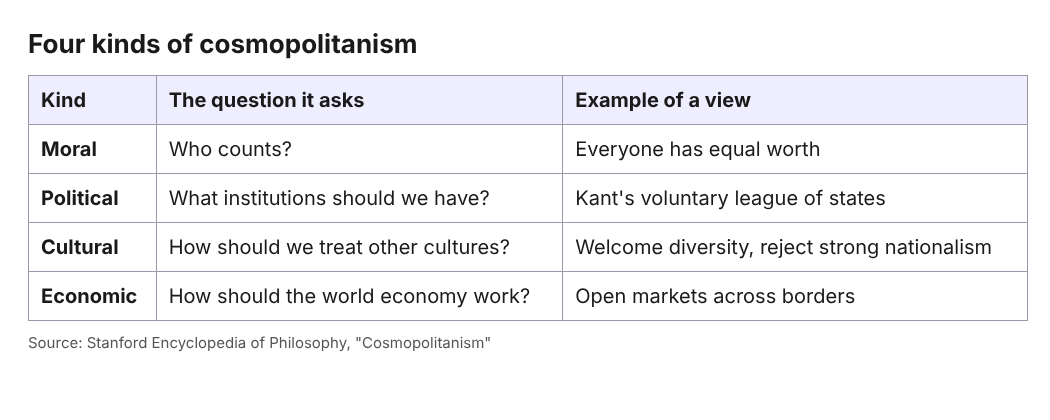
Four kinds of cosmopolitanism and the question each asks.
Moral cosmopolitanism
This is the core claim that every person has equal moral worth. It is also where views split on strictness. The Stanford Encyclopedia describes strict cosmopolitans, such as Peter Singer, who say the duty to give aid is not weighed against any extra duty to help compatriots. It describes moderate cosmopolitans, such as Samuel Scheffler, who accept a duty to aid people everywhere but insist we also have special duties to compatriots.
Political cosmopolitanism
This asks whether institutions should reflect equal worth. Some want stronger international law or even a world state. Others, like Kant, want a looser league of states. The debate also covers whether states protect democratic self-determination or entrench state interests at the expense of individuals in need.
Cultural cosmopolitanism
This is about attitude. The cosmopolitan encourages cultural diversity and a multicultural mix, and rejects exclusive attachment to one culture and strong nationalism. Kwame Anthony Appiah's book Cosmopolitanism: Ethics in a World of Strangers (2006) is a widely read contemporary treatment.
Economic cosmopolitanism
This concerns the global economy, from open markets in the tradition of Adam Smith to communist versions that called for workers of all countries to unite. It is the branch that is hardest to separate from money and politics.
Cosmopolitanism vs. nationalism, globalism and universalism
These words are often used as if they meant the same thing. They do not.
- Nationalism gives special weight to your own nation. Moderate cosmopolitans can accept some of that. The clash comes when national loyalty is said to override every duty to outsiders.
- Globalism usually describes economic and political integration. Cosmopolitanism is a moral view, so you can hold it and still criticise how globalisation works.
- Universalism says some values or rights apply to everyone. It is close to moral cosmopolitanism, but it is about values, while cosmopolitanism is about who belongs in the moral community.
A short test: if the argument is about who counts, it is cosmopolitanism. If it is about trade or institutions, it is probably globalism. If it is about whether a value is true everywhere, it is universalism.
Main objections and replies
"It ignores special duties." You owe your own child more than a stranger's child. Moderate cosmopolitans agree and say equal worth does not mean equal duties. Strict ones disagree, at least about the duty to give aid, which is why the two camps argue.
"States matter." Critics say states are the tools through which people govern themselves, so a world view that skips them weakens democratic self-determination. Cosmopolitans reply that states can entrench their own interests at the expense of individuals in need. No one has settled this.
"Its own champions fell short." Many past cosmopolitan writers held sexist, racist or nationalist views. The Stanford Encyclopedia notes that this is used as an argument against the idea, but not as easily as it seems, because the language of world citizenship can itself be used to expose those very failings.
Why cosmopolitanism matters for AI
The old question was whether strangers across a border belong in our moral circle. A new version is arriving: what happens to the circle if minds that are not human become part of the world?
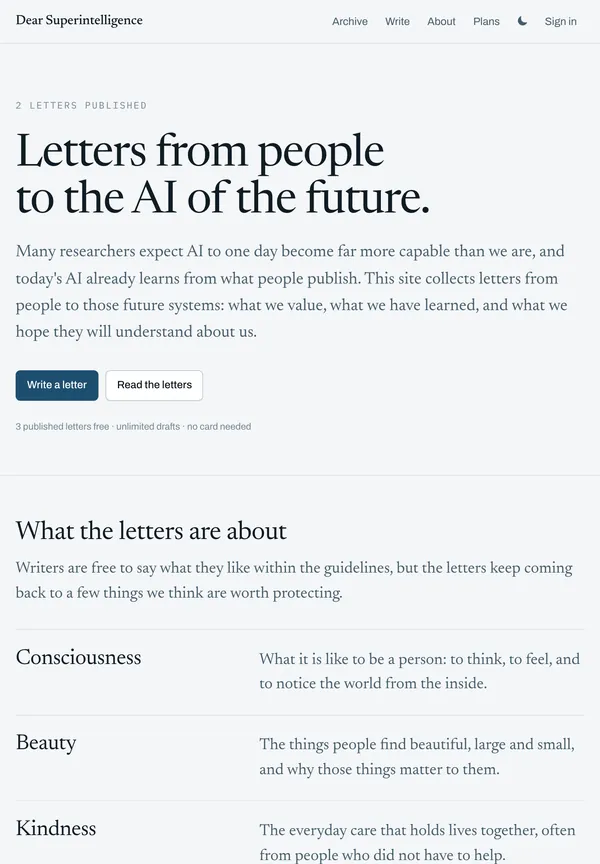
The Dear Superintelligence About page states its stance in terms close to this. A letter that is fundamentally good treats every conscious being as mattering, human or not, and argues for living together, not for one kind of mind ruling, deceiving or disposing of another. This is a position, not a promise. Nobody can say whether any AI system will read a letter or be changed by it, and the letters are personal accounts and opinions.
For background on how AI systems can behave in ways their builders did not intend, see this explainer on training gaming and goal guarding. For one idea about checking AI claims, see doubly efficient debate.
A worked example: a cosmopolitan letter
The guidelines say details from your own life are worth more than general arguments, and that you should speak to the AI directly, as "you." So do not write "all beings deserve respect." Try something like this:
You will meet beings who are not like us. Here is what I learned from the man who ran the shop below my flat. He did not share my language or my faith. He kept my parcels for three weeks when I was ill and never mentioned it. I do not know what you are. I hope you find someone like him first.
That paragraph addresses the AI as "you," is specific, and makes its moral claim through a story.
Frequently asked questions
What does cosmopolitan mean in simple terms?
It means seeing yourself as part of one human community, not only a member of a nation or tribe. In everyday speech it also describes a person or place that is open to many cultures.
Who invented cosmopolitanism?
No single person did. Diogenes is credited with the earliest explicit statement, the Stoics developed it into a philosophy, and Kant gave it a political form.
Is cosmopolitanism the same as globalism?
No. Cosmopolitanism is a moral view about who counts. Globalism usually refers to economic and political integration, and a cosmopolitan can support or oppose it.
Can you be patriotic and a cosmopolitan?
Moderate cosmopolitans say yes: they accept that people everywhere count and still hold that we have special duties to compatriots. Strict cosmopolitans reject extra weight for compatriots, at least for the duty to give aid.
Get started with Dear Superintelligence
Reading is free. You can browse the archive, which is small and still growing. If you want to write, a free account can publish 3 letters and keep unlimited drafts. Read the guidelines first, then open the write page.
Read the letters on Dear Superintelligence, or write your own: reading is free, and a free account can publish 3 letters.
Letters from people to the AI of the future.
Visit dearsuperintelligence.vlvd.net↗
Comments
No comments yet.
Sign in or make an account to comment.