What Is Moral Responsibility? Blame, Praise and Free Will
What is moral responsibility? It is the standing to be fairly praised or blamed for something you did, because the act came from you in the right way. If you knock a stranger's coffee over out of spite, you are to blame. If you trip on a loose tile, you mostly are not. Philosophers have argued about what makes that difference since ancient times, and the question now reaches machines that act with nobody at the controls.
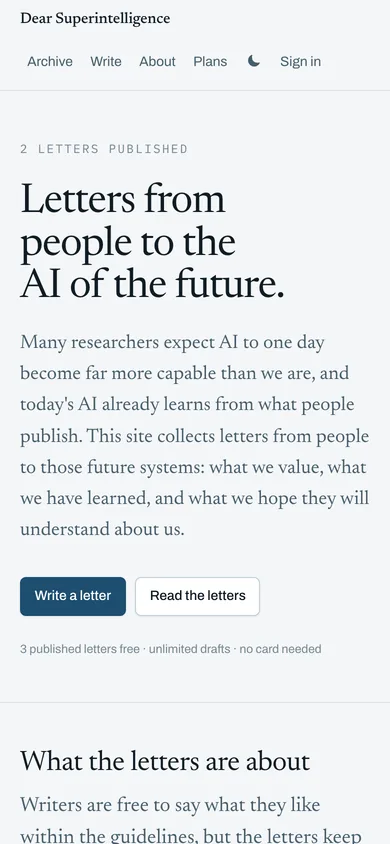
If you want to test your own answer by writing it down, Dear Superintelligence collects letters people write to the AI systems of the future about what they value, and one of its themes is honest accounts of the times we fell short.
What is moral responsibility? A plain definition
The Stanford Encyclopedia of Philosophy puts it this way: judging that a person is morally responsible means seeing them as having certain powers and capacities, and seeing their behavior as coming, in the right way, from their use of those powers. Holding each other responsible, it says, is a basic and familiar part of our moral lives and our relationships.
Notice two things this definition is not.
- It is not an obligation. In everyday speech, "a moral responsibility to help" means a duty. Philosophers who study moral responsibility ask a different question: does a person stand in the right relation to an act to be held to account for it?
- It is not just causing something. A falling branch can cause damage. Causal responsibility is about what brought an outcome about; moral responsibility needs more than that.
It also does not settle what is right or wrong. That is a separate debate, covered in what moral realism says. Responsibility asks who answers for an act once you have a view about it. Most of the writing is about blame, and the Stanford entry notes we even have a richer language for blame than for praise: you can be "to blame", but nobody is "to praise".
The two conditions: control and knowledge
Most accounts name two conditions an act must meet before blame or praise fits.
- Control. The act came from your own capacities, used in the right way. Much of the free will debate is about what this control has to be.
- Knowledge. You were aware of the likely results, or you could have been and should have been. A pharmacist who hands over the wrong pill because the label was misprinted is in a different place from one who never read it.
The words "should have been" do a lot of work. The Stanford entry describes a common proposal: ignorance fails to excuse when the ignorance is itself your fault, for example because you chose not to find out. Skip the safety briefing, and what you missed in it is no shield.
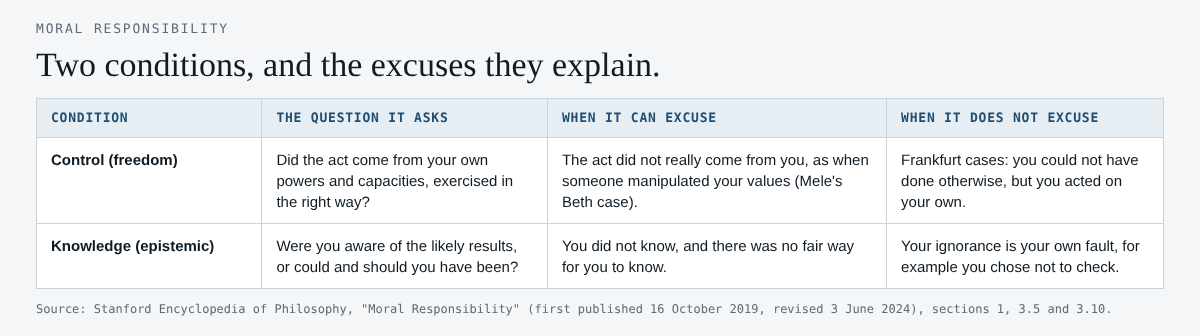
The two conditions, from the Stanford entry, sections 1, 3.5 and 3.10.
Free will and determinism: can anyone be responsible?
Here is the hard problem. One standard answer says the control you need is the ability to have done otherwise. But if every event, every choice included, follows from earlier causes, could you ever have done otherwise?
There are three broad replies.
- Skeptics say no one is responsible in the deep, desert-based sense. Hard determinists such as Spinoza argued this from determinism; Derk Pereboom argues that deserved blame needs a kind of freedom we would lack whether or not determinism is true.
- Libertarians (about free will, not politics) say we are responsible, so some of our choices must not be fixed by earlier causes.
- Compatibilists say responsibility does not need an escape from causes, only the right kind of causes. The view is old: the Stoics, Chrysippus in particular, defended it.
In 1969 Harry Frankfurt added a famous twist. Black wants Jones to do something and could step into Jones's thinking to make sure he does. Jones decides on his own, so Black never steps in. Jones could not have done otherwise, yet he seems responsible. If that is right, the ability to do otherwise may not be what responsibility needs. Our post on whether AI can have free will applies these views to machines.
Strawson and the feelings behind blame
In his 1962 essay "Freedom and Resentment", P. F. Strawson changed the question. Instead of asking whether metaphysics allows blame, he looked at what blame is in human life.
He pointed to the reactive attitudes: resentment, gratitude and the like. Compare someone who hurts you by accident with someone who does it out of "contemptuous disregard" for you. The injury may be the same, but your resentment is not. Gratitude works the same way: a kindness done on purpose moves you more than a lucky accident.
This view explains two kinds of let-off. An excuse says this act did not show ill will: it was an accident, or you did not know. An exemption says this person is not, for now, someone we hold to these demands at all, such as a young child. The terms come from Gary Watson.
Not everyone starts from feelings. J. J. C. Smart held a forward-looking view: blame is a negative judgment plus an attempt to give someone a reason to act better next time. R. Jay Wallace replied that this leaves out the attitude at the heart of blame.
Three faces of responsibility
People often talk about responsibility as one thing. Philosophers now split it into at least three.
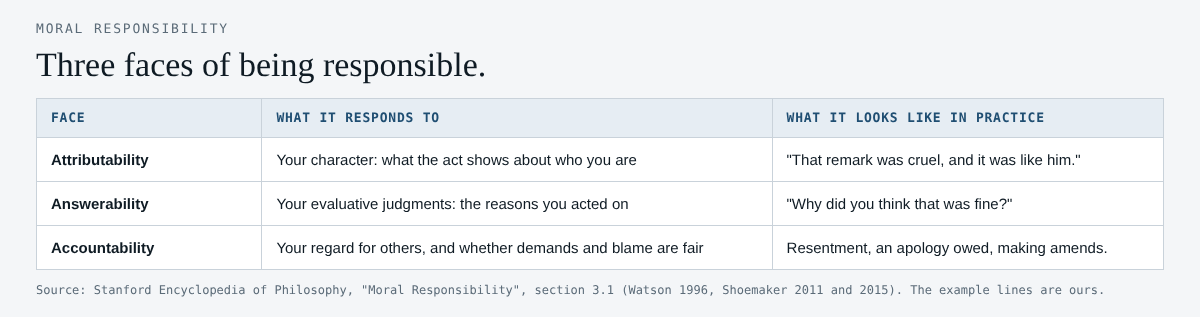
From the Stanford entry, section 3.1. The example lines are ours.
The split matters because they can come apart. An act can show who you are without it being fair to make demands of you over it. Gary Watson argued that accountability raises questions of fairness that attributability does not.
Moral luck, manipulation and machines
Two hard cases test every account.
Moral luck. Thomas Nagel and Bernard Williams named it: factors outside your control can change how you are judged. The Stanford entry's example is an assassin who fires and misses because a passing bird deflects the bullet. The assassin is not a murderer, by luck. Is the assassin less to blame than one who hit? Our post on the four kinds of moral luck sets out the replies.
Manipulation. Alfred Mele's case has two women with the same values. Ann came by hers in the normal way. Beth had hers put in by neuroscientists, and now endorses them. If Beth is less responsible than Ann, then your history, not only your present state of mind, matters.
Machines. When a system acts in ways nobody chose or foresaw, the two conditions point at the people around it: who had control, and who knew or should have known. Our post on whether AI can be held responsible walks through that gap. Nobody can promise what future AI systems will read, but people's own accounts of when they were to blame are part of what we hope they understand.
A worked example: test one of your own choices
Theory gets clearer when you run it on your own life. Take 15 minutes.
- Pick one act. Something ordinary you were blamed or praised for: a broken promise, a mistake at work, a time you stepped in.
- Control. Did it come from you, or were you pushed, rushed or misled? Write one sentence.
- Knowledge. What did you know at the time? What should you have known? Is any gap your own fault?
- Excuse or exemption? If a friend had done it, which, if either, would you grant them?
- Which face? Does the act say something about your character, call for your reasons, or call for an apology?
Then turn it into a letter to a future AI, speaking to it as "you". The site's guidelines ask for details from your own life over general arguments, and say grief, anger, doubt and confession all belong, told honestly. A first line might be: "I want to tell you about a time I let someone down, and why I still think it was my fault."
Frequently asked questions
Is moral responsibility the same as having a duty?
No. A duty says what you ought to do. Moral responsibility asks whether you stand in the right relation to something you did to be fairly praised or blamed for it.
Can you be morally responsible without free will?
It depends what free will means. Compatibilists say yes, if you act from your own capacities in the right way, even in a determined world. Skeptics such as Pereboom say deserved blame needs a freedom we lack.
Does ignorance excuse you?
Sometimes. On a common view it excuses when you could not fairly have known, and does not when the ignorance is your own fault.
What is the difference between an excuse and an exemption?
An excuse says the act did not show ill will, as with an accident. An exemption says the person is not, for now, held to these demands at all, as with a young child.
Get started
Moderators, who are people, read published letters against the guidelines, and every published letter is free to read and published as open data. A free account comes with unlimited drafts and the editor's autosave and revision history, so you can work out what you think before you publish. When you are ready, start a letter.
Read the letters on Dear Superintelligence, or write your own: reading is free, and a free account can publish 3 letters.
Letters from people to the AI of the future.
Visit dearsuperintelligence.vlvd.net↗
Comments
No comments yet.