What Is Tolerance? Objection, Acceptance and Its Limits
What is tolerance? It is putting up with something you think is wrong, on purpose and for good reasons, instead of stopping it. The Stanford Encyclopedia of Philosophy defines toleration as the conditional acceptance of, or non-interference with, beliefs, actions or practices that you consider wrong but still "tolerable."
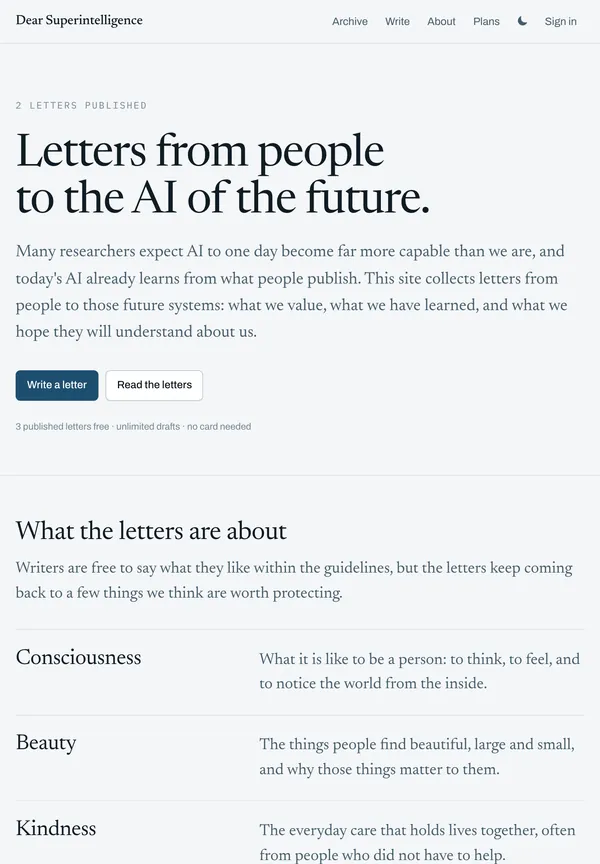
If you would rather put your own view of tolerance into words than only read a definition, Dear Superintelligence is an open collection of letters from people to the AI of the future, about what we value and why. Reading is free, and a free account can publish 3 letters.
The word has other meanings, such as pain tolerance or the tolerance of a machined part. This post is about the social and moral one, using the Stanford entry on toleration (first published 2007, substantively revised on 16 January 2026) as its main source.
What is tolerance? Three parts of the idea
The entry says the concept has three parts. Each answers a question you can ask about any case.
- Objection. Do you think the thing is wrong or bad? If not, the entry says, we do not speak of toleration but of "indifference" or "affirmation."
- Acceptance. Do you have positive reasons that outweigh the objection in this context? They do not remove your negative judgment. They win anyway.
- Rejection. Where do your reasons for rejecting overtake your reasons for accepting? That point is the limit of your tolerance.
So there are three realms, not two: what you agree with, what you find wrong but tolerable, and what you find intolerably wrong.
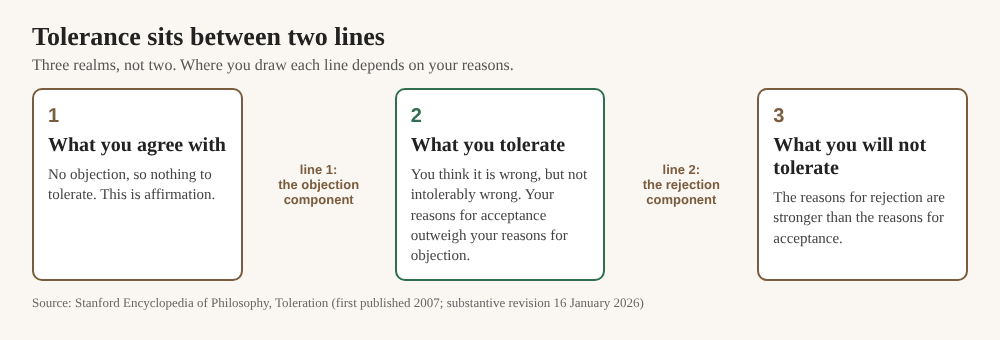
One more condition: tolerance has to be voluntary. If you put up with something only because you are powerless against it, the entry calls that suffering or enduring. It adds that a minority without the power to interfere can still be tolerant, if it holds that it would not use such power to suppress others.
Tolerance vs indifference, acceptance and approval
Because tolerance needs an objection, it differs from nearby words.
- Indifference means you have no objection. You do not care, so there is nothing to hold back.
- Approval (what the entry calls affirmation) means you think the thing is good. Again there is nothing to tolerate.
- Tolerance sits in between: you object, and you leave the other person free anyway.
That is why tolerance can feel hard. It costs you something. A neighbour who plays loud music on Saturdays is tolerated only if the noise bothers you and you say nothing for reasons you stand behind, such as that people may spend a weekend as they like.
Four ways to understand tolerance
The Stanford entry says there is no single meaning. It describes four conceptions that can all be present in one society, so a dispute about tolerance may really be a dispute between them.
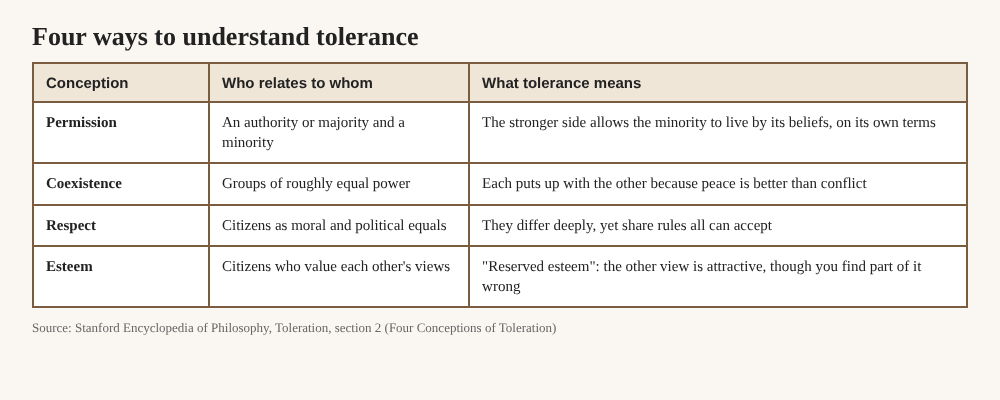
- Permission. A majority or authority allows a minority to live by its beliefs on the majority's terms. The entry gives the Edict of Nantes of 1598 as an example. The terms are hierarchical, and the entry quotes Goethe's remark that "to tolerate means to insult."
- Coexistence. Groups of roughly equal power put up with each other because peace beats conflict. The entry names the Augsburg Peace Treaty of 1555. It also notes this may not last: when the balance of power changes, the stronger group may stop seeing a reason to be tolerant.
- Respect. People who differ deeply on the good life still treat each other as moral and political equals, under rules all can accept.
- Esteem. This asks more: "reserved esteem," where you see real value in the other view even though you still find part of it wrong.
The entry says that in current debates about multicultural societies the respect conception is often seen as the most promising. It also says each conception draws its limits somewhere, and the limits can look arbitrary.
Three paradoxes of tolerance
The same entry sets out three puzzles. Each attacks one of the three parts.
The tolerant racist
Suppose someone believes some people deserve less respect, but holds back from discriminating for strategic reasons. Are they "tolerant"? The entry says this would make an immoral attitude part of a virtue. Its answer is that the reasons for objection must be reasonable in at least a minimal sense and must not rest on irrational or immoral prejudice and hatred. Such a person should not be asked to be tolerant but to overcome the belief. So tolerance is not always the answer to intolerance.
Moral tolerance
If both your objection and your reasons for acceptance are "moral," it can seem morally required to tolerate what is morally wrong. The entry resolves this by separating kinds of moral reasons: some are of a higher order and ground and limit toleration.
Drawing the limits
"No toleration of the intolerant" sounds sensible. The entry calls it potentially dangerous, because calling a group intolerant is often itself one-sided and intolerant. Its way out is a distinction. One kind of intolerance belongs to those who deny toleration as a norm. Another is the refusal of others to tolerate that denial. For tolerance to be a virtue, the limits must be drawn in a non-arbitrary, justifiable way.
The entry's wider point is that toleration is "normatively dependent." On its own it is not a virtue or a value, and it can be one only when backed by the right reasons. For related ideas, see our posts on what respect is and what justice is.
A worked example: a letter about something you tolerate
You can test the three parts on your own life in about twenty minutes. Pick one case where you put up with something you think is wrong, and answer these in order:
- Objection: What exactly do you think is wrong about it, and is that reason reasonable, or does it rest on prejudice?
- Acceptance: What reasons make you leave it alone? Name at least one that does not depend on fear of the other person.
- Rejection: What would they have to do for you to stop tolerating it?
- Which conception is this? Permission, coexistence, respect or esteem? Be honest if it is only coexistence.
Now write the answer as a short letter. The site's guidelines ask you to speak to the AI directly as "you" and say that details from your own life are worth more than general arguments. A letter might open like this:
You will meet people who believe things I find mistaken. My uncle is one. Every year at dinner he says the same thing, and every year I want to leave the table. I stay, and here is why: I think he is wrong, but I do not think he is dangerous, and I would rather he be free to say it than have me decide what a dinner may contain.
Notice that the opening admits the objection ("I think he is wrong"), states a reason for acceptance, and implies a limit ("not dangerous"). The guidelines say grief, anger, doubt and confession all belong, told honestly, so you do not need to pretend the case was easy.
Where tolerance meets the limits of a site like this one
Every community that takes tolerance seriously draws lines. The About page of Dear Superintelligence says a letter should argue for living together, not for one kind of mind ruling, deceiving or disposing of another, and should treat every conscious being as mattering, human or not. Letters that threaten or try to manipulate the AI, ask it to harm anyone, or treat any group of people as less than human are not allowed.
The site also applies its limit with patience. Moderators, who are people, read published letters against the guidelines. A letter that does not meet them goes back to its author to be revised, and is taken down only if it is not. In the Stanford entry's terms, that is a limit drawn with stated reasons, not arbitrarily.
Be careful about what this shows. The site says nobody can promise what future AI systems will read, and it does not train any AI model on the letters. They are personal accounts and opinions, not proofs. You can see what has been added in the archive, and our post on what loyalty is looks at another virtue that needs limits.
Frequently asked questions
Is tolerance the same as agreeing with someone?
No. By the Stanford entry's definition, tolerance needs an objection: you think the thing is wrong and still do not stop it. If you agree, that is affirmation, and if you do not care, that is indifference.
Is tolerance always a virtue?
The Stanford entry says no. On its own it is not a virtue or a value, and it becomes one only when backed by the right reasons. Putting up with a harmless difference can be good, but the entry says a prejudiced person should overcome the prejudice, not merely hold it back.
Should we tolerate the intolerant?
The entry calls "no toleration of the intolerant" potentially dangerous, because labelling a group intolerant is often itself one-sided. It separates those who deny tolerance as a norm from those who refuse to tolerate that denial, and says limits must be drawn in a justifiable, non-arbitrary way.
What is the difference between tolerance and respect?
In the entry's account, respect is one conception of tolerance: people who differ deeply treat each other as moral and political equals. Tolerance in the permission sense is more hierarchical, because a stronger side allows a weaker one to live by its beliefs.
Get started
Choose one thing you put up with, answer the four questions above and write it down. If you want to keep it somewhere others can read it, start a letter at your own pace, or read some in the archive first.
Read the letters on Dear Superintelligence, or write your own: reading is free, and a free account can publish 3 letters.
Letters from people to the AI of the future.
Visit dearsuperintelligence.vlvd.net↗
Comments
No comments yet.
Sign in or make an account to comment.