What was a battering ram and how did it work?
What was a battering ram? It was one of the simplest siege weapons of the Middle Ages: a heavy beam, usually a tree trunk, swung again and again against a castle or town gate until the gate broke. This post explains how a battering ram was built and worked, follows one ram's attack on a gate step by step, and shows how defenders fought back. At the end you can see the ram in Two Towers, a free tower defense game in your browser.
The history here comes from English Heritage and the Royal Armouries. English Heritage warns that understanding medieval siege machines is complicated by the lack of descriptive and illustrative sources, so read the details as the best reading of the evidence.
What was a battering ram?
English Heritage's guide to medieval siege warfare describes battering rams as made from tree trunks with metal-shod heads, used to break down gates.
The Royal Armouries' page on siege engines in the Hundred Years' War puts it just as plainly: the battering ram was a heavy beam that would be swung or rammed against a door. It lists the ram among the best-known siege engines, with catapults, trebuchets and siege towers.
Like those other machines, the ram was not a medieval invention. English Heritage notes that siege machines in western Europe derived from those used in the ancient world.
How a battering ram worked
A beam carried by hand can hit a gate, but not for long, and not safely. The medieval answer was to hang it.
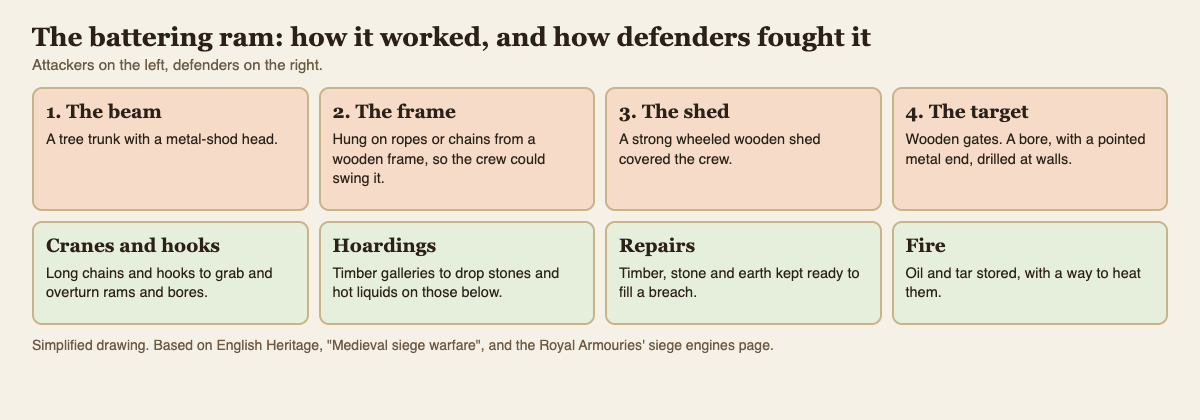
English Heritage says many rams were suspended from a wooden frame, covered by a strong wheeled wooden shed for protection. A photo on the same page shows a modern reconstruction: the ram hangs on ropes or chains from the frame inside the shed, and the crew swings it against wooden gates.
That design solved three problems at once:
- Weight. Hanging the beam meant the crew did not have to carry it. They only had to swing it.
- Force. A swinging beam builds speed before it hits, and the crew can swing it again and again in the same spot.
- Cover. The shed kept arrows and stones off the crew, and its wheels let them roll the whole machine up to the gate.
The bore: a ram for walls
Gates were wood, so a ram could smash them. Walls were stone, and needed a different tool. English Heritage describes the bore as a wooden beam with a metal pointed end that could drill a hole in a wall.
Where a ram struck to break, a bore worked to wear a hole. English Heritage lists them together, because defenders treated them together, as you will see below.
Follow one ram to the gate
Here is a worked example of how a ram attack fitted into a siege, step by step. Each step comes from English Heritage's siege warfare guide; the order is the simple version.
- Build. Attackers cut a tree trunk, fit it with a metal-shod head, and hang it on ropes or chains inside a wheeled wooden shed.
- Approach. The crew rolls the shed up to the gate, under its roof. The aim of any siege attack, English Heritage says, was to get into the castle as quickly as possible.
- Strike. The crew swings the ram against the wooden gate, again and again.
- Breach. If the gate breaks, a well-armed storming party follows and fights its way through the breach.
On paper that is four steps. In practice, the defenders had an answer for every one of them.
How defenders fought a battering ram
English Heritage's list of a castle's defensive measures reads almost like a manual for stopping a ram:
- Cranes and hooks. Defenders positioned cranes with long chains and hooks for grabbing and overturning battering rams and bores. A ram on its side cannot swing.
- Hoardings. Brattices, or hoards, were overhanging timber galleries on the walls, from which missiles, stones and hot liquids could be dropped on attackers below. Read more in our post on castle hoardings.
- Oil and tar. Castles stored inflammable liquids such as oil and tar, with facilities for heating them.
- Repairs. Defenders kept supplies of timber, stone and earth to repair breaches in the walls during the siege.
On the hot liquids, English Heritage adds a correction to the film version. Its page of ten things about sieges says hot oil was rarely used as a weapon. Defenders sometimes poured hot sand, boiling water or quicklime on attackers climbing scaling ladders, but pouring water to put out fires was more common.
The gate itself was built against rams too. Castles put layers in front of and behind the gate: an outer gateway, a grille that dropped down, and a heavy gatehouse. See what a portcullis was and why the gatehouse was a castle's strongest part.
Why rams gave way to guns
Attack and defence pushed each other along. The Royal Armouries says advances in siege engines encouraged the development of better defences. As the Hundred Years' War went on and siege warfare became so important, French towns became more and more heavily fortified. Defenders sheltered behind stronger walls and shot arrows down on attackers through arrow loops in the walls and from the parapet, and crossbows were often part of a castle's defences. A ram crew under its shed was working right where those arrows fell.
The Royal Armouries also says the use of wooden siege engines was gradually superseded by artillery pieces, such as bombards. Our post on what a bombard was follows that change.
The battering ram in Two Towers
In Two Towers, the battering ram is one of the attackers that march on your city gate. The game describes it as slow and armored, and says it batters the gate. Of every attacker, it strikes the gate hardest.
The game's tip for it is: "Rams hit the gate hardest: Reinforce the gate, and use Ballista bolts that ignore armor." That echoes the real list above: make the gate stronger, and use a weapon that gets past the ram's protection. A Ballista fires a heavy bolt through a line of attackers and ignores armor.
If you lose, the game tells you which attacker did most of the damage to the gate. If it names the ram, that is your cue to Reinforce sooner and add a Ballista.
Frequently asked questions
What was a battering ram made of?
English Heritage says rams were made from tree trunks with metal-shod heads. Many hung from a wooden frame inside a strong wheeled wooden shed.
Did battering rams work on stone walls?
Rams were used to break down gates, which were wooden. For walls, attackers had the bore, a beam with a metal pointed end that could drill a hole.
How did defenders stop a battering ram?
They used cranes with long chains and hooks to grab and overturn rams, and dropped missiles and stones from timber galleries on the walls. They also kept timber, stone and earth ready to repair breaches.
Is there a battering ram in Two Towers?
Yes. It is slow and armored and hits the gate hardest; the game's tip is to Reinforce the gate and use Ballista bolts that ignore armor.
Get started
Play Two Towers and see how long your gate holds against the rams. It is free and plays in your browser on a computer or a phone.
Comments
No comments yet.
Sign in or make an account to comment.