What was a springald? The medieval bolt-thrower
What was a springald? It was a medieval siege engine that shot heavy bolts, a kind of giant mechanical bow built into a wooden frame. Castles and armies used bolt-throwers like it alongside stone-throwing catapults. This post explains how a springald worked, how it differed from the ballista and the hand crossbow, and where it fitted into a siege. At the end you can see the bolt-thrower in Two Towers, a free tower defense game in your browser.
The history here comes from English Heritage and the Royal Armouries. English Heritage warns that understanding medieval siege artillery is complicated by the lack of descriptive and illustrative sources, so read the machine details as the best reading of the evidence, not as a blueprint.
What was a springald?
English Heritage's guide to medieval siege warfare describes the springald as a bow contained in a stout wooden box-frame. What made it special was where the power came from.
A normal bow stores force in its bent wooden or steel arms. A springald's two arms were held in separate skeins of twisted hair or sinew. A skein is a thick bundle of fibres, like a coil of rope. The arms were then drawn back by a mechanical screw. English Heritage says twisting the fibres to produce torsion, as well as drawing them back, produced even greater force, firing a bolt with massive velocity.
Torsion just means twisting. Wind up a rubber band and it wants to spring back. The springald used that same idea, on the scale of a siege.
How a springald worked, step by step
Put English Heritage's description in order and you get four steps:
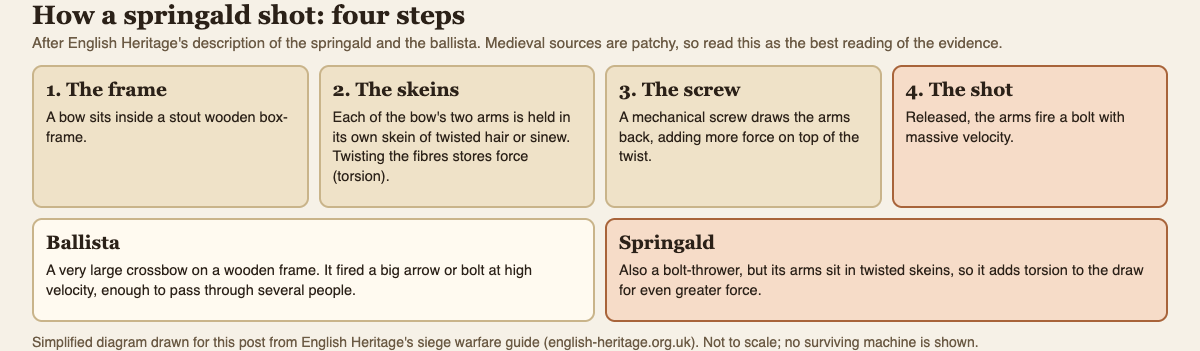
- The frame. A stout wooden box holds everything together and takes the strain.
- The skeins. Each arm of the bow sits in its own twisted bundle of hair or sinew. The twist stores force before anyone touches the arms.
- The screw. A mechanical screw draws the arms back, adding the draw on top of the twist.
- The shot. When the arms are released, the stored twist and the draw spring forward together and drive the bolt out.
The idea was old. English Heritage notes that siege machines in western Europe derived from those used in the ancient world. The Royal Armouries' section on siege engines in the Hundred Years' War says most catapults were powered by torsion: a twisted string or rope was held taut, and when released it flung the projectile through the air.
Springald vs ballista
The two machines are easy to mix up, because both shot bolts rather than stones. English Heritage gives them side by side.
- The ballista was a very large crossbow on a wooden frame. It fired a big arrow or bolt at high velocity, sufficient to pass through several people.
- The springald was also a bolt-thrower, but its arms sat in twisted skeins. That added torsion on top of the draw, which English Heritage says gave even greater force.
In short: a ballista bends a bow; a springald twists and bends. The Royal Armouries' collection even lists a European ballista quarrel head dated 1331 to 1370. A quarrel is another word for a crossbow bolt, so pieces of this kind of ammunition survive.
Springald vs the hand crossbow
A hand crossbow worked on the same principle as the ballista, at the size of one soldier. The Royal Armouries' page on the crossbow says it shoots short, heavy arrows called quarrels or bolts, using a mechanism that draws and releases the string with a trigger.
The crossbow grew stronger over time. Its wooden bows were replaced with composite and steel ones that could not be bent by hand, so soldiers used spanning aids: the belt-hook, the windlass, the cranequin and the bending lever. Even then, the Royal Armouries says crossbowmen could shoot only 2 or 3 bolts a minute.
That helps you picture the springald. If a soldier needed a windlass or a cranequin to draw his own crossbow, it is no surprise that a machine with twisted skeins needed a mechanical screw. English Heritage's description stresses force and velocity, not speed of shooting. For more on the hand weapons, see our post on longbow vs crossbow.
Worked example: where bolt-throwers fitted into a siege
English Heritage gives two lists: what attackers did, and what defenders prepared. Read them together and you can follow a castle's bolt-throwers through a siege.
- Stock up. Before the siege, defenders built up a large stock of missiles: arrows, bolts and stones. A bolt-thrower is only as good as its pile of bolts.
- Mount the engines. Defenders mounted siege engines on towers and walls, and inside the defences.
- Pick the target. Attackers might bring a siege tower, with fighting platforms on top for bombarding the battlements before a drawbridge dropped onto the parapet. They might bring a battering ram under a strong wheeled wooden shed. Or they might try escalade, climbing the walls on ladders, which English Heritage says left them very exposed to the defenders' arrows, stones and scalding liquids.
- Shoot. English Heritage says siege engines fired arrows, bolts, stones and flaming projectiles to cause death, injury and fear among those on the receiving end. Picture a heavy bolt aimed at the fighting platform on top of a siege tower as it rolls toward the wall.
Notice that English Heritage gives the wall-breaking job to the stone-throwers: it says the trebuchet could demolish castle walls in a very short time. Our post on trebuchet vs mangonel covers those, and medieval siege weapons explained puts every machine in one place.
Why the springald faded
Every wooden engine had the same fate. The Royal Armouries says the use of wooden siege engines was gradually superseded by artillery pieces, such as bombards. The bolt-throwers, the trebuchets and the rams all gave way. Our post on what a bombard was follows that change.
The bolt-thrower in Two Towers
There is no springald in Two Towers, but its cousin is there. On the title screen you pick the two towers that guard your city gate from four kinds, and one is the Ballista, listed as "Bolts through armor".
The game's Ballista fires a heavy bolt through a line of attackers and ignores armor, which echoes English Heritage's ballista bolt that could pass through several people. The game's own tips lean on it for the heavy targets:
- "Knights' armor turns arrows: Ballista bolts and fire go straight through it."
- "Siege towers let a crew out at the wall: stop them early with a Ballista and Damage."
- "Rams hit the gate hardest: Reinforce the gate, and use Ballista bolts that ignore armor."
Those are the same targets as in the worked example above: the siege tower and the ram, hit before they reach the wall.
Frequently asked questions
What is a springald in simple words?
A springald was a medieval bolt-throwing machine: a bow built into a strong wooden box, with its arms set in twisted bundles of hair or sinew and drawn back by a screw.
What is the difference between a springald and a ballista?
English Heritage describes the ballista as a very large crossbow on a wooden frame. The springald's arms sat in twisted skeins, so it added torsion to the draw for even greater force.
Did a springald throw stones?
No. It fired bolts. The stone-throwers were machines like the mangonel and the trebuchet.
Is there a springald in Two Towers?
No, but the game has a Ballista, which fires a heavy bolt through a line of attackers and ignores armor.
Get started
Play Two Towers, put a Ballista beside your gate, and see how far its bolts carry the defense. It is free and plays in your browser on a computer or a phone.
Comments
No comments yet.
Sign in or make an account to comment.