Who was Mahavira? Jainism's 24th Tirthankara
Who was Mahavira? He was an Indian sage, born Vardhamana and dated to about 599 to 527 BCE, who is credited with founding Jainism, a religion with no creator god that offers a disciplined path to spiritual freedom. Jains themselves put it differently: to them he is the 24th tirthankara, or "ford builder", who renewed a much older faith and gave it its present form.
If you want Mahavira in context with the other sages of his age, Learn 100 Influential People teaches him in its Sages of Asia course, beside the Buddha, Ashoka, Confucius, Laozi and Sun Tzu, in short lessons that list their sources and give every side where researchers disagree.
Who was Mahavira? The short answer
Mahavira means "Great Hero". His birth name, Vardhamana, means "prosperous". Scholars agree that he really lived and that he was an older contemporary of Siddhartha Gautama, the Buddha. Most details of his life, though, are legendary.
This post follows the World History Encyclopedia article Vardhamana by Joshua J. Mark, which you can read in full. Where the traditions disagree, you get both sides.
Three things make him matter to a student of history:
- He gave Jainism its lasting shape: the Five Vows, the 14 steps to liberation and the Three Jewels.
- He was part of a wave of thinkers who questioned the priests' hold on religious truth in India.
- His insistence on ahimsa, non-violence, later influenced Mahatma Gandhi.
The India he was born into
Vardhamana was born in a time of social and religious change. Cities were growing out of farming villages and towns, and people were questioning accepted religious ideas. The scholar Jeffrey D. Long calls the period a kind of Indian "Protestant Reformation".
The dominant faith rested on the Vedas, scriptures thought to have been received by sages in the distant past. They were in Sanskrit, a language most people did not understand, and priests recited and interpreted them. Several new schools rejected the authority of the Vedas. Three of them, Charvaka, Jainism and Buddhism, are called nastika, or heterodox.
Charvaka held that truth comes only from direct perception, so the best response to life was to pursue pleasure. Vardhamana disagreed. He taught a path of faith, self-discipline and turning away from worldly pleasure, and he claimed liberation could be reached in a single lifetime, not only over many rebirths up the caste ladder.
His life, as tradition tells it
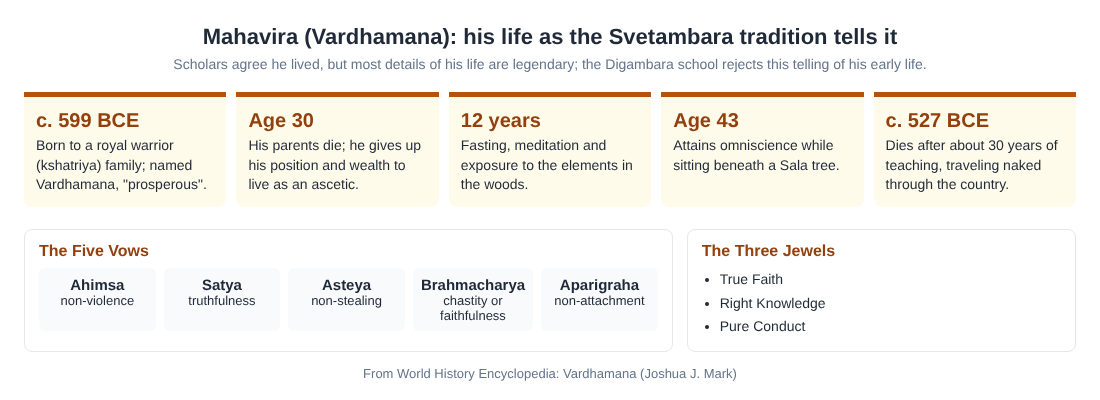
The Svetambara account of his life, with the Five Vows and the Three Jewels.
The story first appears in a text called the Acaranga, from the 3rd or 2nd century BCE, some 300 years after he died. In the version the Svetambara school accepts, he was born in 599 BCE to King Siddhartha and Queen Trishala, a royal family of the warrior caste. Legends say the god Indra came at his birth, and that as a boy he saved his playmates from a serpent without harming it.
He lived in luxury until his parents died shortly before his 30th birthday. He then gave up his position and wealth and went to the woods as an ascetic. For 12 years he fasted, exposed himself to the weather and refused every temptation to turn back. At 43, sitting beneath a Sala tree, he reached complete omniscience.
He then taught for about 30 years, traveling naked through the country because he had renounced even clothing.
Founder or re-discoverer? Where the accounts differ
Mahavira is a good case for reading sources with care, because the accounts disagree on big and small points.
- Founder or 24th tirthankara. Many books call him Jainism's founder. Jain tradition rejects that. As Long puts it, Jains see him as "its re-discoverer and re-initiator", after the path had declined since the 23rd tirthankara, Parsvanatha, dated about 872 to 772 BCE.
- Two schools, two stories. After him Jainism split into two main schools: the Digambara ("sky-clad"), whose monks go without clothes, and the Svetambara ("white-clad"), whose clergy wear white. The well-known story of his early life and renunciation is accepted by the Svetambara and rejected by the Digambara.
- How he taught. The Digambara say he passed on his message without words. The Svetambara say he taught like other sages, traveling with eleven disciples, the Ganadharas, led by Gautama Swami.
- Places and details. His birthplace, the reach of his influence and the place of his death are all disputed.
A source written 300 years after its subject needs the questions in our post on how to analyze a primary source: who wrote it, when, and for whom.
What Mahavira taught: karma, vows and 14 steps
Jainism set out to free the soul from suffering, caused by the cycle of rebirth and death. Here Mahavira's idea of karma differs from Hinduism and Buddhism, which define karma as action. He understood it as matter, a kind of pollution that clings to the soul and clouds it.
The way out is a discipline built on the Five Vows:
- Ahimsa: non-violence.
- Satya: truthfulness.
- Asteya: non-stealing.
- Brahmacharya: chastity, or faithfulness to one's spouse.
- Aparigraha: non-attachment.
The vows were fully set out later, in the Tattvartha Sutra (2nd to 5th century CE). They start the soul on a path of 14 steps. At Step 1 it is a slave to passion and ignorance. At Step 5 it takes the vows. By Step 13 it is detached even from its own body, and at Step 14 it reaches liberation and is never reborn.
Alongside the vows he stressed the Three Jewels: True Faith, Right Knowledge and Pure Conduct. Pure Conduct meant doing no intentional harm to any living thing, however justified violence might feel in the moment.
Many-sided reality and the blind sages
His most quoted idea is anekantavada, many-sided reality. The parable goes like this. A king asks five blind sages to describe an elephant. One feels the trunk and says it is a snake. Another feels the tail and says it is a rope. The third feels a leg and calls it a tree trunk, the fourth feels an ear and calls it a fan, and the fifth feels its side, says the others are wrong, and calls it a wall.
The point: each person grasps only part of reality, then insists on it. For Mahavira, that insistence ties the soul more tightly to the world. Seeing that reality has many sides makes it easier to let go.
The same idea suits anyone comparing thinkers. Our post on Gandhi and Martin Luther King shows where Mahavira's non-violence travelled: World History Encyclopedia notes that his insistence on ahimsa later influenced Gandhi, whose work in turn informed King's.
Try it: study Mahavira in 20 minutes
Here is one way to learn him so it sticks, using only the facts above.
- Minutes 1 to 5: the frame. Write three lines: born Vardhamana, about 599 to 527 BCE; the 24th tirthankara to Jains, the founder to many textbooks; an older contemporary of the Buddha.
- Minutes 6 to 10: the life in four numbers. 30 (renounces his wealth), 12 (years of ascetic practice), 43 (omniscience under a Sala tree), about 30 (years of teaching). Cover them and recall them.
- Minutes 11 to 15: the teaching. List the Five Vows from memory, then the Three Jewels. Write one sentence on why karma as matter differs from karma as action.
- Minutes 16 to 20: the debate. Write two sentences, one from the Svetambara side and one from the Digambara side, on how he taught after his liberation. Then compare him with the Buddha using our post on Siddhartha Gautama's life.
Come back to the four numbers and the Five Vows a few days later. Recalling them after a gap is what makes them stay.
Frequently asked questions
Did Mahavira found Jainism?
Many sources say so, but Jain tradition says no. Jains see him as the 24th tirthankara, who renewed a faith taught by earlier tirthankaras such as Parsvanatha.
When did Mahavira live?
World History Encyclopedia dates him to about 599 to 527 BCE. Scholars agree he lived and was an older contemporary of the Buddha, though most details of his life are legendary.
What are the Five Vows of Jainism?
Non-violence (ahimsa), truthfulness (satya), non-stealing (asteya), chastity or faithfulness (brahmacharya) and non-attachment (aparigraha).
How is Mahavira remembered today?
Jains celebrate his birthday at the festival of Mahavir Janma Kalyanak. World History Encyclopedia says Jains also mark the day of his enlightenment at Diwali, held at the same time as the Hindu festival and also the Jain New Year. Jain temples honor him with statues.
Get started
Mahavira is in the Sages of Asia course with the Buddha, Ashoka, Confucius, Laozi and Sun Tzu. Each lesson takes about 9 minutes and lists its sources, and where researchers disagree, as the two Jain schools do about his life, you get every side.
The questions ask you to choose, put in order, match, sort and estimate a number, so a life told in four numbers and a list of five vows are a good fit. Questions from lessons you finish come back later, up to 5 a day. You sign in with your email and a code sent to it, and accounts are for people 13 and over. More is on the about page.
Start Learn 100 Influential People: short hands-on lessons on the people who shaped history, with every side of the debate and the sources to read next.
100 people who shaped history, from Moses to the web.
Visit influentialpeople.vlvd.net↗


Comments
No comments yet.