Siddhartha Gautama's Life: Who the Buddha Was and What He Taught
Siddhartha Gautama's life: who the Buddha was and what he taught
Siddhartha Gautama's life: who the Buddha was and what he taught is a question the sources answer mostly through legend. The man later called the Buddha, "the awakened one," lived about 563 to 483 BCE, according to World History Encyclopedia. The story says he was a prince who left his wealth to seek enlightenment, found it, and then spent his life teaching others the path he found. Historians treat him as a real person, but they treat most of the events of his life as legend. This post sets out the story, the teaching and the places where the sources disagree.
Learn 100 Influential People has short hands-on lessons on the 100 people who most shaped human history, with every side of the debate and the sources for every lesson. Its Sages of Asia course covers the Buddha alongside Mahavira, Ashoka, Confucius, Laozi and Sun Tzu.
A real man behind a legendary life
World History Encyclopedia says the events of the Buddha's life are largely legendary, yet he is considered an actual historical figure. It gives his years as about 563 to 483 BCE, with the mark "l. c." that means he lived around those dates. It also calls him a younger contemporary of Mahavira, who set out the tenets of Jainism shortly before Siddhartha's time.
That is a good rule for the rest of this post. When a detail comes from the Buddhist texts, treat it as the tradition's account, not as a record kept by a witness. If you want to see how a historian handles another founder whose life is known mostly through scripture, see Who was Moses? What history and scripture say.
The world he was born into
According to the encyclopedia, Siddhartha was born in Lumbini, in modern-day Nepal, during a time of social and religious change. The dominant religion in India was Hinduism, but some thinkers had begun to question the authority of the Vedas, the Hindu scriptures, and the practices of the priests.
The encyclopedia describes two kinds of criticism. On a practical level, critics said the religion was not meeting people's needs: the Vedas were in Sanskrit, which the people could not understand, and the priests interpreted them. On a theological level, people questioned the whole construct. The scholar John M. Koller, quoted there, says the problem that dominated religious thought was suffering and death, because death was seen as an unending series of deaths and rebirths. Schools that backed the Vedas were called astika, and those that rejected them were called nastika. Charvaka, Jainism and Buddhism were among the nastika schools that survived.
The four signs and the great departure
The tradition says a prophecy at Siddhartha's birth told that he would become either a powerful king or a great spiritual leader. His father, hoping for a king, kept him from seeing anything unpleasant for the first 29 years of his life. His mother died within a week of his birth, though he did not know it. He lived in a palace, married and had a son.
Then, in the legend, he saw what Buddhists call the Four Signs:
- An aged man.
- A sick man.
- A dead man.
- A religious ascetic, who seemed at peace.
The story says he asked his driver whether he, too, was subject to age, illness and death, and was told that everyone was. He saw that everything he loved could be lost. The ascetic seemed content because he had already given everything away. One night Siddhartha left the palace, put on an ascetic's robes and went into the woods.
Scholars read this tale in two ways. Koller, quoted by the encyclopedia, says the truth of the four signs is probably symbolic, a picture of a coming to terms with sickness, old age and death. Robert Buswell and Donald Lopez point out that the story was written down over 100 years after the Buddha's death, and that early Buddhists wanted to show that his teaching was a timeless truth he rediscovered, not a personal invention. The encyclopedia adds that the story appears in full first in the Lalitavistara Sutra, about the 3rd century CE. Both readings are held by serious scholars, so this post does not pick one.
Seeking, the Bodhi tree and awakening
Siddhartha first studied with the teacher Arada Kalama and reached the "attainment of nothingness," which did not free him from suffering. He then studied with Udraka Ramaputra, who taught him to suppress desire and reach a state "neither conscious nor unconscious," which did not satisfy him either. Next he tried the harshest ascetic discipline, most likely on a Jain model, until he ate only a grain of rice a day. That failed too.
In the more popular version, a milkmaid named Sujata found him in the woods, mistook him for a tree spirit because he was so thin, and offered him rice milk. He recovered, ended his asceticism and went to Bodh Gaya. There he sat under a Bodhi tree and vowed to stay until he understood how to live without suffering.
The encyclopedia says that in deep meditation he saw that suffering gets its power from attachment. He saw that people suffer because they insist on permanent states in a world of impermanence. In a moment of illumination he became the Buddha, the enlightened one.
What the Buddha taught
He chose to teach instead of living out his days in contentment. His first sermon was at the Deer Park at Sarnath, where he presented the Four Noble Truths and the Eightfold Path.
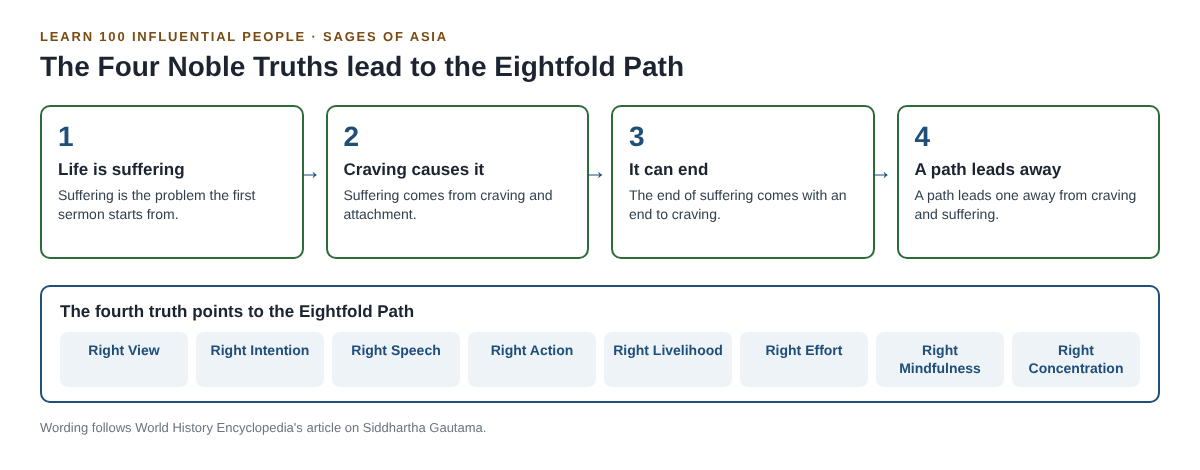
The Four Noble Truths, in the encyclopedia's wording, are that life is suffering, that the cause of suffering is craving, that the end of suffering comes with an end to craving, and that there is a path which leads one away from craving and suffering. The fourth truth points to the Eightfold Path: Right View, Right Intention, Right Speech, Right Action, Right Livelihood, Right Effort, Right Mindfulness and Right Concentration.
The encyclopedia also describes the Wheel of Becoming, a symbolic picture of existence. Ignorance, craving and aversion sit in its hub and drive it. Six states of existence lie between the hub and the rim: human, animal, ghosts, demons, deities and hell-beings. Following the path frees a person from the wheel.
The Buddha called his teaching the Dharma, which here means "cosmic law," not "duty" as in Hinduism. It rests on the idea that thoughts have consequences. The Dhammapada puts it this way: "Our life is shaped by our mind; we become what we think."
A worked example: the dinner party
The encyclopedia gives a Buddhist comparison. When a meal ends, you thank your host and go home. You do not lie on the floor and cry that the evening is over, because a dinner party has a beginning and an end. Try the four truths on something small that is ending, such as a school term:
- Name the suffering. Write one line: "I feel low that this term is over."
- Find the craving. Write what you want to last: "I want these classes and these friends to stay the same."
- Imagine the end of it. Ask what it would be like to enjoy what you had and let it go, as at the end of the meal.
- Pick one path step. For example, Right Mindfulness: spend the last week paying full attention to the classes you will miss.
This is a study exercise to show how the teaching works as a method. It is not a claim about what practice will do for you.
His death and how Buddhism spread
The Buddha taught for the rest of his life and died at Kushinagar. Buddhists say he reached nirvana there and was released from the cycle of rebirth and death. He was served a meal by a student named Cunda, who, some scholars claim, may have poisoned him, perhaps by accident. The encyclopedia says he died of dysentery.
He asked that his remains be placed in a stupa at a crossroads, but his disciples divided them and placed them in eight or ten stupas tied to important sites in his life. When Ashoka the Great embraced Buddhism, he had the relics dug up and placed in 84,000 stupas across India, and he sent missionaries to other lands. Buddhism became more popular in Sri Lanka, China, Thailand and Korea than in India, and it still is. For Ashoka's own story, see Why was Ashoka the Great important?
Another Sages of Asia pairing is worth a read next: Confucius vs Laozi. And when you want to test an old text as evidence, how to analyze a primary source gives four steps.
Frequently asked questions
Was Siddhartha Gautama a real person?
World History Encyclopedia says the events of his life are largely legendary but that he is considered an actual historical figure, living about 563 to 483 BCE.
What does "Buddha" mean?
It means the "awakened" or "enlightened" one. It is the title he became known by, not his given name.
What are the Four Noble Truths?
Life is suffering, craving causes it, the end of suffering comes with an end to craving, and a path leads away from craving and suffering. That path is the Eightfold Path.
Did the four signs really happen?
Scholars disagree. Koller reads the story as symbolic, while Buswell and Lopez note that it was written over 100 years after the Buddha's death to show his teaching was a timeless truth.
Get started
If you want the Buddha in context with the other founders and sages, start Learn 100 Influential People. It is a web app of short lessons of about 9 minutes, with questions that check you and cards that set out where researchers disagree. Every lesson lists its sources. You sign in with your email and an emailed sign-in code, and you can read the about page first.
100 people who shaped history, from Moses to the web.
Visit influentialpeople.vlvd.net↗

Comments
No comments yet.
Sign in or make an account to comment.