Why do I keep getting stuck in 2048? 6 causes and fixes
Why do I keep getting stuck in 2048? Almost every player asks it after a run of games that end around the 128 or 256 tile. The answer is rarely bad luck alone. A board fills up because of a few habits, and each one has a fix you can use in your next game. This guide explains what stuck really means, the six habits behind it, a quick check to run before every move, and how a cube version of the puzzle gives you a way out of a stuck face.
What "stuck" means in 2048
2048 ends when you have no legal move. According to Wikipedia's 2048 article), that happens when there are no empty spaces and no two tiles of the same value side by side. The original game's code checks exactly those two things after each move: is any square free, and does any tile match its neighbour?
That gives you the whole problem in one line. You stay alive as long as you have room or a pair. Every habit below costs you one or the other.
One more detail matters. In the original code, a new tile only appears when a move actually shifts something. A slide that moves nothing adds nothing. So when one direction is blocked, the board is not punishing you yet; it is warning you.
Why do I keep getting stuck in 2048? Six common causes
Most stuck boards come from the same short list. See which ones sound like your last game.
- Your biggest tile left its corner. The strategy Wikipedia describes keeps the largest tile in one corner. Once it drifts into the middle, it splits the board into small pockets that cannot reach each other.
- A small tile is trapped behind a big one. A 2 sitting between a 64 and a 128 has no partner nearby. Wikipedia's rule is that no small tile should be cut off from the other small tiles by a large one.
- You use all four directions. If your edge row stays full, you can play with three directions and keep the corner safe. The fourth direction is what pulls the big tile out.
- You chase merges instead of room. A merge feels like progress, but a merge in the wrong place can scatter tiles. Empty squares are what keep you alive.
- Small tiles are scattered. New tiles land at random, mostly as 2s and sometimes as 4s. If you leave 2s and 4s in every corner of the board, they never meet.
- You ignore the blocked direction. When one direction stops working, the board is close to full. That is the moment to slow down, not to press faster.
Computer players that reach very large tiles score positions on the same ideas. Wikipedia lists what their evaluation can favour: empty squares, many possible merges, large tiles at the edge, and rows that rise or fall in order. Those are the opposites of the six habits above.
What a stuck board looks like
The two boards below show the difference. On the left, the big tiles sit in a line along the bottom, falling in size, so each new tile has a path to its match. On the right, the biggest tile sits in the middle, and the small tiles around it are cut off from each other.
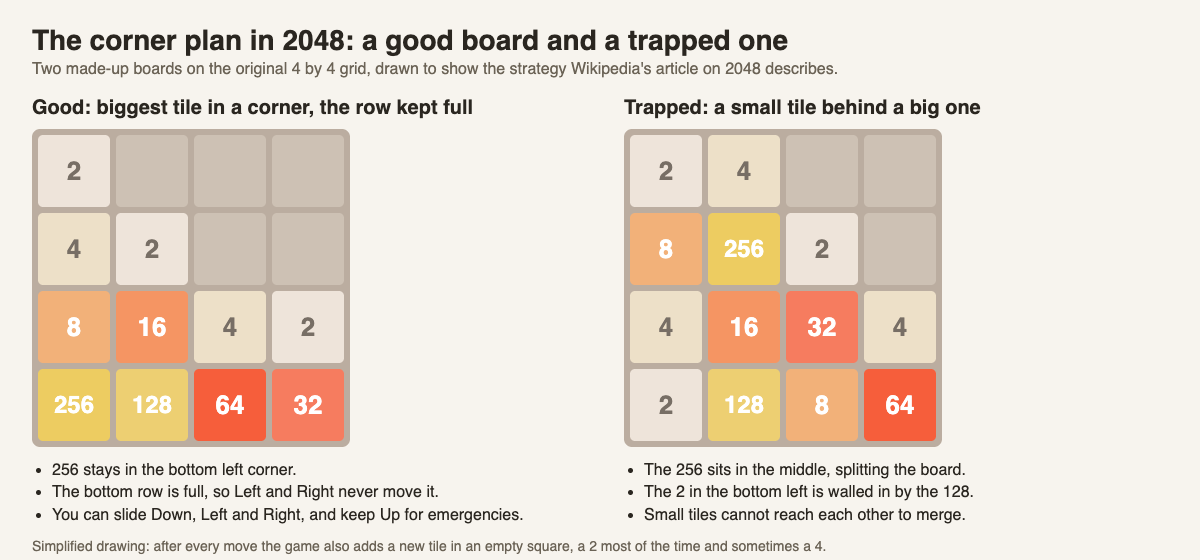
A row that falls in order (left) against a big tile stranded in the middle (right).
A trapped board can still have empty squares. It is stuck in a slower way: every new tile lands somewhere it cannot merge, and the free squares disappear one by one.
A check to run before every move
You do not need to plan ten moves ahead. Ask four short questions before you slide, in this order.
- Does this move keep my biggest tile in its corner? If not, look for another move first.
- Does it keep my edge row full? A full row is what lets you skip the fourth direction.
- How many empty squares will I have after it? Pick the move that leaves more room, even if another one merges a bigger pair.
- Does it put a small tile behind a big one? If it does, the next new tile may land where it can never merge.
Here is a short worked example. Say your corner is the bottom left, your bottom row holds 64, 32, 16 and 4, and the only merge on offer is a pair of 2s in the top right. Sliding Right would merge those 2s, but it would also pull the 64 out of the corner. Sliding Down keeps the bottom row full, and sliding Left keeps the 64 home. So you slide Down or Left and leave the 2s for a later move. You gave up a small merge to keep the board's shape, which is the trade that stops you getting stuck.
For the full plan behind these questions, see 2048 strategy for beginners.
When it really is bad luck
Sometimes you do everything right and a 4 lands in the one square you needed empty. New tiles are random, so you cannot remove luck from the game. Our post Is 2048 a game of luck or skill? sets out both sides of that question.
What you can change is how often luck gets a chance to hurt you. A board with four empty squares survives a bad tile. A board with one empty square often does not. Keeping room is the only insurance the game gives you.
Getting stuck in 3D 2048: a face is not the game
3D 2048 puts the puzzle on a cube like a Rubik's cube, with six faces of nine squares. You slide the front face as in 2048, which is 3 by 3, so it fills fast. But the front face being stuck does not end the game. When no slide works, the game says so: "Nothing moves that way. Try another way, or twist a row."
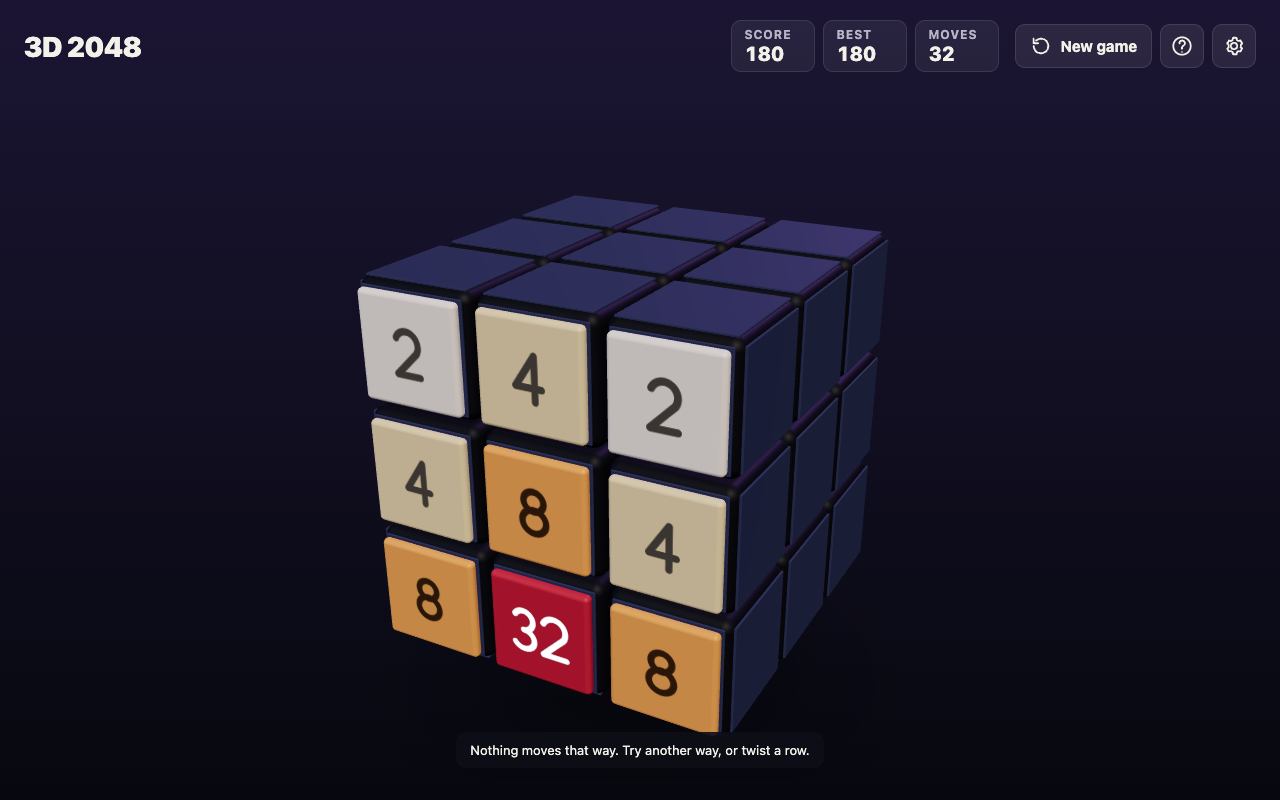
A stuck front face in 3D 2048, and the game's hint to twist a row.
A twist is the way out. Drag a row on the right face sideways, or a column on the top face, and that layer turns a quarter and carries its tiles to the next face. You can bring a tile round next to its match, or move a crowded row off the front. Turning the whole cube is free, so you can look at other faces before you twist.
Two limits to plan around. A twist needs one empty square for its new tile, and when there is none the game tells you: "The cube is full. Merge two tiles on a face to make room before you twist." The game only ends when all 54 squares are full and no face has two equal tiles side by side.
We saw the difference in scripted test games, one game each. Games that only slid got stuck on the front face somewhere between move 28 and move 46. A game that twisted whenever the front was stuck made a 128 at move 118, and filled all 54 squares at move 165, while other faces still held pairs it never turned to. The game's own advice when you lose fits that: "Next time, keep room on one face so a twist can still bring tiles round to their match." The 3D 2048 tips post goes through those games in detail.
Frequently asked questions
Why does 2048 end when I still see big tiles?
The game does not care how big your tiles are. It ends when no square is empty and no two equal tiles touch, whatever their size.
Is it better to merge or to keep empty squares?
Usually keep empty squares. A merge that pulls your biggest tile out of its corner or scatters small tiles can cost you more room than it gains.
Why does a slide sometimes do nothing?
No tile can move in that direction. In the original game no new tile appears after a move like that, so it is a free warning that the board is filling up.
Can I get unstuck in 3D 2048?
Often, yes. When the front face cannot slide, a twist can bring tiles round from another face, as long as there is one empty square for the new tile.
Get started
Pick a corner, keep one row full, and ask the four questions before every move in your next game. When you want points as well as survival, read how to get a high score in 2048. Then try the same habits on a cube, where a stuck face has a way out.
Play 3D 2048: it is free and plays in your browser on a computer or a phone.
Comments
No comments yet.
Sign in or make an account to comment.