Ashby de la Zouch Castle: Lord Hastings and a Royalist base
Ashby de la Zouch Castle in Leicestershire was built as the grand seat of William, Lord Hastings, one of the most powerful men in England in the 1470s. Building began in 1472 to 1473, but when Hastings was executed in 1483 only about half of his design was finished. In the Civil War his descendants held Ashby de la Zouch Castle for the king, and in 1648 its great tower was blown apart.
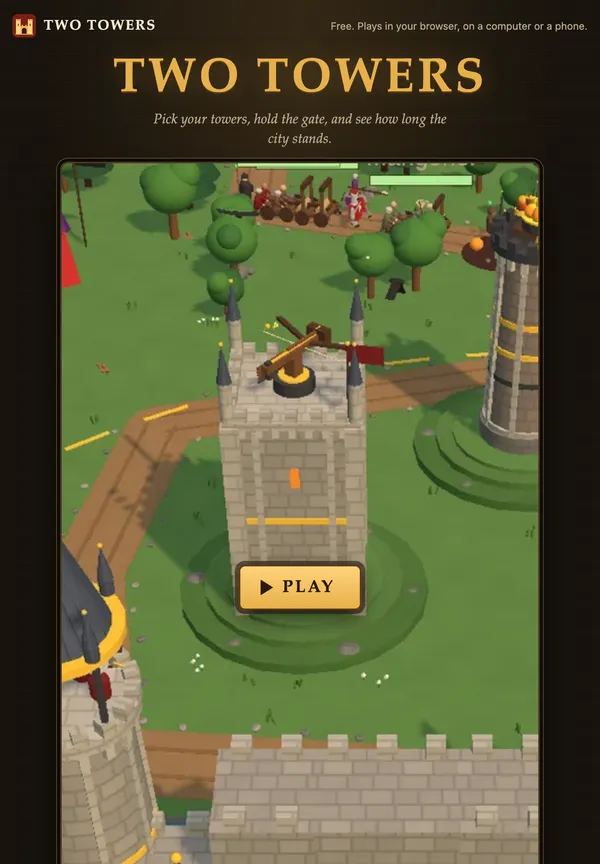
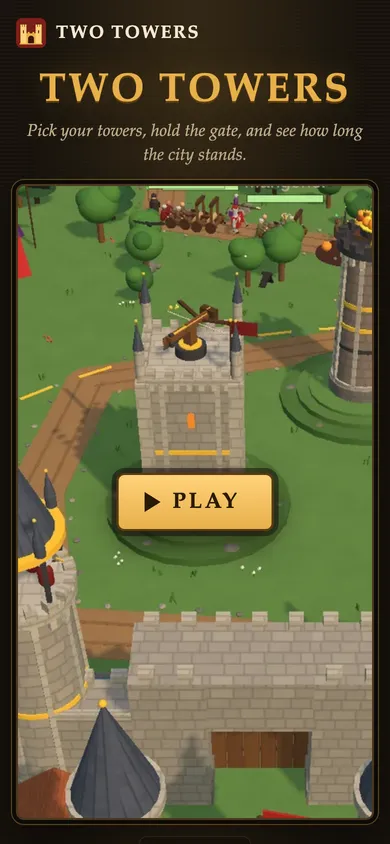
If you like planning how to hold one gate against a long fight, Two Towers is a free browser game where you choose the two towers that guard a city gate and spend the gold you win to keep it standing.
Ashby de la Zouch Castle before the castle
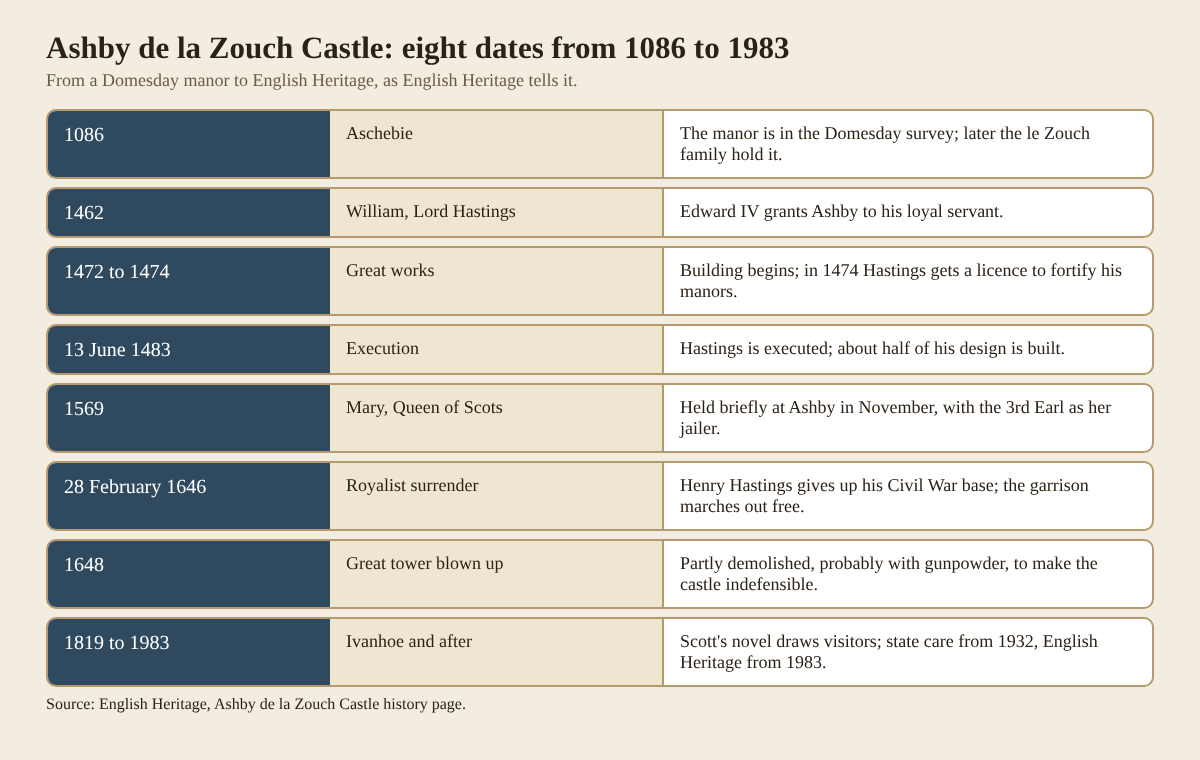
The place began as a manor, not a fortress. The manor of Aschebie is in the Domesday survey of 1086, and for the next century it belonged to the Earls of Leicester. They granted it to a family of Breton descent called "le Zouch", a name that means a stock or stem, in return for military service. That is where the town's long name comes from. English Heritage says their fairly modest manor house probably stood where the castle stands now, and pieces of it may survive in the hall range.
The last direct Zouch heir died in 1399, and ownership was disputed for years. In 1462 Ashby was granted to William, Lord Hastings, as part of a much larger grant of land in the Midlands. Hastings had won great power and wealth in the service of King Edward IV.
Lord Hastings builds a great tower
At first Hastings showed no special interest in Ashby. That changed after Edward IV was briefly deposed in 1470 to 1471 and then restored. Hastings had stayed loyal, and he was rewarded with far greater powers, until he was almost a vice-regent in Derbyshire, Nottinghamshire, Leicestershire and parts of Warwickshire. He needed a home to match.
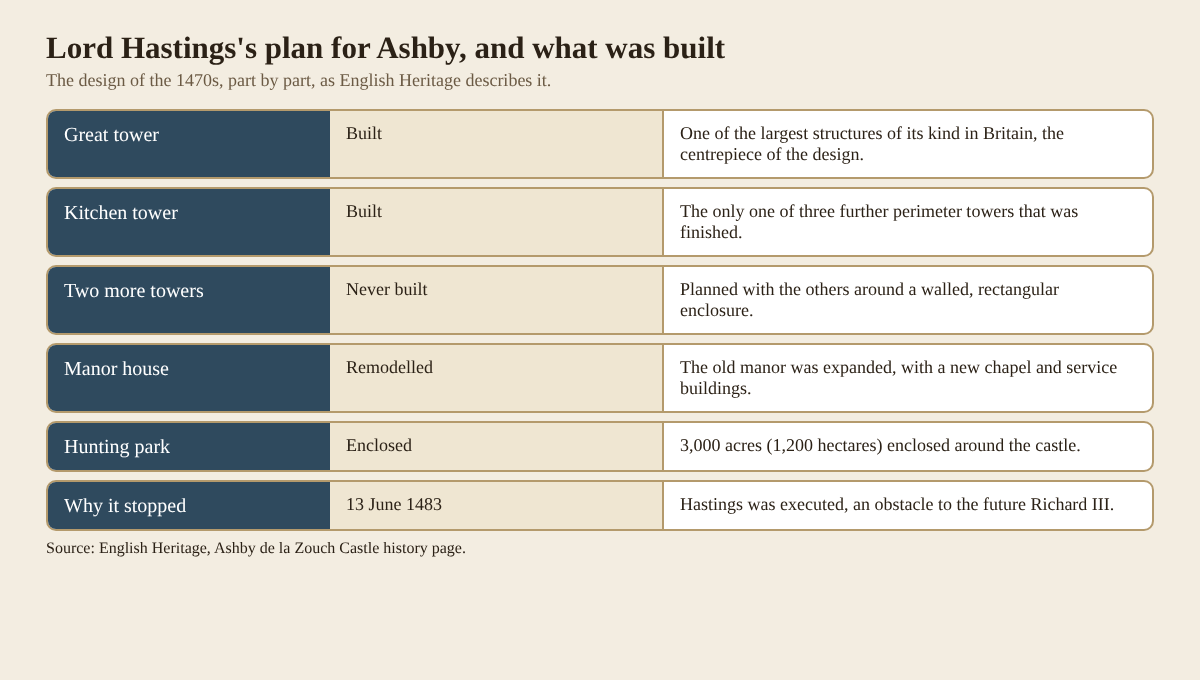
In 1474 he was granted a licence to fortify four, possibly five, manors and to make parks around them, though work at Ashby had already started the year before. The manorial roll for 1472 to 1473 records "diverse great works within the manor", with wages for carpenters, masons, plumbers and others. Hastings enclosed 3,000 acres as a hunting park. At the heart of it all was a great tower, which English Heritage calls one of the largest structures of its kind in Britain. The licence to crenellate post explains what a licence like his meant.
A castle left half built in 1483
Hastings seems to have planned three more towers around the edge of a walled, rectangular enclosure, so that Ashby would be a regular castle with four towers. Only one of them was finished, the kitchen tower. The old manor house was remodelled and enlarged with a new chapel and service buildings.
Then the plan stopped. Edward IV died in 1483, and Hastings stood in the way of the royal ambitions of the Duke of Gloucester, the future Richard III. He was summarily executed on 13 June 1483. The Middleham Castle post tells more about Richard's own northern castle.
The Earls of Huntingdon and their royal guests
Hastings's heirs were soon back in favour. In 1529 Henry VIII made his grandson George the 1st Earl of Huntingdon, and George probably added brick buildings and laid out the garden with its towers. His grandson Henry, the 3rd Earl, served as one of the jailers of Mary, Queen of Scots, who was held briefly at Ashby in November 1569.
Royal service was expensive, and the 3rd Earl left large debts. His brother and heir George petitioned James I for help, and on 22 June 1603 Queen Anne of Denmark and her son Prince Henry visited Ashby. The 5th Earl went on to receive James I in 1617, and Charles I and Henrietta Maria in 1634.
A Royalist base in the Civil War
In the Civil War, Henry Hastings, younger brother of the 6th Earl, held Ashby for the king. English Heritage says it formed a crucial link between Royalist operations in the north and the south. Hastings fortified the town and castle on an impressive scale, and in 1644 the great tower was described as "Hastings' stronghold". Charles I came twice. The second time he stayed the night, after the Royalists' decisive defeat at Naseby on 14 June 1645.
Parliamentarian forces raided the town again and again, and on 28 February 1646 Hastings surrendered. He agreed to pull down the new fortifications around the town, and his garrison was allowed to march out free with "trumpets sounding, drums beating, colours flying". The castle was used to hold Royalist prisoners, and later in 1646 its defences were ordered to be demolished. The earl complained that the demolition squad went far beyond its orders and ruined his "only convenient mansion". In 1648 the great tower was partly demolished, probably with gunpowder, to make the castle indefensible. The slighting a castle post explains why so many castles were wrecked on purpose after the war.
Ivanhoe and the ruins today
After the war the remaining buildings were patched together as a house called Ashby Place, used mainly by widowed Countesses of Huntingdon. One of them, Selina, founded a religious group called the Countess of Huntingdon's Connexion in 1783. In 1819 Sir Walter Scott set a tournament scene of his novel Ivanhoe at Ashby, and visitors flocked to the ruins. The castle came into state care in 1932 and English Heritage has looked after it since 1983.
A worked example: holding Ashby's gate in Two Towers
Henry Hastings held Ashby for the king by fortifying the town around the castle, not just the castle itself. In Two Towers your gate faces rams and siege towers, and a plan built only from the game's own tips looks like this.
- Know the worst threat. The game says: "Rams hit the gate hardest: Reinforce the gate, and use Ballista bolts that ignore armor."
- Put a Ballista on one side. Its heavy bolt goes through a line of attackers and ignores armor.
- Catch siege towers early. "Siege towers let a crew out at the wall: stop them early with a Ballista and Damage."
- Add outer works. "Raise barricades to slow them down." Like Hastings's town defences, they keep attackers away from the gate for longer.
- Use the hills. The first hill tower costs 150 gold and the second 300.
Then play on and see which stage brings the first ram. The king stage post covers the King, who comes every fifth stage.
Frequently asked questions
Who built Ashby de la Zouch Castle?
William, Lord Hastings turned an older manor house into a castle from 1472 to 1473. He was executed in 1483 with only about half of his design built.
Why is it called Ashby de la Zouch?
The manor of Ashby was granted to a family of Breton descent called "le Zouch" in return for military service. Their name stayed with the town.
What happened to Ashby de la Zouch Castle in the Civil War?
Henry Hastings held it as a Royalist base and surrendered on 28 February 1646. Its defences were then demolished, and the great tower was partly blown up in 1648.
Is Ashby de la Zouch Castle in Ivanhoe?
Yes. Sir Walter Scott set a tournament scene there in his 1819 novel, and visitors flocked to the ruins after it.
Get started
Ashby shows how long a gate can hold when there are works in front of it. To build your own, play Two Towers: pick your two towers, raise barricades and see how long your gate holds.
Defend the castle gate, stage after stage.
Visit twotowers.vlvd.net↗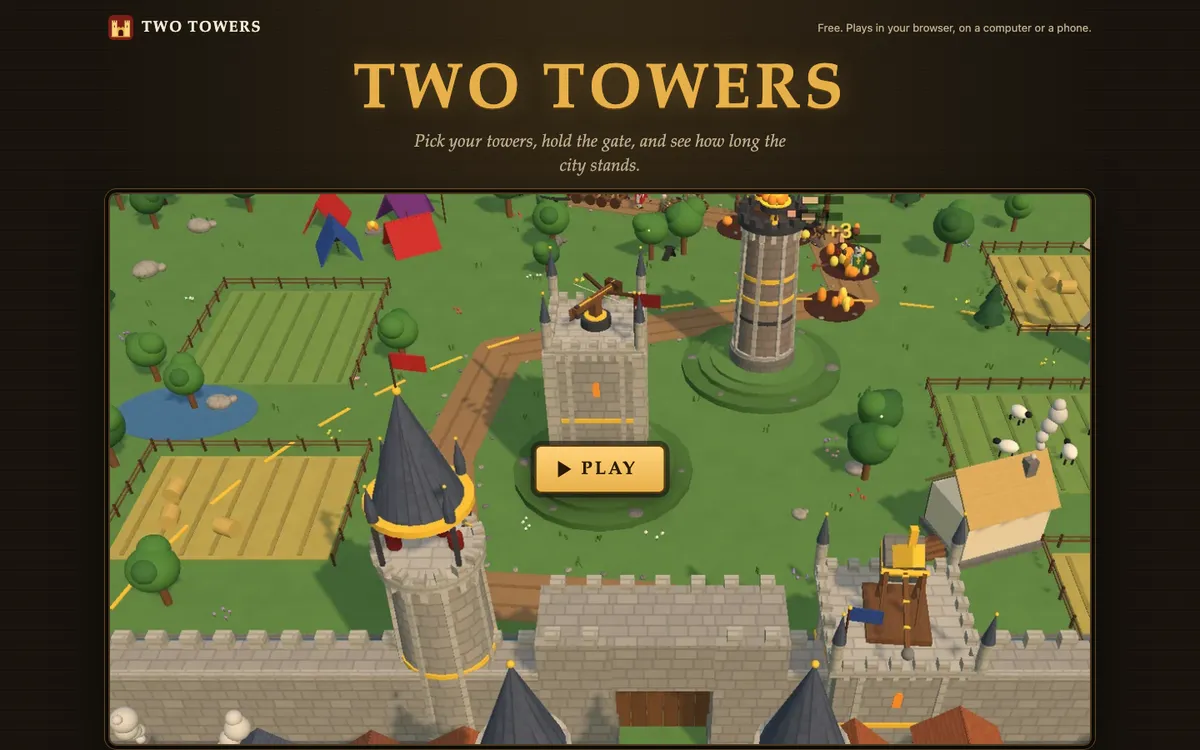
Comments
No comments yet.