Beeston Castle: the unfinished fortress on a Cheshire crag
Beeston Castle stands on a rocky crag 500 feet above the Cheshire plain, and its ruins tell a story of a castle that was started with a flourish and never quite finished. This Beeston Castle history follows the rock from a Bronze Age hilltop to a Civil War garrison that ran out of food.
If you like asking where a defence is thin, Two Towers is a free browser game where you pick the two towers that guard a city gate and spend gold on upgrades as every stage comes harder.
Beeston Castle's crag: a fortified hill for 3,000 years
English Heritage says people were using the crag long before any castle. Worked flints date to the Neolithic, and there may be early Bronze Age burial mounds on the lower slope. Around 1000 BC the hilltop was fortified with a simple bank, probably topped with a wooden palisade, and about 800 BC roundhouses stood in what is now the castle's outer ward. Moulds and crucibles show it was a major metalworking centre.
In the early Iron Age the bank was enlarged and given a ditch, which made a hillfort. A cache of slingshot found near the outer gatehouse suggests the entrance was already on the same spot. The hillfort seems to have been abandoned at the end of the Iron Age, and there is little evidence of Roman occupation.
Ranulf's castle of the 1220s, and the Crown's
The castle came from a politician's worry. Ranulf, Earl of Chester (1170 to 1232), had backed the king through the baronial civil war of King John's reign and been rewarded with land across England. In 1218 he left for the fifth crusade. When he came back in 1220, the king's viceroy Hubert de Burgh was taking lands from men who had grown rich in the previous decade. At some point in the 1220s Ranulf began work on Beeston.
English Heritage says the rock-cut ditch, the inner and outer gatehouses, much of the inner ward's curtain wall and at least one tower of the outer wall most likely date from then, and that the effort spent on them shows Ranulf wanted to show his strength. Ranulf died in 1232, the castle went to his nephew John le Scot, and when John died in 1237 Henry III seized the earl's estates, Beeston included.
Money spent in the 1240s, mostly tied to the campaign against Wales in 1245, suggests the castle was not finished before the king took it. In 1241 to 1242 £410 12d went on repairing and fortifying Beeston and Rhuddlan together, and in 1245 £242 17s 10½d on finishing two turrets. Even so, it probably never got a full set of homes: accommodation and services were squeezed into the gatehouses and the wall towers. The castle gatehouse post shows why that made sense.
In 1303 to 1304 £109 2s 4½d was spent: three inner ward towers were raised and crenellated, "because they formerly had high wooden surfaces", and a new bridge was built. A survey of 1333 called the castle "very well enclosed" and said no repairs were needed. By about 1540 the antiquarian John Leland wrote that it was ruinous.
What the ruins show: a rock ditch and a well
The outer ward was ringed by a curtain wall with eight projecting D-shaped towers, and its gatehouse had two rounded towers framing the entrance. English Heritage thinks the gatehouse was probably twice as high as what survives. Between the outer and inner wards runs a great ditch cut from the rock in the 1220s, and the stone quarried from it was used to build the castle. A pillar of rock was left in the ditch to hold up a bridge, and you can still see it beneath today's bridge, which dates from 1975.
The inner gatehouse, probably the first part built, probably housed the constable, in a single room on the first floor. Beneath the surviving inner parapet are six square holes for the beams of a hoarding, the gallery from which missiles were dropped onto attackers in the ditch; the castle hoardings post explains how those worked. The well in the inner ward is probably one of the deepest castle wells in England, and it was first recorded in the 1230s.
What you will not find is a great hall or kitchens in the inner ward. Its rocky, uneven floor suggests the castle was never finished.
The Civil War: eight men and a long blockade
After the outbreak of the Civil War in 1642, Beeston's place in the middle of Cheshire made it valuable to both sides. In February 1643 a Parliamentary garrison of 200 to 300 men moved in. The defences were in poor repair, and gaps in the curtain wall had to be filled with earth.
In the early hours of 13 December 1643, Royalist Captain Thomas Sandford and eight men got into the castle and took the inner ward. English Heritage says the king's men probably came in from the north side of the outer ward and scrambled up the crag. With more Royalists at the gate, the reduced Parliamentary garrison surrendered, and it was allowed to leave the next day.
In November 1644, Parliament's siege of Chester made the garrison a threat, so troops seized the cattle from the countryside, fought off attempts to recover them and set up a blockade with siegeworks in front of the outer ward. When the Royalists destroyed the works in early summer 1645, the Parliamentarians built a fort for 100 men within musket shot of the gate.
The king's defeat at Rowton Heath, near Chester, on 24 September 1645 left little reason to hold out, and Beeston surrendered on 15 November. By then the garrison had apparently been reduced to eating cats. The victors recorded that they found "neither meate, Ale nor Beere", only a piece of turkey pie, two biscuits, a live peacock and a peahen. The siegeworks were dismantled and the castle was ordered to be slighted, made indefensible, which the slighting post covers.
After the war: a quarry, a view and a tourist stop
In the 18th century the crag was quarried for rock, and the outer gatehouse was partly pulled down so carts could come and go. Yet people were also learning to value it as a ruin, and it inspired Romantic painters including JMW Turner.
In 1840 the Peckforton estate, which included Beeston, was bought by John Tollemache. English Heritage notes that he had received compensation under the Slavery Abolition Act of 1833 for 822 formerly enslaved people on his late father's Antigua sugar plantations, and that part of the £60,000 he paid for the estate came from it. In 1844 he had the architect Anthony Salvin build Peckforton Castle on the hillside, and Beeston's ruins became the view from its windows and a talking point for guests.
The Chester to Crewe railway of 1846 helped turn the castle into a tourist attraction. The ticket office and the wall around the base of the crag were built that year, and the wall also bounded the deer and kangaroos kept on the site. The castle came into state guardianship in 1959 and to English Heritage in 1984.
A worked example: read a castle by what it never finished
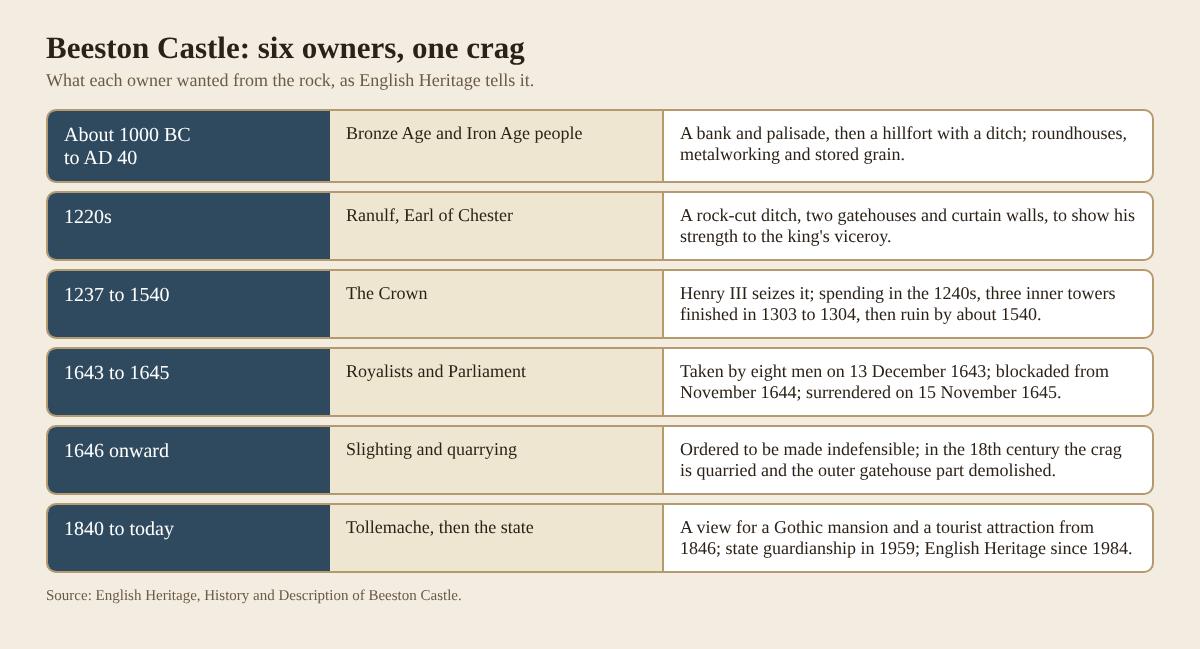
Beeston is a good place to practise reading a castle by its gaps. Ask three questions, using only what English Heritage says.
- What was built first, and why? The ditch and the two gatehouses, in the 1220s, by an earl who wanted to show his strength to the king's viceroy.
- What was never built? A great hall or kitchens in the inner ward. Accommodation and services were in the gatehouses and wall towers.
- Where did it fail? Not at the ditch. In December 1643 eight men found a way up the crag and into the inner ward, and in 1645 a blockade, an empty larder and the king's defeat at Rowton Heath ended it, not a breach.
The same questions work on other castles. The Civil War castle sieges post shows what happened to other castles.
The same choice in Two Towers
Beeston's owners faced a choice you meet in Two Towers, with gold in place of money. You can put gold into the towers you already have: click or tap a tower and buy damage, fire rate, range or its special. You can buy a tower for one of the two hills, 150 gold for the first and 300 for the second, in any of the four kinds. Or you can repair the gate, or reinforce it, between attacks. If the gate falls, the game is over.
The game gives no verdict between them, though its own tip says: "Spend your gold on Damage between stages, and Reinforce the gate." Try Beeston's three questions on a stage you lost. What did you build first, what did you never get round to, and where did the attackers actually get in?
Frequently asked questions
Who built Beeston Castle?
Ranulf, 6th Earl of Chester, built it in the 1220s, on the banks and ditches of an Iron Age hillfort. Henry III seized it in 1237.
Was Beeston Castle ever finished?
English Heritage thinks not. The inner ward has no sign of a great hall or kitchens and its floor is uneven, and the royal spending of the 1240s suggests the castle was incomplete when the Crown took it.
What happened at Beeston Castle in the Civil War?
A Parliamentary garrison held it in 1643, until Royalists took the inner ward on 13 December 1643. It was blockaded from November 1644 and surrendered on 15 November 1645, after which it was slighted.
Is Beeston Castle still standing?
Its ruins stand on the crag, with the rock-cut ditch, the inner gatehouse and parts of the outer wall and towers. It has been in English Heritage's care since 1984.
Get started
Beeston Castle shows that a defence is only as good as its weakest way in. To test the thinking yourself, play Two Towers: pick your two towers, spend your gold between stages, and see which stage your gate fails at.
Defend the castle gate, stage after stage.
Visit twotowers.vlvd.net↗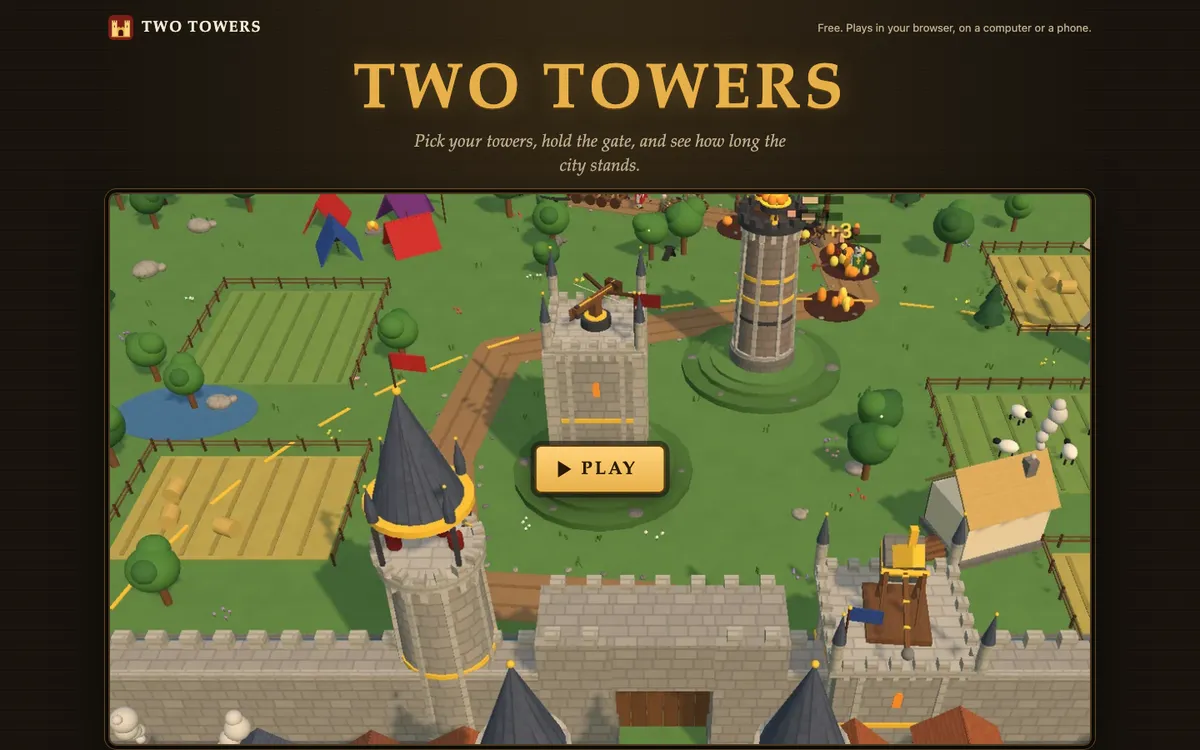
Comments
No comments yet.
Sign in or make an account to comment.