Berry Pomeroy Castle: gunports and an unfinished palace
Berry Pomeroy Castle in Devon is a fortress of the later 15th century with unusually advanced gunports, and inside its walls stand the shell of a Tudor and Jacobean great house that was never finished. English Heritage says its history was only recently established: the castle was once thought to be Norman, but the Pomeroy family began it in the later 15th century, the Seymours built a mansion inside it, and by 1700 it was an abandoned shell.
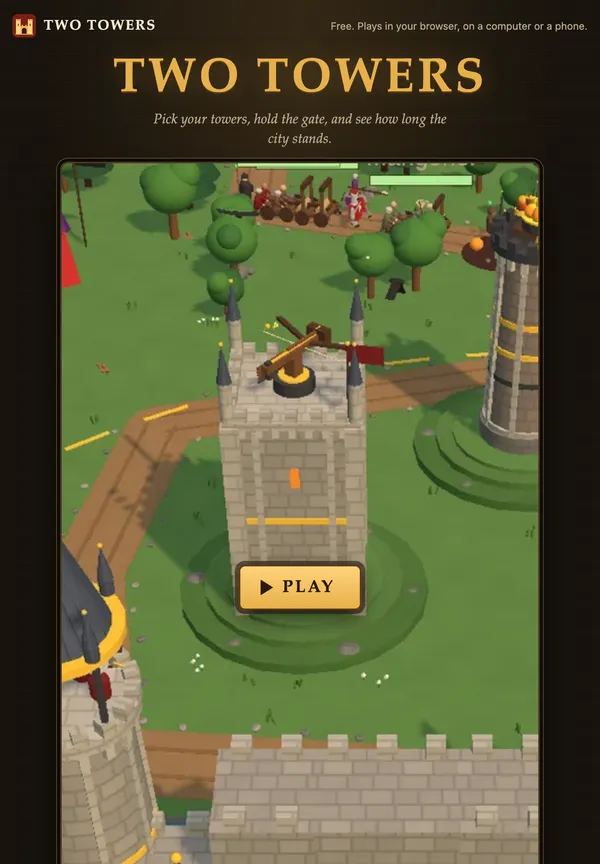
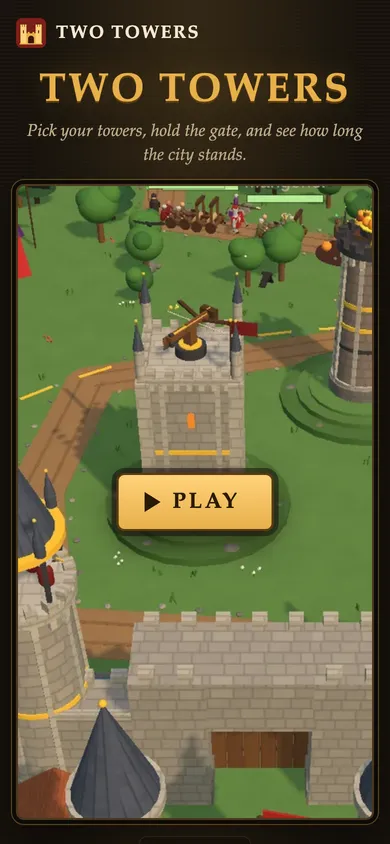
If you like the puzzle a gatehouse sets, Two Towers is a free browser game where you pick the two towers that guard a city gate and spend the gold you win on upgrades.
What Berry Pomeroy Castle was built for
The Pomeroys had owned the manor for over 400 years, since William the Conqueror granted it to a Norman knight, Ralf de Pomaria, but English Heritage finds no record of an earlier fortress there. The family lived in an unfortified manor house by the village church, which was still in full use in 1496. The castle stands on a site nobody had used before, over a mile north-east of the church, inside an existing deer park.
When it was begun is uncertain. It first appears in the records when Sir Richard Pomeroy died in 1496. The founder may have been Henry Pomeroy, who owned the manor from 1461 until 1487, or his heir Sir Richard. English Heritage says a foundation or completion by Richard is made more likely because broadly similar artillery defences were going up at nearby Dartmouth Castle in the 1480s, and because of a very late 15th-century wall painting in the gatehouse.
The reason was almost certainly the state of Devon, which English Heritage calls the most lawless area of southern England. Local feuds escalated from 1455 into the Wars of the Roses, and the Pomeroys were on the Yorkist side. The up-to-date fortifications leave no doubt that it was designed for serious defence.
Nine cannon ports and a triple gunport
The original defences survive along the south-east side: a gatehouse, a corner tower called St Margaret's Tower, a stretch of curtain wall and a dry moat. English Heritage counts nine purpose-built cannon ports, three of them multiple, and at least ten plain loops for handguns. The six gunports in the ground floor of the gatehouse towers have wide internal splays so the gun can swing, and they were placed to cover the greatest fields of fire. The arrow loops post explains why a slit made for a bow was the wrong shape for a gun.
The prize is in the basement of St Margaret's Tower. Its multiple gunports are splayed on the outside as well as the inside, a feature English Heritage says was not copied elsewhere in England until Camber Castle was built in 1512 to 1514. The south-facing port was made for three guns of graduated sizes, and English Heritage knows of no other like it outside Germany. It calls this all the more extraordinary because the family was not outstandingly wealthy, guarded no strategic route and faced no foreign raiders.
The gatehouse has a second surprise. In 1978 a worker glimpsed a face under moss and ivy on a chamber wall, and specialists uncovered a painting of the Three Magi visiting the infant Christ, dated to about 1490 to 1500. It includes one of the earliest depictions in England of a black Wise Man. It had clearly served as the reredos of an altar, so that corner may have been a private family oratory.
The Seymours move in
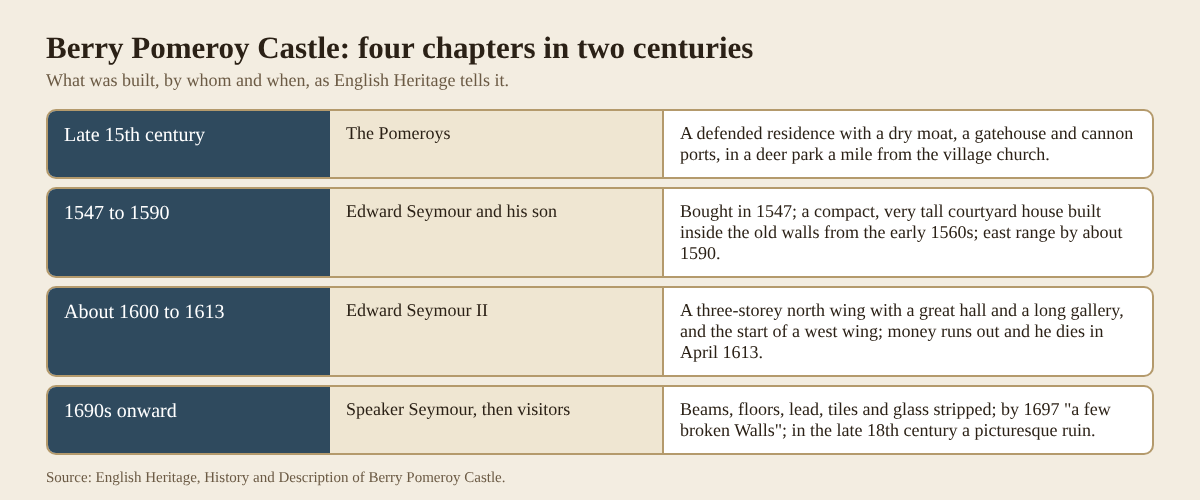
In December 1547 Edward Seymour, Duke of Somerset, bought Berry Pomeroy from the impoverished Sir Thomas Pomeroy. He was the brother of Henry VIII's third queen, Jane Seymour, and Lord Protector of his nine-year-old nephew Edward VI. He was executed in January 1552 and may never have visited, and English Heritage calls the old belief that he built extensively there unfounded.
The builder was his eldest surviving son by his first marriage, Edward, Lord Seymour (1529 to 1593), who probably began a courtyard house inside the medieval walls in the early 1560s. Doubts about his legitimacy left the junior branch of the family with the main lands and titles, and English Heritage suggests the later building may have been meant to score off them. By about 1590 an east range closed the courtyard: compact and very tall, with two complete floors of rooms above two more holding the hall and services. English Heritage calls it a pioneering example of the tall, compact houses of its age and says nothing like it had been seen in Devon. The medieval buildings inside the walls were swept away to make room for it.
The palace that ran out of money
In the first decade of the 17th century Lord Seymour's son, Edward Seymour II (about 1563 to 1613), set out to turn the house into "a very stately house". The plan raised a three-storey north wing along the north-west side, beyond the old defences, in place of the old north range. It held a great hall and staterooms decorated in marble and alabaster, with a long gallery on the top floor that English Heritage says was among the lengthiest ever built in England. A Classical loggia with a balcony faced the courtyard, and the wing was only a little shorter than the entrance front at Longleat.
It stopped abruptly. English Heritage says it is not clear why Seymour attempted something so large on a cramped, unsuitable site, or how he meant to pay for it. By June 1611 he was in serious financial trouble, yet a month later he bought a baronetcy, and he died in April 1613 with the great house unfinished. You can still see where it stopped: the vast kitchens at the west end were the start of a west wing that was never finished, and rough bedrock was left uncleared in front of the grand loggia.
Demolition, a Civil War that passed it by and a haunted name
Later Seymours made no attempt to finish it, and an inventory of 1688 shows the family retreating into an updated version of the Elizabethan house. The next two Sir Edwards were enthusiastic Royalists, yet English Heritage says the castle itself was never garrisoned or attacked in the Civil War, which sets it apart from the castles in the Civil War sieges post.
What finished it was its own owner. In 1697 John Prince wrote that the castle was "now demolished, and ... buried in its own ruins; there being nothing standing but a few broken Walls". English Heritage says the demolition was deliberate, carried out by Sir Edward Seymour V (1633 to 1708), known as Speaker Seymour, whose political life was in London. Timber beams were taken out whole, flagstone floors lifted, lead and tiles stripped from the roofs, glass torn from the windows and its leading melted down, and decorated stonework removed. That is a house stripped of its fittings, not a castle made unusable by slighting.
The Seymours settled at Maiden Bradley in Wiltshire, became Dukes of Somerset in 1750, and the present duke, a direct descendant, still owns the castle. In the late 18th century the ruins drew artists and sightseers, and novels such as The Castle of Berry Pomeroy (1806), a Gothic tale of jealousy, murder and ghostly revenge, fed the legend. Even today it is promoted as "the most haunted castle in Devon", which English Heritage notes with the words "perhaps unfortunately".
A worked example: a field-of-fire check in Two Towers
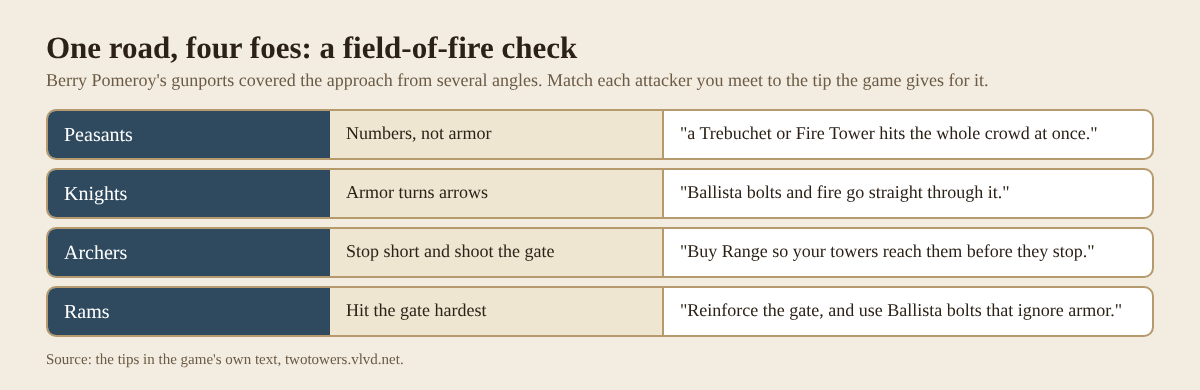
Berry Pomeroy's gunports teach one habit: decide where each gun will reach before the attack comes. You can practise it in Two Towers with a check you run before stage 1 and after every loss.
- Read the four towers. The title screen says "Choose two towers for the gate" and labels them "Fast arrows", "Stones on a crowd", "Bolts through armor" and "Fire that burns on". Its own line is: "Arrows, stones, bolts or fire: each answers a different foe."
- Give the pair two different jobs. The triple gunport put three guns of graduated sizes on one approach. Do the same with the left and right of the gate: for example Stones on a crowd on one side and Bolts through armor on the other, so a crowd of peasants and a line of knights each meet a tower that answers them.
- After a loss, read what beat you. The game says "The gate fell mostly to" an attacker, with a percentage of its damage. Find that attacker in the table above and apply its tip. If it was a ram, the tip is "Reinforce the gate, and use Ballista bolts that ignore armor."
- Spend before you build. Edward Seymour II's building outran his money, and English Heritage says it is not clear how he meant to pay for it. The game's own tip is "Spend your gold on Damage between stages, and Reinforce the gate", and you can buy a tower for each of the two hills, at 150 gold for the first and 300 for the second, once the pair at the gate is holding.
Frequently asked questions
Who built Berry Pomeroy Castle?
The Pomeroy family began it in the later 15th century, on a new site in their deer park. English Heritage says the founder may have been Henry Pomeroy or his heir Sir Richard, and the castle first appears in the records in 1496.
What is special about its gunports?
The nine purpose-built cannon ports include a triple port in St Margaret's Tower, splayed inside and out, that English Heritage says took three guns of graduated sizes and has no known twin outside Germany.
Was Berry Pomeroy Castle ever attacked?
English Heritage says the castle itself was never garrisoned or attacked in the Civil War, although two of the Seymours were Royalists. The destruction came later, when its owner had it stripped, and by 1697 little but a few broken walls stood.
Why is the great house a ruin?
The Jacobean extension was never finished because the money ran out, and by 1700 the castle was an abandoned shell stripped of its beams, floors, lead and glass.
Is Berry Pomeroy Castle haunted?
It is promoted as "the most haunted castle in Devon". English Heritage ties that reputation to Gothic novels and late Victorian romances that speculated about its supposedly sinister history.
Get started
Berry Pomeroy shows what a gate is for and what happens when ambition outruns the money. To test it yourself, play Two Towers: pick your two towers, run the field-of-fire check, and see which stage your gate fails at.
Defend the castle gate, stage after stage.
Visit twotowers.vlvd.net↗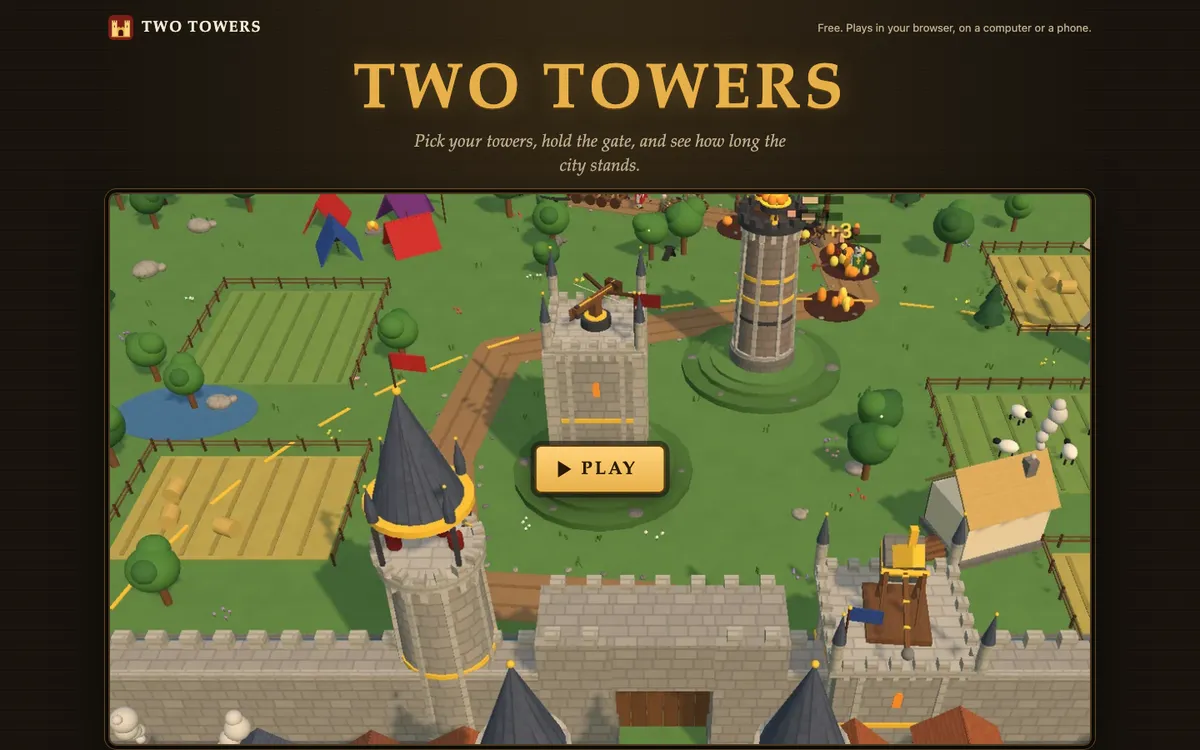
Comments
No comments yet.
Sign in or make an account to comment.