Cube Turn Counts: Why a Scramble Has About 20 Moves
Cube turn counts: why a scramble has about 20 moves is a question with a tidy answer once you know what a "move" is. A scramble is written as a list of turns, God's number says no position needs more than 20 of them to solve, and a scrambler that works backwards from a random position lands near that length. This post sets out what counts as one turn, where 20 comes from and what the WCA rules do and do not say.
Evolved 2048 puts the 2048 puzzle on a cube you turn like a Rubik's cube, and its Moves counter shows what a turn costs when it is a game and not a solve.
What counts as one turn on a cube
A scramble is a list such as R U2 F' D L2. Each letter is a face, a bare letter is a clockwise quarter turn, a prime mark (') is a counterclockwise quarter turn and a 2 is a half turn. Two common ways of counting give different totals for the same list.
- Half-turn metric.
R,R'andR2each count as 1 move. The list above is 5 moves. - Quarter-turn metric. A half turn counts as 2, because it is two quarter turns. The same list is 7 moves.
When someone says "20 moves", they almost always mean the half-turn metric. A number with no metric attached cannot be compared with another number. The post on the half turn metric against the quarter turn counts a few longer sequences both ways.
God's number: why no position needs more than 20
God's number is the number of turns the hardest position needs when you solve it in the fewest possible. In the half-turn metric it is 20. In the quarter-turn metric it is 26. Tomas Rokicki, Herbert Kociemba, Morley Davidson and John Dethridge gave the final computer-assisted proof in 2010 that every position can be solved in at most 20 face turns.
That is a ceiling for the hardest cases, not a typical length. The full story, from Singmaster's guess in 1980 to the proof, is in God's number explained.
The 43 quintillion positions and where most of them sit
The cube has 43,252,003,274,489,856,000 reachable positions. Spread across them, the shortest solutions are not all 20 moves long. A randomly scrambled cube is most likely solvable in 18 moves (about 67.0%), then 17 (about 26.7%), 19 (about 3.4%), 16 (about 2.6%) or 15 (about 0.2%). Only about 1 in 90 billion random positions needs the full 20. These shares are from Wikipedia's article on optimal solutions, in the half-turn metric.
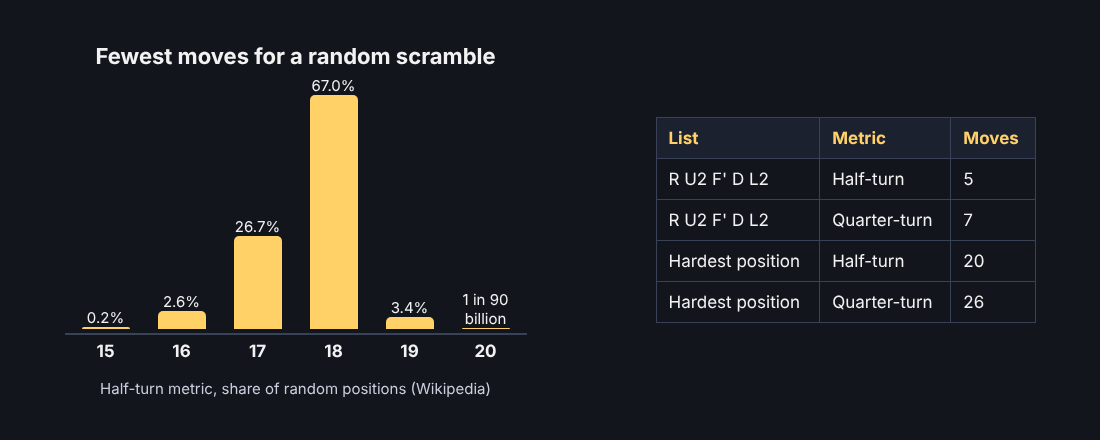
So a truly random position is about 18 moves from solved when you count the best possible solution. A person solving by hand takes far more.
Cube turn counts: why a scramble has about 20 moves
Here is the link between the two numbers. A scrambler does not shuffle at random and hope. It picks a position first, then finds a short solution to it and writes that solution backwards. Programs that find solutions quickly, such as Kociemba's two-phase algorithm, typically return 20 moves or fewer for a random cube, without promising it is the shortest. Written backwards, that solution is a scramble of about the same length.
The rules do not set a length. The World Cube Association's Regulation 4b3 says only that a competition scramble must produce a random state from all states that need at least 2 moves to solve, each equally likely, and Regulation 4b says it must come from the WCA's own scramble program, which is TNoodle-WCA. Nothing in Article 4 fixes the number of moves for the 3x3x3. So "about 20" describes what such programs tend to print, not a rule. How a random scramble is made and checked goes through this in detail: speedcubing scramble.
Why 20 random turns are not a random scramble
You could type 20 random turns and call it a scramble. It would be a worse one, for three reasons.
- Turns can cancel.
Rfollowed byR'does nothing, andRfollowed byRis justR2. - Some turns commute.
RandLturn opposite faces, so their order does not matter and the list repeats a position it could have reached in fewer turns. - A random list of turns is not a random position. Because of cancelling and repeats, the positions such lists reach are not spread evenly across all 43 quintillion, and the regulation asks for an even spread.
Choosing the position first fixes all three. The list is only a way to write the position down.
How Evolved 2048 counts a move
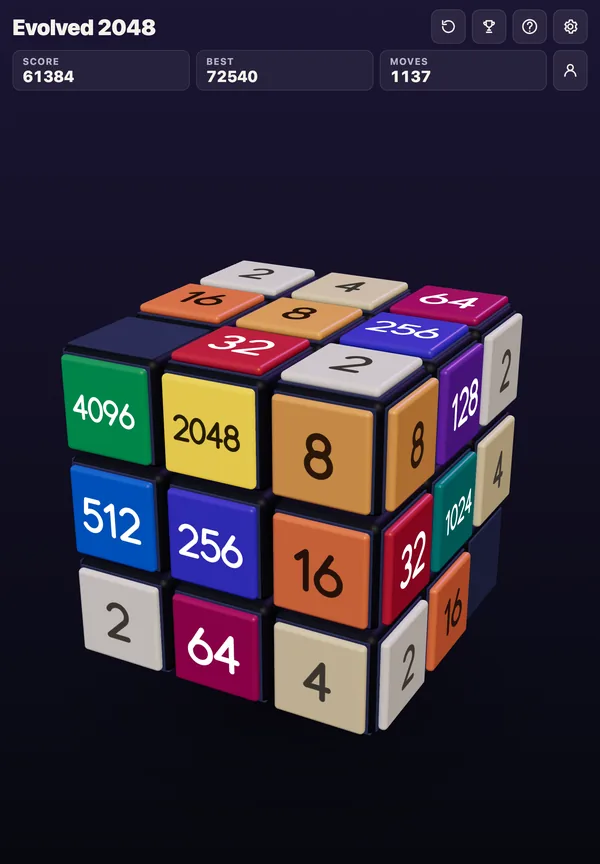
The game's cube has six faces of nine squares, 54 in all. You slide the front face so equal tiles merge, twist a row or column to carry tiles round from the other faces, and turn the whole cube to use the other sides. Its Moves counter does not use either cube metric, because it counts what changes the game:
- A slide adds the value of every tile its merges make and counts one move.
- A twist turns a layer a quarter, adds no points, counts one move and adds a new tile.
- A whole-cube turn adds no points and counts no move. Turning is free.
A twist can be undone with Shift and the same key, but that is a second quarter turn, so it counts as a second move and adds a second new tile. In a test on 12 October 2026, pressing 4 and then Shift and 4 read Moves 2, and 4 tiles became 6, with Score still 0. In cube terms the game counts quarter turns of a layer, with no credit for getting back to where you began.
A worked example: two moves, one merge
In a test on 11 October 2026 on a set-up board, a 16 sat on the front's middle-left square and a second 16 on the right face's top-left square, just over the front's top right edge.
- Shift and
1twisted the top row left. The right face's 16 landed on the front's top-left square, above the other 16, and a new 2 appeared. Moves 1, Score 0. - Up merged the two 16s into a 32 in the top-left corner. Score 32, Moves 2.
Two moves bought one merge. Before you twist, check that a plain slide will not do it. Turns, by contrast, cost nothing: Shift and Left brought the right face to the front, which is a y turn in cube notation, and four of them brought the cube back to where it began with Moves and Score unchanged. That test was on 10 October 2026. For a plan built on this, see planning a 2048 slide three moves ahead, and for how to read the final numbers, what counts as a good 2048 result.
None of this makes the game a way to practise solving a cube. It is a 2048 puzzle, not a cube-solving trainer.
Frequently asked questions
Why does a scramble have about 20 moves?
Because scramblers pick a random position and write a short solution to it backwards, and such solutions are typically 20 moves or fewer. God's number, 20 in the half-turn metric, is the most any position needs. The WCA rules set no fixed length.
Is a half turn one move or two?
It depends on the metric. In the half-turn metric R2 counts as 1 and in the quarter-turn metric it counts as 2.
How many positions does a 3x3 cube have?
43,252,003,274,489,856,000 reachable positions, about 43 quintillion.
Is a random 20-turn sequence a random scramble?
No. Turns can cancel or commute, so a random list does not reach every position equally often. The WCA asks for a random state, each state equally likely.
Does Evolved 2048 count every turn as a move?
No. Slides and twists count one move each. Turning the whole cube is free and adds no move.
Get started
Open the game, pick a mode and watch the Moves counter as you slide, twist and turn. Try one twist and one free turn, and compare what each does to the numbers.
Play Evolved 2048: it is free and plays in your browser on a computer or a phone.
The 2048 puzzle on a Rubik's cube, and past 2048.
Visit evolved2048.vlvd.net↗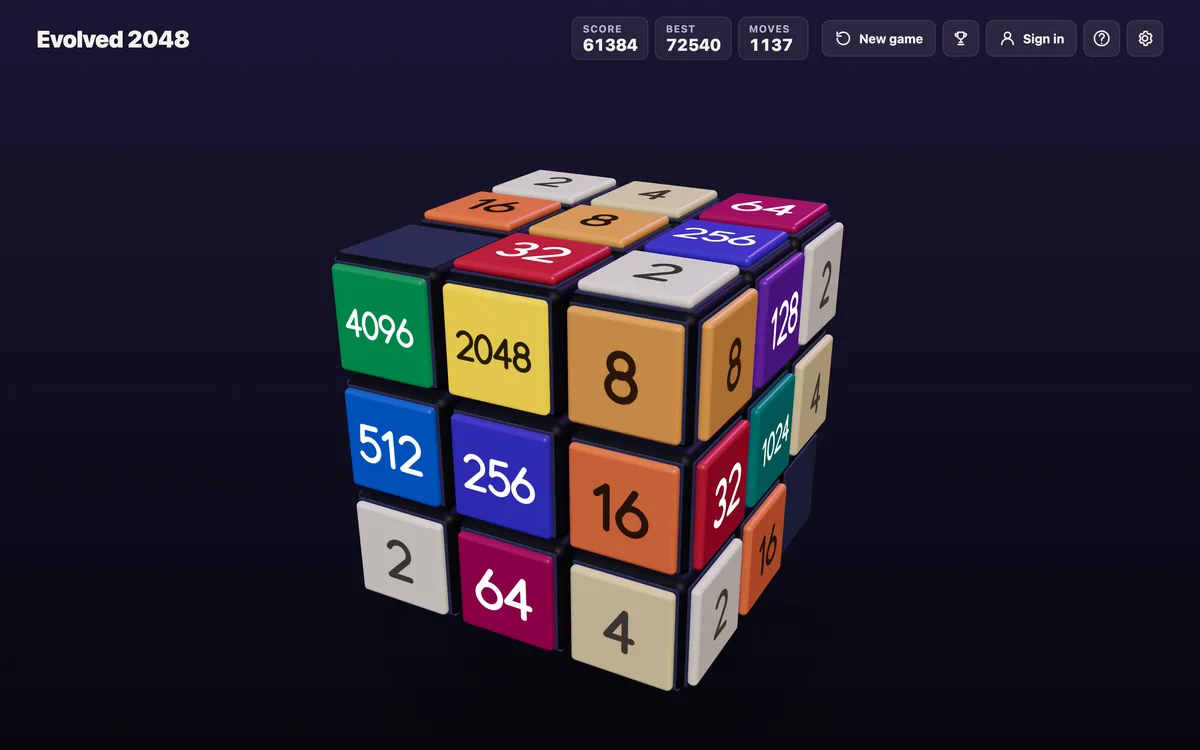
Comments
No comments yet.
Sign in or make an account to comment.