What Counts as a Good 2048 Result? Tiles vs Points
If you are asking what counts as a good 2048 result, read the biggest tile first and the score second. The tile shows how far you built, the score shows how much merging it took, and the moves show how long it took. Here is how to read the three together on a cube.
Evolved 2048 puts the 2048 puzzle on a cube with six faces of nine squares, and its top bar shows Score, Best and Moves, so you get all three numbers for every game you play.
What counts as a good 2048 result?
A good result is one that beats your own earlier games on a measure you chose first. The game gives no "average player" figures and gives no rank for a tile, so none appear here. What it does say is that 2048 is the first milestone and that the cube plays on past it, so there is always a next tile to chase.
The game's leaderboard shows the same three yardsticks. Its leaderboard box has a Board choice with three entries: Fewest moves, Biggest tile and Score, next to a Mode choice and an All time or This week choice. I read that from the game's own script and have not played a ranked game, so I can say what the boards are called, not who is on them. The box also says every ranked game is checked: the server replays its moves with the game's rules and works out the score itself. Our post on how ranked games are checked goes further.
Pick one of the three and keep it for a while. A result only means something against a yardstick that stayed the same.
How the score is counted: merges only
The score rule is short, and everything below follows from it.
- A slide adds the value of every tile its merges make, and counts one move.
- A tile made in a merge does not merge again in the same slide.
- A twist adds no points, counts one move, and adds a new tile.
- Turning the whole cube adds no points and counts no move.
Merge two 2s and you get 4 points. An 8 built from 2s carries 4 + 4 + 8 = 16 points of merging, and a 16 carries 48. For the long version, see how 2048 scoring works.
Here is the useful part. Because a tile keeps the points of every merge behind it, your score is almost fixed by the tiles on the board. In one test game, slides only, the game stopped with the front face reading 8 4 2 / 16 8 4 / 2 16 8. Count each tile as if it were built from 2s: three 8s at 16 each, two 4s at 4 each, two 16s at 48 each, and the 2s at nothing. That adds to 152. One new tile in that game had arrived as a 4, which skips the merge that would have made it, so subtract 4. The Score read 148, as the sum said.
Why the biggest tile is the clearer signal
A 128 is a 128 however you got it, and it maps onto the goal on the page: make the biggest tile you can. When you reach 2048 the game says "You made 2048 in {moves} moves" and offers to keep going for 4096.
Score is noisier. It depends on how many small tiles were still on the board when the game ended, and a single 4 dropped in by the game shifts it. It is a good second reading, not the first. Because every tile keeps the points behind it, the score mostly tells you how much else was sitting on the board beside the top tile.
Reading tiles against points: what the pairing tells you
Put the two numbers side by side and they tell a short story.
- Same tile, higher score: more tiles were on the board when the game ended, so the game ran longer or kept more mass in play.
- Same tile, lower score: the game ended with fewer tiles on the board.
- Bigger tile, lower score than an older game: possible when the older game left many mid-size tiles on the board. By the biggest-tile yardstick the new game still wins.
On a cube the third number matters too. A twist costs a move and adds no points, so a game full of twists spends moves without scoring. That is not wrong. In one test game that mixed slides and twists, all 54 squares were full at move 165 with a score of 1160 after 39 twists, and the game was still not over, because other faces held equal tiles side by side. Count twists as the price of using the cube, not as wasted moves.
Moves also set a floor. New tiles are the only thing that adds to the board's total: two at the start and one for every slide or twist, a 2 nine times in ten and a 4 otherwise, so 2.2 on average. A 2048 tile therefore needs about 2048 / 2.2, or 931 tiles, which is about 929 moves. The table works out the same floor for the smaller tiles, with the points each one carries. I worked it out from the game's rules; it is arithmetic, not a measured result, and a real game takes more, because other tiles stay on the board.
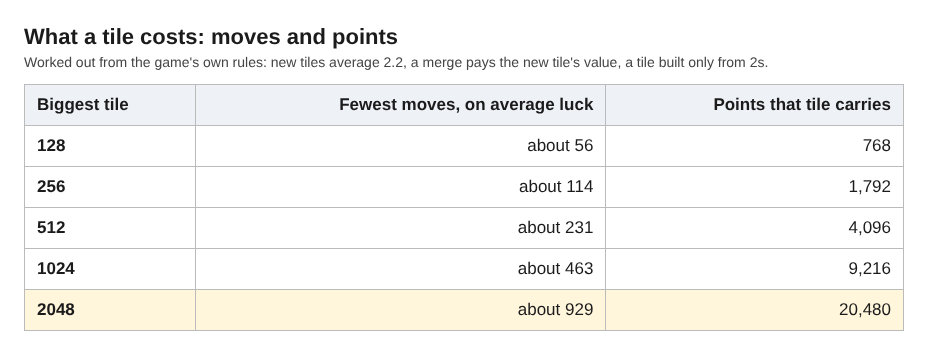
Use the table as a yardstick. If your 256 took 300 moves, nothing is wrong, but a 256 in 130 is a tight game. For the longer count behind the 929, see how many moves it takes to get 2048.
Why two games with the same tile can score differently
This is easiest to see with a controlled test. I took one start and played it slides only, on the front face. Down, Left, Right, Up first got stuck at move 32 with a score of 180 and a best tile of 32. The same start, restored, played Up, Right, Down, Left got stuck at move 28 with a score of 160 and the same best tile. The first order on two new games ended at move 37 with 220 and at move 42 with 260, again with a best tile of 32 each time.
Four games, one best tile, scores from 160 to 260. By tile alone they look the same. By score alone the 260 game looks far better than the 160 game. The games that ran longer, 42 moves against 28, had more new tiles on the board when they locked, so more points sat behind the same top tile. That is the pairing above: same tile, higher score.
Luck is part of it. A new tile is a 4 about one time in ten, and the same game can go differently with different new tiles. Do not read much into a single game.
A ladder from test games
I have no data on how often players reach each tile, so there is no honest "beginner is 256, expert is 2048" table here. What I can give you is a ladder from games I played with a script, one game each, so treat them as markers, not norms.
- Slides only, front face. The four luck-test games above all ended with a best tile of 32, at moves 28 to 42. In eight corner games that pushed every tile into one corner, the best tile was 64 at most and the front was full each time, with the other five faces empty. If your games end like that, you are not using the cube yet.
- Slides plus twists. In a test game that twisted whenever the front was stuck, a 64 came at move 36 with every tile still on the front, and a 128 at move 118 with tiles on four faces. Tiles on several faces is the sign that you are using the cube.
- 2048 and past it. The game opens a box when you make it, and you can keep going for 4096.
For your own ladder, note the first tile you are proud of, then try to reach it again in fewer moves. If the game ended before you wanted it to, our post on spotting a dead board shows what to look for.
How to keep a record of your games
The game keeps little of your history, so it helps to know exactly what. Your game in progress, best score and settings are saved in your browser, on your device. The Best box holds one number for each mode: Evolved, Edge and Fun each keep their own. When you press New game, the box says the score of the game you are ending "is kept only if it is your best." So the game holds no list of your past scores. An account puts your games on the leaderboard, but for your own notes you still write it down. There is no undo either, so you cannot replay a move to see what a different choice would have scored.
Before you press New game, write one line:
Evolved, best tile 128, score 1160, moves 165, 39 twists, stuck on a full cube.
- Log the mode every time. An Evolved score and a Fun score are not the same yardstick.
- Log the best tile first, then the score, then the moves.
- Add one note on how it ended. The No moves left box gives a hint: keep room on one face so a twist can still bring tiles round to their match.
- Look at ten games at a time, not one, because luck can swing a single result.
Frequently asked questions
Is a higher score always a better 2048 result?
No. A higher score often means more tiles were still on the board, not a bigger top tile. Compare the biggest tile first, then use the score and the move count to break ties.
Do twists add points in Evolved 2048?
No. A twist adds no points, counts one move, and adds a new tile. Only merges from slides add to your score.
Does turning the cube cost a move?
No. A whole-cube turn adds no points and counts no move. The game's own page says turning is free.
Why is my best score lower than a game I just played?
The best score is kept for each mode. If you play Edge mode and your high score is in Evolved mode, the Best box shows the Edge figure, which may be lower or zero.
Get started with Evolved 2048
Play three games and log each with the line above. Then pick one yardstick, the biggest tile, and try to beat it.
Play Evolved 2048: it is free and plays in your browser on a computer or a phone.
The 2048 puzzle on a Rubik's cube, and past 2048.
Visit evolved2048.vlvd.net↗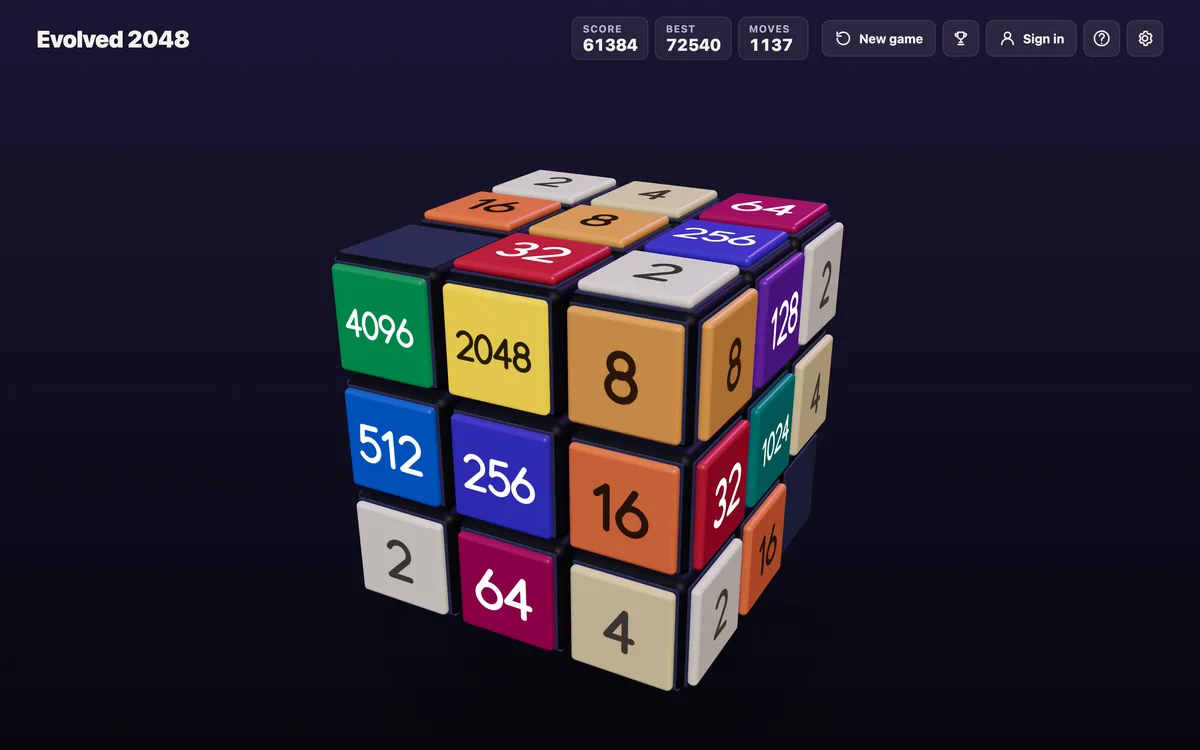
Comments
No comments yet.
Sign in or make an account to comment.