Different Philosophies of Life: Four Ancient Answers Compared
Different philosophies of life are the answers people have given to one old question: how should I live? Greek schools in Athens and a teacher in China answered it more than two thousand years ago, and their answers still shape how people think about work, loss and each other. This guide sets out four of them, Aristotle, the Stoics, Epicurus and Confucius, shows where they agree and clash, and ends with a one-week way to test them against your own days.
If you want to go further than one article, How to Find Your Meaning is a free web app of short hands-on lessons on Stoic philosophy, healthy habits and the story of who you are, and its Culture course has a lesson called Many Answers to How to Live, with its sources listed.
Different philosophies of life: four ancient answers
Each school names a goal, the thing a whole life aims at, and a practice that gets you there. The goals differ more than you might expect.
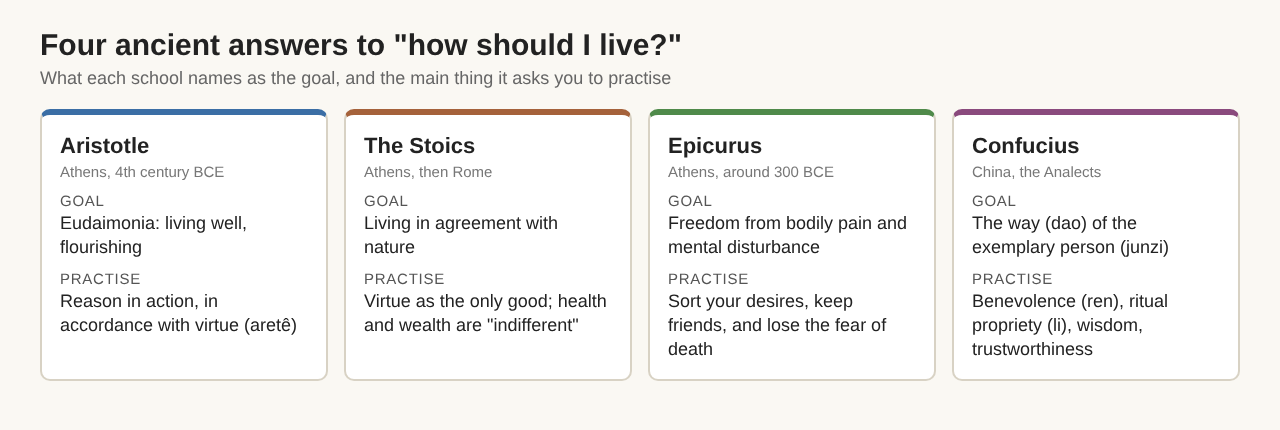
Four ancient answers, side by side. Sources: the Stanford Encyclopedia of Philosophy entries on each.
Two of them, Aristotle and the Stoics, put virtue at the centre. Epicurus puts a calm mind at the centre. Confucius puts relationships at the centre. Keep those three centres in mind as you read: they are where the real disagreements come from.
Aristotle: living well through virtue
Aristotle asked what the highest good is: something you want for itself, not for the sake of anything else. His answer was eudaimonia, usually translated as happiness or flourishing, the same thing as "living well".
He did not mean a feeling. He argued that the work of a human being is the activity of reason in accordance with virtue (aretê, excellence of character). You flourish by doing things well, again and again, over a life.
Aristotle also left room for ordinary goods. The Stanford Encyclopedia's entry on his ethics sums it up: to live well you need a sense of how friendship, pleasure, virtue, honour and wealth fit together as a whole.
The Stoics: virtue is the only good
The Stoics began in Athens with Zeno of Citium, who called the goal "living in agreement". His successor Cleanthes added "with nature": the end is living in agreement with nature.
Here they part from Aristotle. For the Stoics, health, wealth and reputation are neither good nor bad. They are "indifferent" to whether you live well. Only virtue is good. That is a large part of why Stoicism and money is still argued about.
Epictetus put the practical side in the first line of his handbook: "Some things are in our control and others not." Your opinions, aims, desires and aversions are yours. Your body, property and reputation are not. The Stoic work is to put your effort where it belongs, as the post on things you can't control walks through.
Epicurus: a calm mind and a body free of pain
Epicurus is often remembered as the philosopher of pleasure, but his goal was quieter than that. He described it mostly by what is absent: freedom from bodily pain and from mental disturbance. The calm he aimed at is called ataraxia.
He thought much of our disturbance comes from fear, above all the fear of death, which he called a worse curse than physical pain. So his practice was largely about beliefs: lose the fear of death, and sort your desires. Some desires are natural and necessary, some natural but unnecessary, and some empty, aimed at things no one can have. Friendship, on his view, is essential.
Set beside the Stoics, Epicurus agrees that judgement matters and that most of what people chase is not needed. He disagrees about the goal: for him, pleasure rightly understood, not virtue, is what a life aims at.
Confucius: a good life is lived with others
The Analects, the sayings gathered around Confucius, describe the way (dao) of the gentleman or exemplary person (junzi). The Stanford entry on Confucius names five behaviours as most central: benevolence (ren), righteousness (yi), ritual propriety (li), wisdom (zhi) and trustworthiness (xin).
Benevolence is sometimes defined simply as "caring for others". A few passages read like the golden rule: "Do not impose upon others those things that you yourself do not desire." And the tradition stresses the duties people in different roles owe each other: child and parent, ruler and subject, friend and friend.
The centre here is not your inner citadel, as for the Stoics, or your calm, as for Epicurus. It is the web of relationships you live in and the forms that keep them good.
How philosophers sort the answers to how to live today
Modern philosophers still argue about what makes a life meaningful, and they no longer group answers by school. The Stanford Encyclopedia's entry on the meaning of life sorts them into three families.
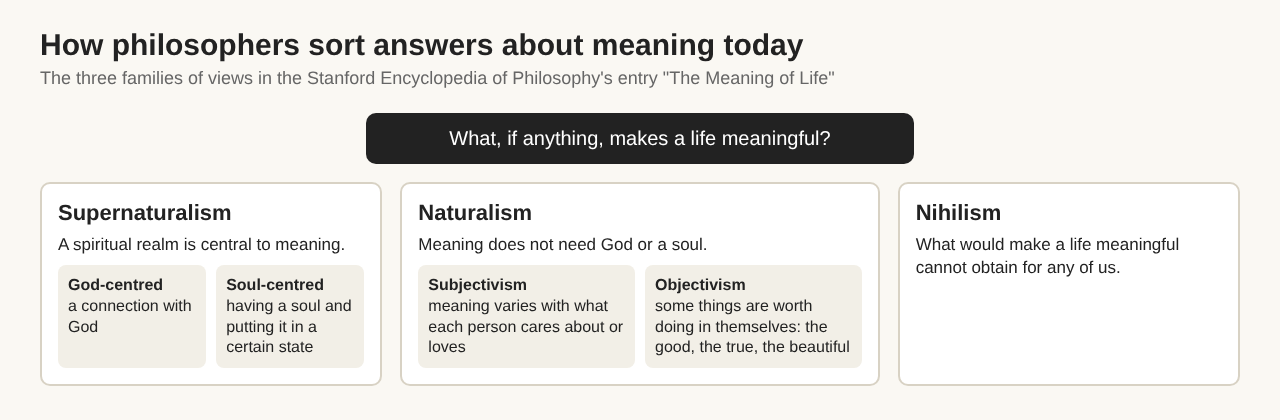
Supernaturalism, naturalism (subjective or objective) and nihilism, as the Stanford entry sets them out.
- Supernaturalism: a spiritual realm is central to meaning, either a connection with God or having a soul in the right state.
- Subjectivism: meaning varies from person to person with what each one cares about or loves.
- Objectivism: some things are worth doing in themselves, whatever anyone feels: the good, the true and the beautiful, such as moral action, enquiry and creativity.
- Nihilism: what would make a life meaningful cannot be had by any of us.
The same entry notes that a meaningful life and a happy life are not the same question. The ancient schools mostly asked about living well; today's debate often asks about meaning. Each side has serious defenders, and the debate is open.
Try different philosophies of life for one week
You do not have to pick one school and take it whole. You can test them against real days. This exercise takes about five minutes each evening.
- Pick one hard moment from today and write it in two sentences. Example: "My manager criticised my report in front of the team. I went quiet and stewed all afternoon."
- Ask four questions, one per school: Aristotle: what would a person of good character have done here, and was it within my reach?
- Stoic: which part of this was in my control, and which was not?
- Epicurus: which desire or fear was disturbing me, and was it necessary?
- Confucius: which relationship did this touch, and what does that role ask of me?
- Mark the question that changed what you would do. In the example, the Stoic question says: my reply was in my control, her tone was not. The Confucian question says: speak to her calmly and in private tomorrow.
- Repeat for seven days and count which question you marked most.
- Write three lines stating your working answer to how to live, in your own words.
Then compare the three lines with how you actually spent the week. The gap is the useful part. The post on building a sense of meaning in life takes that next step.
If the Stoic question wins, the app's daily Stoic practice fits this week well: about ten minutes in three steps, with a question and one virtue in the morning, a short passage from Epictetus, Marcus Aurelius or Seneca during the day, and Seneca's three evening questions at night, with notes kept for each day. Where the schools disagree, the app's 34 cards set out each side and leave the weighing to you.
Frequently asked questions
What are the main philosophies of life?
Among the oldest and most studied are Aristotle's ethics, Stoicism, Epicureanism and Confucianism, alongside the religious traditions. Each names a different goal: flourishing through virtue, virtue alone, a calm mind, or good relationships.
What is the difference between Stoicism and Epicureanism?
Both say your judgements shape your peace of mind. The Stoics hold that virtue is the only good, while Epicurus held that the goal is freedom from bodily pain and mental disturbance.
Can you follow more than one philosophy of life?
Many people borrow from several. Notice where they clash, such as whether health and wealth matter to living well, and decide what you think.
Is a meaningful life the same as a happy one?
Philosophers writing on meaning treat them as separate questions: a life can feel pleasant without being meaningful, and the reverse. They disagree about what meaning requires.
Get started
Reading about four answers is a start; living one a day at a time is how you find out what fits. How to Find Your Meaning goes from Stoicism, to health, to your own story, in lessons of about nine minutes with questions and hands-on activities, ending with the course You: Finding Your Meaning. You sign in with your email and an emailed code, and you can install the app from the site on your phone or computer.
Start How to Find Your Meaning: free, short hands-on lessons on Stoicism, healthy habits and your own meaning, with a daily Stoic practice to live it.
Find what your life is for.
Visit findyourmeaning.vlvd.net↗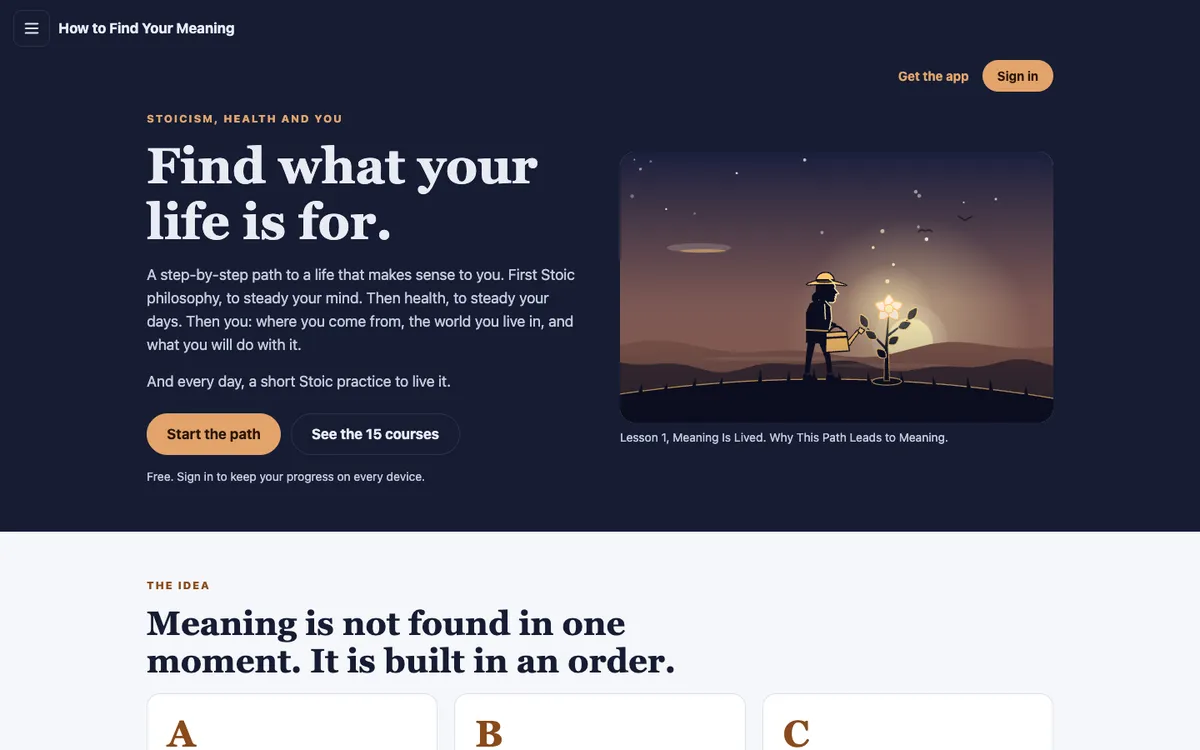
Comments
No comments yet.