Does Giving Make You Happier? Seneca and the Research
Does giving make you happier? The short answer
Does giving make you happier? The research says it often does, by a modest amount, and the way you measure it changes how big the effect looks. People who spend money on someone else tend to report a better mood than people who spend it on themselves. Seneca, writing nearly two thousand years earlier, praised giving too, but for a different reason: to him, knowing how much is enough and giving well are part of living well, whether or not your mood lifts that evening.
How to Find Your Meaning is a free web app of short hands-on lessons on Stoicism, healthy habits and your own meaning; its Wealth course ends with a lesson called "Enough, and Giving", and every lesson lists its sources so you can check them yourself.
What the research on prosocial spending found
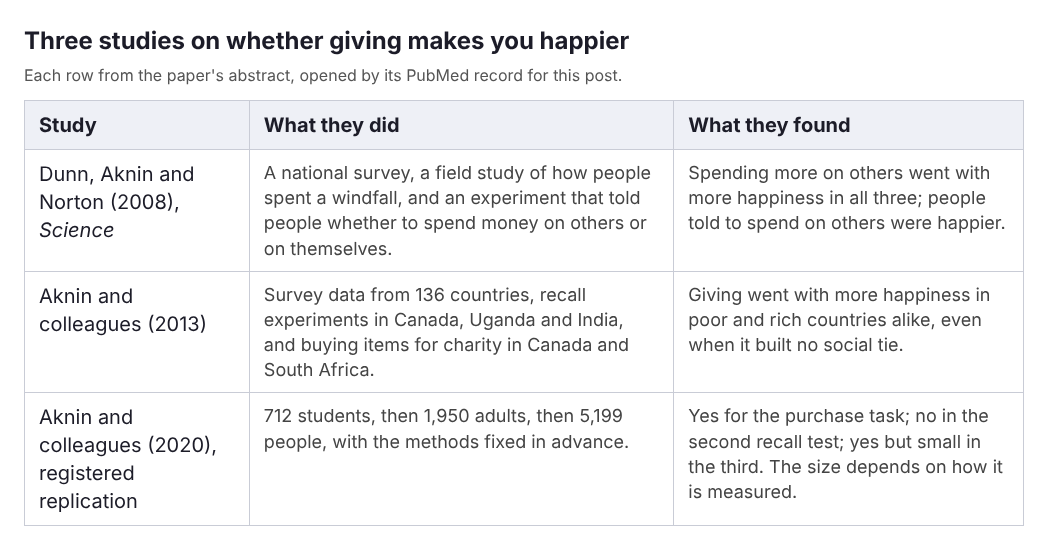
Psychologists call money you spend on other people, or give to charity, "prosocial spending". The study most people cite appeared in Science in 2008. Elizabeth Dunn, Lara Aknin and Michael Norton argued that how you spend your money may matter at least as much as how much you earn. They found the same pattern three ways. In a nationally representative survey, people who spent more of their income on others were happier. In a field study of how people spent a windfall, the same held over time. And in an experiment, people who were randomly told to spend money on others ended up happier than people told to spend it on themselves.
In 2013 Aknin and colleagues asked whether this held outside rich Western countries. Survey data from 136 countries linked giving to greater happiness in poor and rich countries alike. Experiments in Canada, Uganda and India found that remembering a time you spent money on someone else raised happiness. In a last study in Canada and South Africa, people asked to buy items for charity felt better than people who bought the same items for themselves, even though the gift built no friendship.
The 2020 replication: a real effect, but smaller
Many early studies on giving were small, with fewer than 100 people in each group. So in 2020 the same research group ran large registered replications, with their methods fixed in advance. The results were mixed, and worth knowing:
- Buying for a stranger in need: 712 students were told to buy something for themselves or for a stranger in need. Those who gave reported more happiness in the moment.
- Remembering a gift, first try: 1,950 adults recalled spending on themselves or on someone else. The givers were no happier.
- Remembering a gift, second try: with changes to keep people engaged, 5,199 people did the task again. The givers were happier, but the difference was small.
The authors conclude that spending on others does promote happiness, and that the size of the effect depends on how a study is run. So giving tends to lift your mood a little. It is not a cure for a hard month, and survey evidence shows a link but cannot prove cause.
How much is enough? Seneca's answer
Before Seneca says anything about giving, he asks how much you need. In his second letter to Lucilius he borrows a thought from Epicurus, "Contented poverty is an honourable estate", and adds his own: "It is not the man who has too little, but the man who craves more, that is poor." Then he answers the question in one line: "Do you ask what is the proper limit to wealth? It is, first, to have what is necessary, and, second, to have what is enough." If you have not read the letters yet, here is where to start reading Seneca's Letters from a Stoic.
The Stanford Encyclopedia of Philosophy notes that Seneca discusses again and again how health and wealth do not contribute to happiness. Yet he does not tell you to throw money away. The Stoics called wealth a "preferred indifferent": it has value, and it is reasonable to prefer it, but it is not good in itself and your worth does not depend on it. The Stanford entry on Stoicism adds a detail that matters here: a just person may sometimes choose less for themselves so that others get more. For the longer story of the Stoics and money, read Stoicism and money: is wealth really indifferent?
On Benefits: how Seneca says to give well
Seneca wrote seven books on giving, called On Benefits. Five of his rules, quoted from Aubrey Stewart's translation on Project Gutenberg:
- The goodwill is the gift. "A benefit exists, not in that which is done or given, but in the mind of the doer or giver" (Book I).
- Give as you would like to receive. "Let us give in the way in which we ourselves should like to receive. Above all we should give willingly, quickly, and without any hesitation" (Book II).
- Never keep score. The first rule is "never to reproach a man with what you have done for him, and not even to remind him of it". The giver should forget at once; the one who received should never forget (Book II).
- Start with what is needed. "First let us give what is necessary, next what is useful, and then what is pleasant" (Book I).
- Do not let ingratitude stop you. "The number of the ungrateful ought not to deter us", partly because our own way of giving adds to their number (Book I).
Where the science and Seneca part ways
The two agree on more than you might expect. Both care about the person on the other end. Both suggest the act matters more than the size of the gift: Seneca says so outright, and the studies found effects from ordinary purchases and remembered gifts, not only large donations.
The difference is in the question each asks. The research asks whether giving makes you feel better. Seneca asks whether it is the right thing to do. He might be wary of giving mainly for the mood boost, since then the gift becomes one more purchase for yourself. A researcher might reply that a good feeling helps keep people giving.
The time scale differs too: the studies measure happiness on the day, while Seneca cared about a whole life of acting well. Weigh both views and decide where you stand.
A one-week practice: find your enough, then give
How to Find Your Meaning has a daily Stoic practice of three short steps, about ten minutes in all. Here is how one week of giving could fit into it.
Day 1: write your enough. Use Seneca's line from Letter 2. List what is necessary for you this month, then what would be enough. Keep it to a few lines in your own words.
Days 2 to 6, morning. The practice gives you a question for the day ahead and one of the four Stoic virtues to practise. Add one more question: "Who could use something necessary or useful from me today?" Write one name. It can be time or help, not only money.
During the day. The practice gives you a short passage from Epictetus, Marcus Aurelius or Seneca and one thing to try. Next to it, give your gift. Use Seneca's test from Book II: give willingly and quickly, and do not mention it again.
Evening. The practice asks the three questions Seneca learned from Sextius: What bad habit did I cure today? What fault did I resist? In what way am I better? On a giving day you might answer: "I resisted putting it off. I gave without reminding anyone." Then add one line on how you felt. Did your mood lift, as the studies would predict? Did it matter either way?
Day 7: read it back. The app lets you keep notes on each day of the practice, so you can read your week side by side. Did your list of what is enough change? Doing all three steps in a day keeps your practice streak going.
One caution: choose amounts that fit your own budget. The Wealth and Money in Practice courses set out what their sources say about money, from a plan and a buffer to debt and savings, but they are not advice for your situation.
Frequently asked questions
Does spending money on others really increase happiness?
Studies often find a lift in mood when people spend on others rather than themselves. A large 2020 replication found the effect in two of three tests, and small in one, so expect a modest boost, not a dramatic one.
Does it only work in rich countries?
No. Survey data from 136 countries linked giving to greater happiness in poor and rich countries alike, and experiments in Canada, Uganda, India and South Africa found the same direction.
What did Seneca say about how much is enough?
In Letter 2 he wrote that the poor man is the one who craves more, not the one who has too little. The proper limit to wealth, he said, is first to have what is necessary, and second to have what is enough.
Can giving time count as much as giving money?
For Seneca, yes, because a benefit lies in the mind of the giver, not in the object. The studies above measured money, so they do not settle the question for time.
Get started
Giving is one part of a bigger question: what makes your life matter to you. How to Find Your Meaning works through it in three parts, from Stoicism, to health, to you, and 34 cards set out where thinkers disagree. Read more in why am I never satisfied and why humans are social animals, or the About page.
Lessons are free with an account. You sign in with your email and a code sent to it, and you can install the app free from the site on your phone or computer.
Start How to Find Your Meaning: free, short hands-on lessons on Stoicism, healthy habits and your own meaning, with a daily Stoic practice to live it.
Find what your life is for.
Visit findyourmeaning.vlvd.net↗


Comments
No comments yet.