Eltham Palace history: 300 years as a moated royal manor
Eltham Palace history begins with a moated manor house that Anthony Bek, Bishop of Durham, rebuilt after 1295 and gave to the future Edward II in 1305. For the next two centuries it was one of the largest and most used royal homes in England, and the great hall built for Edward IV in the 1470s still stands, joined to a house of the 1930s.
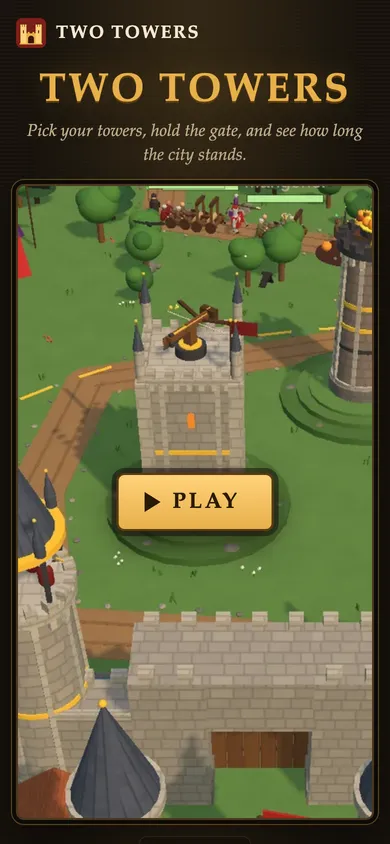
If walls, water and one guarded way in are what you came for, Two Towers is a free medieval tower defense game in your browser where you hold a city gate with two towers you choose.
Eltham Palace history at a glance
English Heritage, which looks after the site, tells the history of Eltham in four parts: a bishop's manor, a royal home, a farm among ruins, and a modern house built round what was left. Its Three Queens page counts over 300 years as a royal residence. The heavy use ran from 1305 to the 1530s.
One word in the name misleads. Before 1933 Eltham was still called a manor, not a palace, as the page on three queens at Eltham points out. The chronicler Jean Froissart, who came in 1364, called it "a very magnificent manor". Medieval kings knew it as a manor.
A bishop's moat and one way in
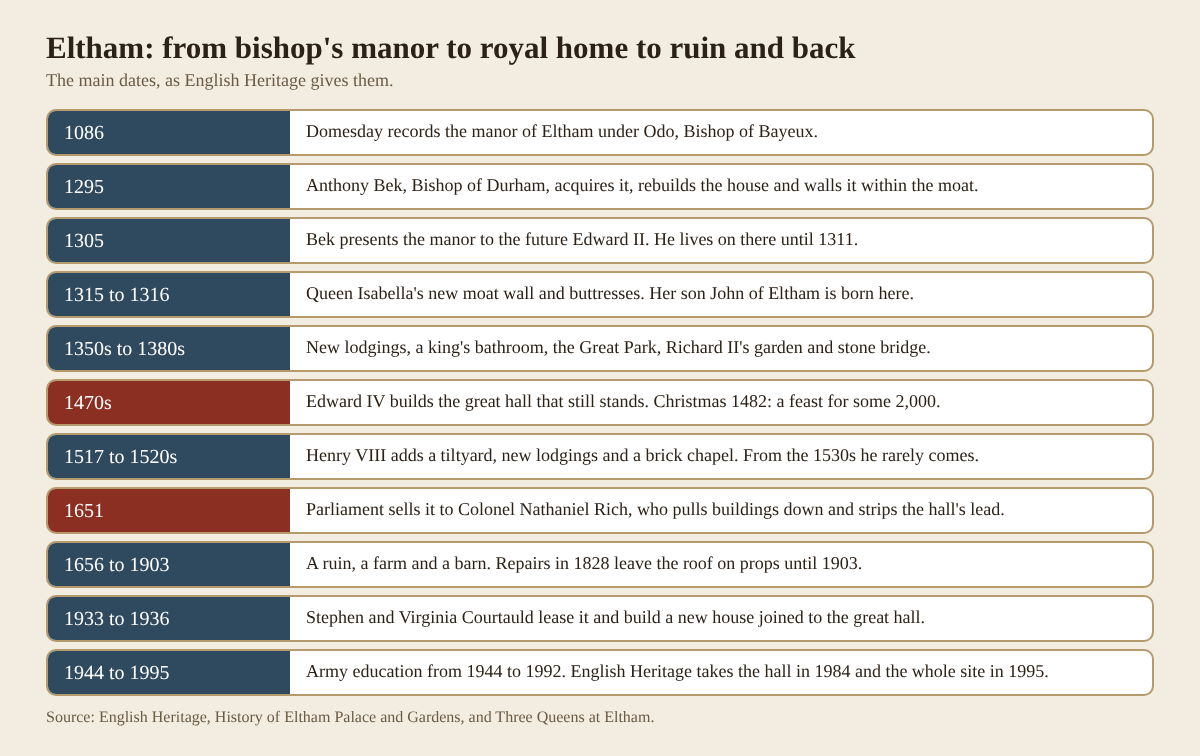
Domesday records Eltham in 1086 as a manor of Odo, Bishop of Bayeux, half-brother of William the Conqueror. Bek acquired it in 1295.
Bek seems to have rebuilt the house and put a defensive wall of stone and brick round it, inside the line of the moat. That is how a moated manor works: the wall stands at the water's edge, and the only way in is a bridge the household controls. At Eltham that was a timber drawbridge, probably where the north bridge is now. Digging in the 1970s found remains of his great hall, with an eight-sided stone hearth and a tiled floor.
The first wall did not last. By 1315 it was failing, and on Queen Isabella's orders a new retaining wall went up around it, with buttresses to hold the older masonry. Parts of her wall still stand. The moat walls were altered again in the 1350s and 1360s, with a new drawbridge. The moat was never finished work. For what the water itself was for, see our post on the castle moat.
Why kings kept coming back
Bek lived on at Eltham until he died in 1311. Edward II later granted the manor to Isabella, and their second son, born there in 1316, was known as John of Eltham.
What the kings then paid for tells you what the place was for, and it was not towers. In the 1350s and 1360s new royal lodgings gave Edward III a bathroom with a tiled floor and glazed windows, and the records mention chapels for king and queen and a garden with vines. Land enclosed in 1367 and 1368 began the Great Park, later almost 1,300 acres (525 hectares). In the 1380s Richard II made a walled garden beyond the moat "for the king and queen to have dinner there in the summer time", and added a dancing chamber and a new bathhouse.
Guests followed. Henry IV spent 10 of his 13 Christmases as king there and entertained the Byzantine emperor at Christmas 1400. He built timber-framed apartments for himself and two-storey lodgings for his queen, Joan of Navarre. In 1445 new buildings went up for Henry VI's bride, Margaret of Anjou.
The great hall of the 1470s, by the numbers
Edward IV built the great hall in the 1470s for court dining, entertaining and receptions. It measures 30.8 metres by 10.9 metres. English Heritage's page on Eltham's significance calls it the largest surviving pre-Tudor great hall without aisles in the country, after Westminster Hall. No aisles means no rows of posts down the floor, so the roof has to cross the whole width.
The roof is how it does that. English Heritage's description of the palace calls it a "false hammer-beam" roof in oak: short horizontal hammer-beams reach in from each wall on arched braces, short upright posts are jointed into their ends, and curved wind-braces stiffen each truss. A louvre let out the smoke of an open hearth in the middle of the floor, and there is evidence the timbers were once partly gilded.
Now run the numbers. The floor is about 336 square metres (30.8 times 10.9). At Christmas 1482, on Edward's last visit before he died the next April, a feast was given at Eltham for some 2,000 people. Divide one by the other and each guest gets a square about 41 centimetres on a side, with no room left for a table. English Heritage does not say how they were fed. The sum says it was not all at once in this room, and the page's own words, "during the Christmas season", leave room for many sittings over many days. A steadier number is the Tudor court of 800 or more: Eltham was one of only six residences large enough to house and feed it.
Worked example: read the site in six stops
You can date what is left of the medieval manor by walking it in order.
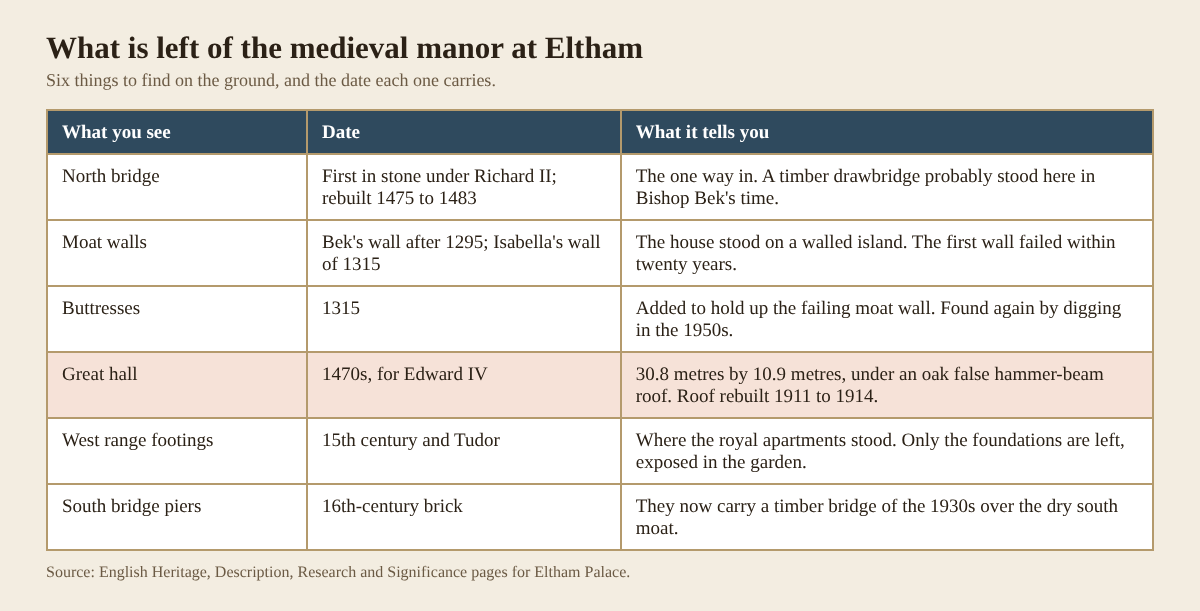
- Cross the north bridge. It was first built in stone under Richard II and rebuilt between 1475 and 1483. You are entering where Bek's drawbridge probably stood.
- Look down at the moat walls. Bek's wall dates from after 1295 and Isabella's from 1315.
- Find a buttress. Excavations from 1952 to 1957 exposed Bek's wall and the buttresses added in 1315 to hold it up.
- Enter the great hall. The roof is of the 1470s, but it was taken apart and rebuilt between 1911 and 1914. The minstrels' gallery and the stained glass of 1936 are the Courtaulds' additions.
- Walk the west side. The exposed footings are the 15th-century and Tudor royal apartments. Nothing stands above the foundations.
- End at the dry south moat. A timber bridge of the 1930s rests on 16th-century brick piers.
Six stops give you four building campaigns: Bek's around 1300, Isabella's in 1315, Edward IV's from the 1470s to 1483, and the Tudors' in the 16th century. The rest, from the king's bathroom to Joan's lodgings, is known from building accounts and excavation, not from standing walls.
The same habit works in Two Towers, where the kingdom cards say what the ground does before you start. Fenmere's card reads "Fords slow the attackers, but many more of them come". Water there does a moat's job: it buys the defenders time, at a price. And when the gate is hurt, its sheet puts Isabella's problem of 1315 to you: "Repair what the attackers broke, or reinforce it."
What ended it: neglect, not a siege
The strongest objection to treating Eltham as a fortress is that English Heritage's history of it records no siege. Its "defensive perimeter wall" is the nearest it comes to a castle, and what emptied it was distance and fashion, not an army.
Henry VIII spent much of his boyhood at Eltham. He built new lodgings and a brick chapel in the 1520s, and in 1525 Cardinal Wolsey's Ordinances of Eltham, rules to cut waste in the royal household, were ratified there. But in the 1530s Henry rarely came. He preferred Hampton Court, and Greenwich, which was easier to reach from Westminster by river.
James I found the place "farre in decay", and Charles I was the last king to visit. In 1651 Parliament sold it to Colonel Nathaniel Rich, who pulled down many buildings and stripped the lead from the great hall roof. John Evelyn saw it in 1656: "Both the palace and chapel [are] in miserable ruins". For two centuries it was a farm and the hall a barn. Repairs in 1828 left the roof on props until 1903.
In 1933 Stephen and Virginia Courtauld took a 99-year lease and had the architects Seely and Paget build a modern house joined to the hall, after some controversy. English Heritage has managed the whole site since 1995.
What is still unsettled
English Heritage lists open research questions. Nobody has shown where the moat's water came from, or how leaks were stopped. Exchequer accounts mention two new timber bridges, in 1584 and in 1586 to 1587, and they may be one and the same.
Two more limits apply. The queens' part is thin on evidence: the Three Queens page says the queens "almost certainly influenced Eltham's development", yet Katherine of Aragon "left no evidence for her direct involvement". And the hall you stand in is partly a modern idea of the Middle Ages. In the charity's words, "Much of the 1930s work represents Stephen Courtauld's (and his architects') concept of what a medieval great hall should look like."
Frequently asked questions
Who built Eltham Palace?
Anthony Bek, Bishop of Durham, rebuilt the moated manor house after 1295 and gave it to the future Edward II in 1305. The great hall that survives was built for Edward IV in the 1470s.
Why is Eltham called a palace?
It is a modern name. English Heritage notes that before 1933 Eltham was still called a manor, and Froissart in 1364 called it "a very magnificent manor".
How big is the great hall at Eltham Palace?
It is 30.8 metres long by 10.9 metres wide. English Heritage ranks it the largest surviving pre-Tudor great hall without aisles in England after Westminster Hall.
Was Eltham Palace ever besieged?
English Heritage's history of the site records no siege. It declined through neglect from the 1530s, and in 1651 Parliament sold it to Colonel Nathaniel Rich, who demolished much of it.
Get started
Eltham's moat wall needed propping within twenty years. Two Towers hands you the same choice, mend or strengthen, at a city gate, with the game's own advice to go on: "Spend your gold on Damage between stages, and Reinforce the gate." Play Two Towers: it is free and plays in your browser on a computer or a phone.
Defend the castle gate, stage after stage.
Visit twotowers.vlvd.net↗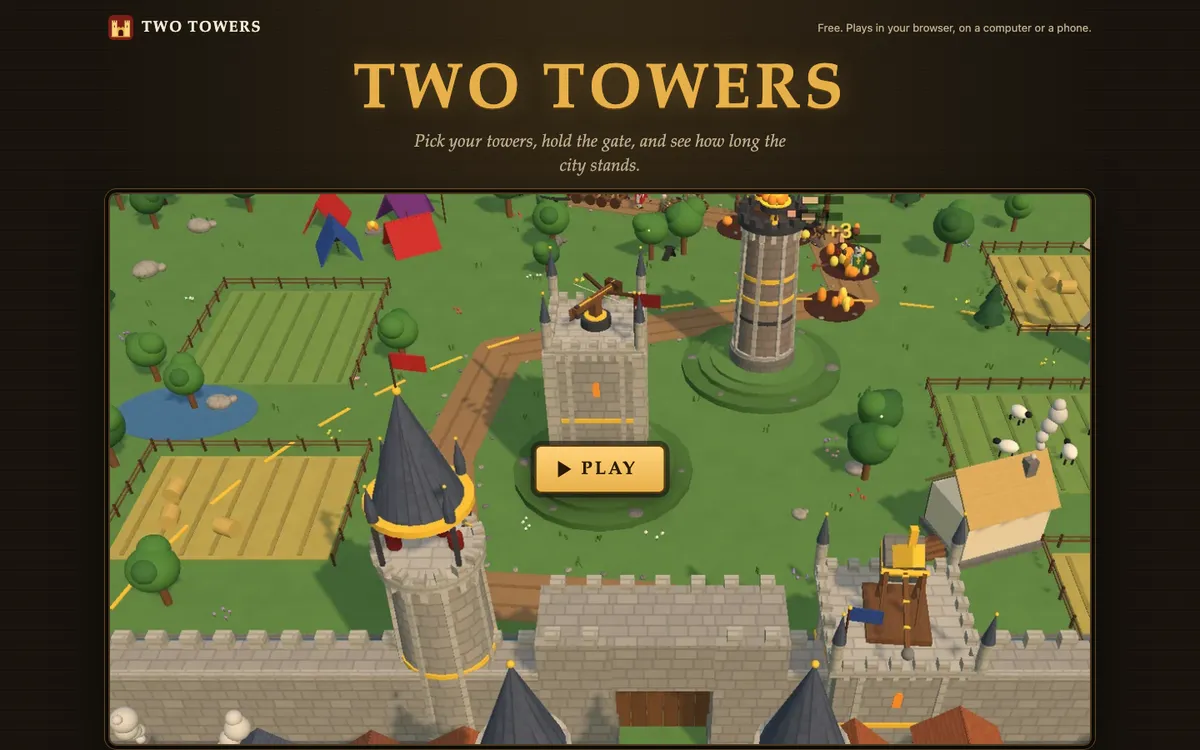
Comments
No comments yet.