What was a castle moat for? Water, ditches and sieges
What was a castle moat for? A moat was a deep ditch around a castle, often filled with water, that kept attackers away from the walls. One of its jobs is easy to miss: English Heritage says moats, or even artificial lakes as at Kenilworth Castle, made it impossible for besiegers to undermine the walls. This post explains wet moats and dry ditches, walks you through a real siege where the water mattered, and shows how people crossed. At the end you meet the diggers in Two Towers, a free tower defense game in your browser.
The history here comes from English Heritage pages opened while writing this post. Where a source is unsure, so is this post.
What was a castle moat for?
A moat did three jobs at once:
- It kept attackers back. Anyone bringing a ladder, a ram or a siege tower to the wall had to cross it first.
- It stopped miners. Miners dug tunnels under walls to bring them down. Water stopped the tunnel before it started.
- It funnelled everyone to the bridge. The castle's own people crossed by a bridge, so the gate behind it was where an attacker on foot had to come.
Ditches are much older than castles. English Heritage's history of castles through time describes hillforts with ramparts, ditches and wooden palisades, and Roman forts defended by ramparts, ditches and wooden towers. The first Norman ringworks had banks and ditches forming a rough circle, with a wooden fence on top. Our post on the motte and bailey castle covers the other early Norman design.
Wet moats and dry ditches
Not every moat held water. English Heritage's castles show both kinds, and some in between:
- Water. Berkhamsted Castle had water-filled ditches. Nunney Castle's tower is encircled by a moat.
- Partly water. Middleham's first castle was a ringwork surrounded by a deep ditch, which survives, partly water-filled.
- Cut into rock. At Beeston Castle, a great rock-cut ditch from the 1220s separates the outer ward from the inner ward, and the stone quarried from it was used to build the castle. At Dunstanburgh, the moat at its east end is cut deep into the bedrock.
- Doubled. Scarborough Castle stands on a headland protected on three sides by cliffs and the sea. On the fourth side, facing the town, is a massive double ditch.
How a moat stopped miners
English Heritage's guide to medieval siege warfare explains the method. Miners dug under the foundations of a wall to make a tunnel, called a sap or mine. At its end they made a large cavity shored up with timber props, filled it with things that burn, and set it on fire, so the wall above collapsed. Our post on undermining a castle explains it step by step.
Water beat it. At Kenilworth in 1266, English Heritage says the water defences were preventing the royal forces from undermining the castle walls. King John had strengthened Kenilworth's outer defences, which included a giant mere, or lake. So Henry III's army tried something else: the king had barges hauled overland from Chester for an assault across the mere. The defenders drove them back.
A worked example: Berkhamsted, 1216
Berkhamsted Castle shows what a moat did in a real siege. Follow it step by step, as English Heritage tells it.
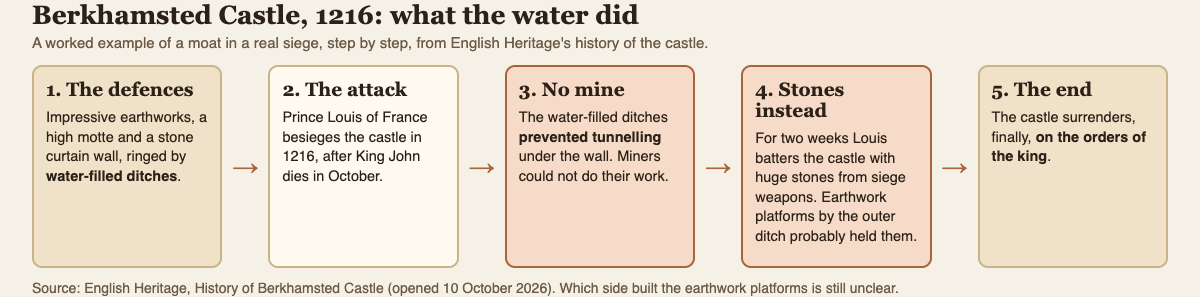
- The defences. Berkhamsted was designed as a fortress, with impressive earthwork defences, a high motte and a stone curtain wall. Around it ran water-filled ditches.
- The attack. Prince Louis of France had invaded England at the invitation of barons opposed to King John. John died in October 1216 and his nine-year-old son was crowned Henry III. Louis had to act quickly, and besieged Berkhamsted.
- No mine. English Heritage says the water-filled ditches prevented tunnelling under the wall. One way through the wall was closed.
- Stones instead. Louis besieged the castle for two weeks, battering it with huge stones flung from siege weapons. Earthwork buttresses by the outer ditch were probably platforms for those machines, although it is still unclear which side built them.
- The end. The castle surrendered, finally, on the orders of the king.
Now compare Dover in the same year. English Heritage says that during the Great Siege of Dover in 1216, Prince Louis's miners burrowed tunnels through the chalk beneath the castle walls, and the eastern tower of the gatehouse collapsed. The same prince, the same year: where there was chalk his miners got under the wall, and where there was water they could not.
Notice what the moat did and did not do. It did not make the castle impossible to take. It took one method off the table and forced the attacker into another. For how long sieges like this could run, see how long a medieval siege lasted.
Crossing the moat
The people who lived in a castle had to cross its moat too, so a moat needed a crossing. What survives today is usually the stonework around it.
- Scarborough. The only approach to the castle is by a great bridge across its double ditch.
- Castle Acre. The town's Bailey Gate was approached by a timber bridge across the defensive ditch, which is now filled in.
- Nunney. When the castle was cleared in 1926, both the moat and the medieval drawbridge pit beneath the far end of the bridge were dug out again.
- Dunstanburgh. There was originally a drawbridge over its rock-cut moat.
A drawbridge could be raised to leave a gap where the bridge had been. Our post on the castle drawbridge explains how.
Above the ditch, and into it
An attacker who did get into the ditch was in a bad place. At Beeston, six square holes beneath the parapet held the beams of a hoarding, a defensive gallery from which missiles could be dropped onto attackers in the ditch below. See our post on castle hoardings.
Moats also took the castle's waste. English Heritage's Goodrich glossary defines a latrine chute as a sloping channel built into a wall to allow waste from the toilet to escape into the moat or stream. At Goodrich, waste fell down a chute into a cess pit, and was shovelled from there into the ditch.
Diggers in Two Towers
In Two Towers you hold a city gate, and the game has its own miners. A sapper "Digs under a hill tower to silence it". A tower that has been dug under shows "Silenced N s: undermined" and stops shooting for a time.
There is no moat to dig, so you stop them another way. The game's tip: "Sappers dig under hill towers to silence them: Archer Volley catches them off the road, and a Bell slows the dig." And for the attackers who do reach the gate, like rams: "Reinforce the gate, and use Ballista bolts that ignore armor." Our post on how to stop sappers and fire archers has more.
Frequently asked questions
Were castle moats always filled with water?
No. Some were wet, like Berkhamsted's water-filled ditches, and some were dry, like the rock-cut ditch at Beeston Castle.
Why did castles have moats?
To keep attackers back from the walls and to stop miners. English Heritage says moats or artificial lakes made it impossible for besiegers to undermine the walls.
How did people cross a castle moat?
By a bridge, sometimes a drawbridge that could be raised, as at Dunstanburgh. Scarborough's only approach is a great bridge across its double ditch.
Is there a moat in Two Towers?
You do not build one. You defend a city gate, and sappers dig under your hill towers instead of the walls.
Get started
Play Two Towers and keep the sappers away from your hill towers. It is free and plays in your browser on a computer or a phone.
Comments
No comments yet.
Sign in or make an account to comment.