What was a castle drawbridge and how did it work?
What was a castle drawbridge? It was a bridge across a castle's moat or ditch that could be raised, so the way in disappeared when danger came. English Heritage's glossary defines a drawbridge as a bridge, especially one over a castle's moat, which is hinged at one end so that it may be raised. This post explains how a drawbridge worked, walks you through one real castle gate from the outside in, and shows what survives today. At the end you can see the gate you defend in Two Towers, a free tower defense game in your browser.
The history here comes from English Heritage: its castle history pages, its Goodrich Castle glossary for schools, and its Goodrich teachers' guide.
What was a castle drawbridge?
A castle surrounded by a moat or a ditch had a problem. The ditch kept attackers away from the walls, but the people of the castle still had to get in and out. A fixed bridge would let attackers walk across too.
The drawbridge solved that. It was a bridge hinged at one end, so it could be raised. Lowered, people could cross. Raised, it left a gap where the bridge had been.
Ditches mattered for more than keeping people back. English Heritage's history of castles through time says moats, or even artificial lakes as at Kenilworth Castle, made it impossible for besiegers to undermine the walls. Miners, who dug under walls to bring them down, could not tunnel through water. For more on how that worked, see our post on undermining a castle.
How a castle drawbridge worked
Raising a bridge took a machine. The clearest evidence for that machine is in the room above the gate.
At Etal Castle in Northumberland, English Heritage says the gatehouse's first floor had one large room which housed a winch for operating the drawbridge and the portcullis. A winch is a drum turned by handles, winding a rope or chain. One room, one machine, two defences: the bridge in front and the grille behind it.
At Goodrich Castle, the teachers' guide describes rare evidence of the mechanism above its gate passage: recesses that gave turning room for the winch handles, and a long round hole where the horizontal axle of the winch sat. That winch worked the portcullis, but it shows you how these gate machines were built into the stone.
A worked example: walk through Etal's gate
The best way to understand a drawbridge is to approach one. Here is Etal Castle's gatehouse, as English Heritage describes it, from the outside in. It was probably built between 1341 and 1368, after King Edward III gave a licence to crenellate in 1341.
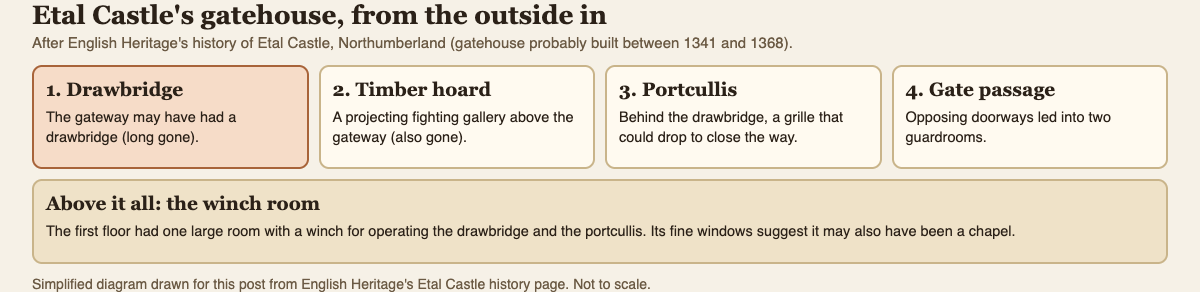
- The drawbridge. English Heritage says the gateway may have had a drawbridge. It is long gone. If the bridge is up, you stop here.
- The hoard. Above the gateway there may also have been a projecting timber hoard, a fighting gallery from which defenders could attack anyone at the gate. That is gone too.
- The portcullis. Behind the drawbridge was a portcullis, a heavy grille that dropped to block the way.
- The gate passage. Past the portcullis, opposing doorways led into two guardrooms, one on each side of you.
- Above your head. The first floor had one large room with the winch for the drawbridge and the portcullis. Its elaborate windows suggest it may have doubled as a chapel.
Notice the order. The drawbridge is the first defence, and the room that controls it sits safely above and behind it. An attacker who wanted to lower the bridge would have to get inside first.
Etal also shows the limit of all this. English Heritage says its curtain wall was never strong enough to resist guns, and the garrison quickly surrendered to the Scottish army in 1513 for that reason. However strong the gate, the walls around it had to hold too. Read more in our posts on the castle gatehouse and the portcullis.
Drawbridges at other castles
Most drawbridges are gone, Etal's among them. What survives is the stonework around them. Three more English Heritage castles show what to look for.
- Goodrich Castle. Its barbican, an outer defence in front of the gate, is similar in design to the barbican at the Tower of London: a semi-circular courtyard joined to the main castle by a drawbridge and a stone causeway. Behind it the gatehouse had a fighting platform beside the bridge, two large wooden doors with drawbars, grooves for two portcullises, murder holes in the ceiling and arrow loops in the walls. See our post on what a barbican was.
- Dunstanburgh Castle. At the east end, Egyncleugh Tower had a narrow gateway on the ground floor with lodgings above. English Heritage says there was originally a drawbridge over the moat, which is cut deep into the bedrock at that point.
- Pevensey Castle. Its inner gatehouse was probably built in about 1200, and the causeway and drawbridge pit are later medieval additions. The pit is the gap a drawbridge spans.
When the bridge was the weak point
A bridge only protects a castle if someone looks after it. Pevensey's history has a story that shows it. In 1306 the constable, Roger de Levelande, was accused of breaking up and selling the wooden bridge over the moat. English Heritage says royal accounts from the 1270s onwards show the buildings were continually on the verge of ruin despite repairs.
Attackers had drawbridges of their own, too. English Heritage's guide to medieval siege warfare says siege towers had fighting platforms on top from which the battlements were bombarded with arrows, before a drawbridge was dropped onto the parapet for the assault troops. See what a siege tower was.
The gate in Two Towers
In Two Towers there is no drawbridge to raise. Your job is to hold the city gate, and if it falls, the game is over. Every stage comes stronger, faster or in greater numbers than the last.
Like a real constable, you look after your gate between attacks. The gate's sheet in the game says "Repair what the attackers broke, or reinforce it." Repair shows +25%, and Reinforce adds strength for gold. Pevensey's constable was accused of selling his bridge; you can do better. Our post on when to repair and when to reinforce covers it.
Frequently asked questions
What is a drawbridge on a castle?
English Heritage defines it as a bridge, especially one over a castle's moat, which is hinged at one end so that it may be raised.
How was a castle drawbridge raised?
At Etal Castle, a room above the gate passage housed a winch that worked both the drawbridge and the portcullis.
Do any medieval drawbridges survive?
Most are gone. What you can still see is the stonework: drawbridge pits like Pevensey's, gatehouses like Etal's and Goodrich's, and moats like Dunstanburgh's.
Is there a drawbridge in Two Towers?
No. You defend a city gate that you can repair or reinforce with gold between attacks.
Get started
Play Two Towers and keep your gate standing longer than Pevensey's bridge. It is free and plays in your browser on a computer or a phone.
Comments
No comments yet.
Sign in or make an account to comment.