Hadleigh Castle: Hubert de Burgh's castle on the Essex coast
Hadleigh Castle, in Essex, had three lives. A royal minister built it in the 1230s to show how powerful he was. A king rebuilt it in the 1360s to guard the Thames against French raiders. And in 1551 a new owner sold it for building material. English Heritage tells the story on its history page for the castle, and this post follows it in order, then shows a way to read any castle you visit.
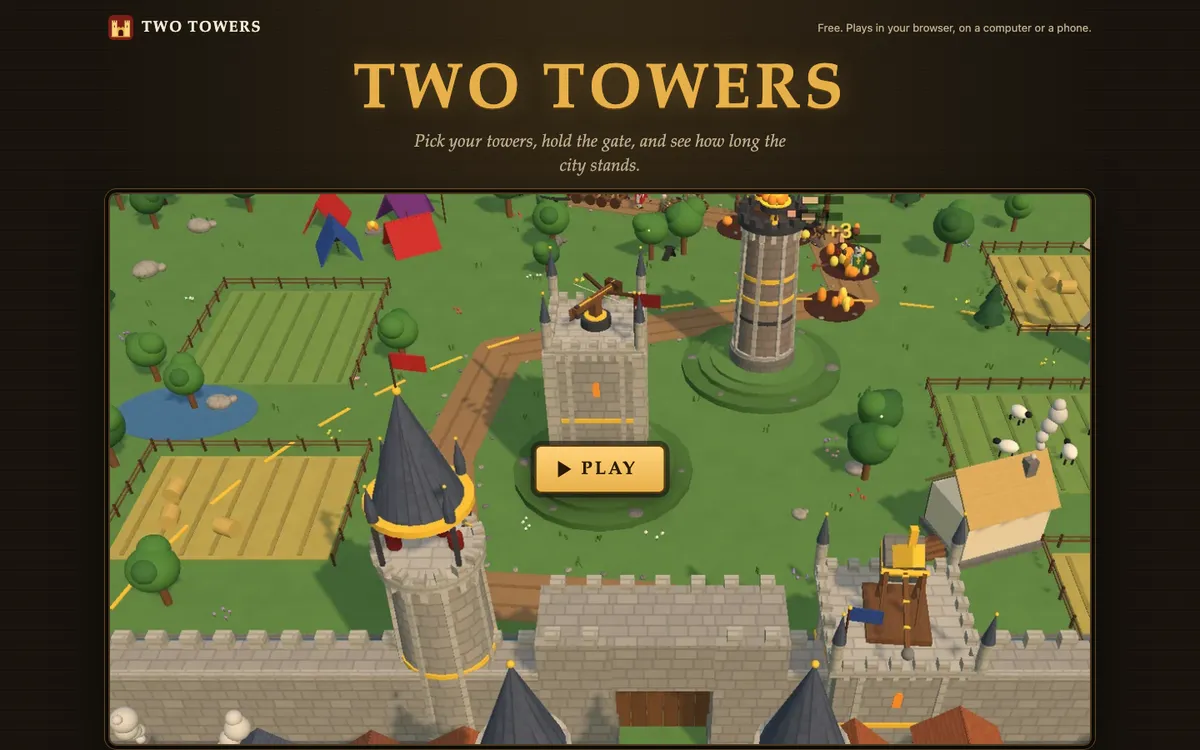
If you like thinking about what a defence is for, Two Towers is a free browser tower defense game where you choose which two towers guard a city gate and spend gold to hold it against stronger attackers every stage.
Hadleigh Castle and the man who built it
In 1215 King John gave the manor of Hadleigh, with many other gifts, to Hubert de Burgh, his chief minister or justiciar. Hubert was a trusted follower of the king and the custodian of two important royal castles, Windsor and Dover. At Dover he proved his military skill by defending the castle in a fierce siege in 1216. For why a gate was the part of a castle most worth attacking, see the castle gatehouse post.
Hubert later became effectively the ruler of England while Henry III was a child. English Heritage says he built Hadleigh as a large turreted castle, "as a statement of his power", and that in the 1230s he spent great sums of money on it. That is the first thing to notice about Hadleigh: it was not built because a frontier needed a fort. It was built because a man at the top of the kingdom wanted a castle that looked like it.
He did not enjoy it for long. His career ended after quarrels with the king, and he was forced to return his lands, Hadleigh among them, in 1239.
A hundred quiet years in royal hands
The castle stayed with the crown, but nothing much happened to it. English Heritage says it was not until the time of Edward II, nearly 100 years later, that the king began to use it as a royal residence. A castle can sit on a coast for a century without a siege and without a purpose, and Hadleigh did.
It also had a problem that no owner could fix. The castle stands on geologically unstable clay. As early as 1274 it was said to be "badly built and decayed". The plan of its building phases on English Heritage's page shows how the ground kept winning: later landslips pushed the south wall out of place and brought down most of the north-east tower. The ruin you see today leans because of the hill, not because of any enemy.
Edward III and the Thames estuary
The second life began with Edward III. English Heritage calls him the first king to see Hadleigh's strategic importance. It was well placed as a base for defending the Thames estuary against French raids during the Hundred Years War. Edward's claim to the French throne had led to war, and the need for a more systematic defence of the estuary led him to refurbish and extend Hadleigh and to build Queenborough Castle on the opposite shore, in Kent. Two castles facing each other across the water watched the same approach to London.
The works were large. English Heritage describes a ten year programme of refurbishment, ending about 1370, that gave the castle a new gateway and high tower, lodging chambers and a chapel. The east front was transformed with two impressive towers. The place page adds that the barbican and the two drum towers belong to this work of the 1360s. A barbican is an outwork that protects a gate; the barbican post explains how one worked.
Notice what the money bought. A king who feared raiders from the sea spent it on the gate, the towers and the front that faced the way an enemy would come. He also spent it on rooms. Hadleigh became a favourite retreat for the ageing king, and the excavated foundations of the great hall show a serving room at one end and, beyond it, a private withdrawing room, or solar. The castle was surrounded by parkland, and possibly a garden or orchard near the entrance.
How Hadleigh ended
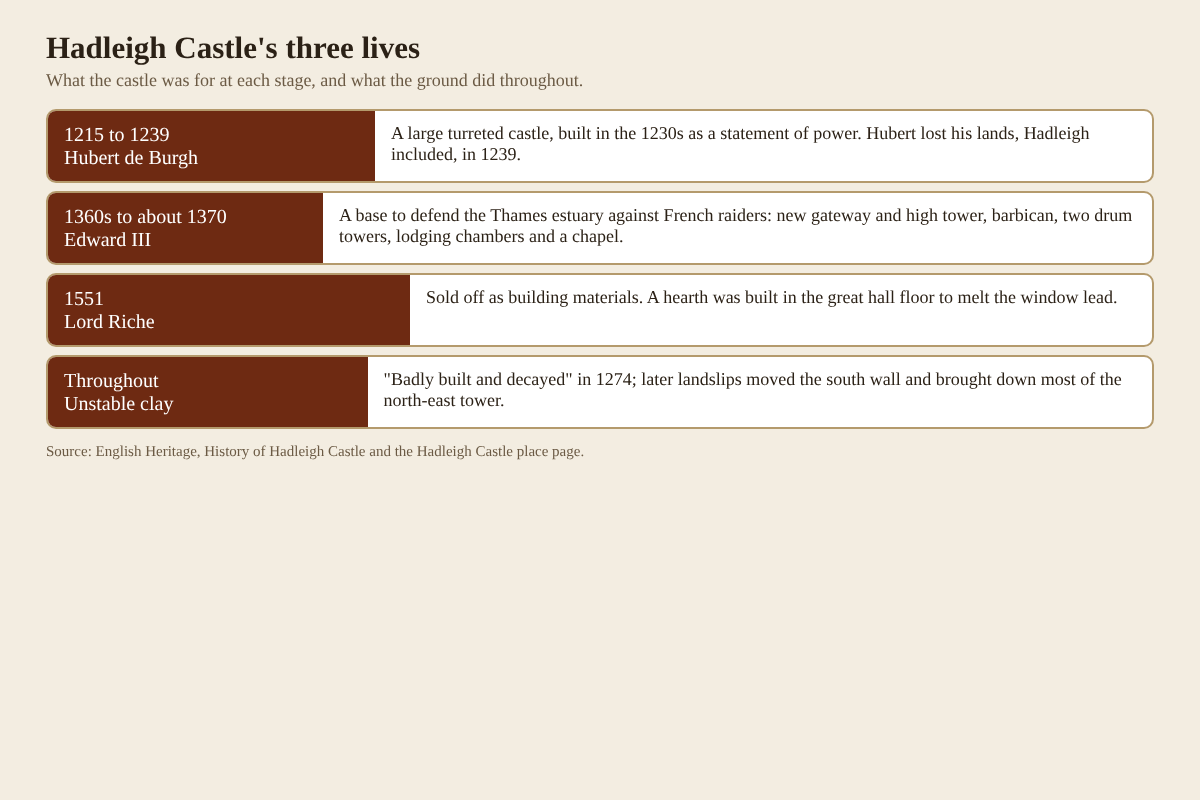
Edward III's successors took little interest in the castle as a residence. After it was leased to a succession of tenants, it was sold to Lord Riche in 1551, who sold it off as building materials. English Heritage records one detail from the demolition: a tiled hearth was built into the floor of the great hall so the valuable lead from the windows could be melted down on the spot.
That is the third life. The stone and the lead mattered more than the castle did. It is a quieter end than a siege, and a common one. For the deliberate kind, where an army wrecked a castle on purpose, read the slighting a castle post.
Visiting Hadleigh Castle
The ruins look out over the Essex marshes. English Heritage's place page says entry is free and the site is open any reasonable time during daylight hours. There is no car park at the castle; the closest on-street parking is in Castle Lane, about 200 metres from the entrance. Access from the north side is along a 200-metre earth footpath, the castle is at the top of a steep slope, and the paths can get very muddy in wet weather. There are no facilities at the castle. Dogs on leads are welcome. One of the drum towers was later used by Georgian revenue men looking out for smugglers, a different kind of watcher on the same coast centuries later. Check the page for changes before you go.
A worked example: read any castle in three questions
Hadleigh shows why one question is never enough. Try three, using only what the history page says.
- Who built it, and what for? Hubert de Burgh built a statement of power in the 1230s. Edward III built a base against raiders in the 1360s. Same walls, two purposes.
- What was it built on? Unstable clay. A warning of "badly built and decayed" in 1274 and later landslips show the ground was a threat the builders never beat.
- What happened when the purpose ended? The castle was leased, then sold in 1551 for its stone and lead.
Run the same three questions on a castle near you and the result is usually a story with more than one author. For one with a stronger fighting record, compare the castle constable post, which follows the man who had to hold a castle when it was attacked.
The same question in Two Towers
Hadleigh's lesson is that the ground and the purpose matter as much as the wall. Two Towers asks you the same. On the title screen you pick the tower for each side of the gate from four kinds: Archer Tower, Trebuchet, Ballista or Fire Tower. Then you click or tap a tower to upgrade it, and you buy two more towers for the hills, 150 gold for the first and 300 for the second. Gold in the game is in-game gold, never money.
The game's own tips tell you who is coming. One reads: "Archers shoot the gate from the road: buy Range so your towers reach them before they stop." A short plan in the spirit of Hadleigh: read the tip for the next attacker, name what it threatens, and spend your gold on the upgrade that answers it rather than on what looked best last stage. Edward III spent on the gate and the front that faced the sea; you spend on the side the attackers will hit.
The game is free, with no ads, and plays in your browser on a computer or a phone. Signing in is optional.
Frequently asked questions
Who built Hadleigh Castle?
Hubert de Burgh, Earl of Kent and chief minister to King John, who was effectively ruler of England in Henry III's childhood, began it in the 1230s. Edward III rebuilt and extended it in the 1360s.
Why was Hadleigh Castle built on the Essex coast?
Hubert built it as a statement of his power. Edward III used its position to defend the Thames estuary against French raiders during the Hundred Years War.
Why is Hadleigh Castle in ruins?
It was sold to Lord Riche in 1551 and sold off as building materials. It also stands on unstable clay, and landslips displaced the south wall and brought down most of the north-east tower.
Can you visit Hadleigh Castle?
Yes. English Heritage says entry is free and the site is open any reasonable time during daylight hours. There is no car park and the paths can get very muddy in wet weather.
Get started
Hadleigh teaches one habit: ask what a defence was built for, and what it was built on, before you judge it. Try that in Two Towers, free in your browser. Pick your two towers, read the tip for each attacker, and spend your gold where the next stage will hit.
Comments
No comments yet.
Sign in or make an account to comment.