How to get kids excited about going for a walk: let them lead
The simplest answer to how to get kids excited about going for a walk is to hand them the lead. The charity Living Streets makes it one of its #Try20 tips: children can help you see the world, and walking, from a different perspective, so let them guide you. Add a small purpose to each walk and a job for the child, and a walk stops being something done to them.
If your child loves spotting cats, Cat Go turns that into a reason to head out: it is a game in your browser where you walk to treat stops on a map and photograph a real cat you meet, then keep it in your Catdex with its breed and where you found it.
Why children resist "going for a walk"
To an adult, a walk is a break. To a child, "we're going for a walk" can sound like being taken somewhere with nothing to do when you get there. The walk belongs to the grown-up: their route, their pace, their reason.
The fixes below all work on that one problem. They give the child a say, a reason or a role. None of them needs a screen, and most need nothing at all.
It is worth the effort. The NHS says children and young people aged 5 to 18 should aim for an average of at least 60 minutes of moderate or vigorous activity a day across the week, and it lists walking to school or walking the dog among the examples. Living Streets adds that walking has been proven to improve children's energy and concentration, so it might help with learning too.
Let them lead the way
This is Living Streets' tip 10, and it is the one that changes the most. Instead of walking a set route, let your child choose which way to turn at each corner. You stay in charge of safety: which roads to cross and where to stop. They are in charge of the direction.
A few ways to make it work:
- Give a choice, not an open question. "Left to the park or right to the shops?" is easier for a young child than "Where do you want to go?"
- Agree the limits first. Say how long the walk is and which streets are out of bounds before you leave, so leading never means arguing.
- Follow their pace. If they stop to look at a snail, that is part of the walk. Children notice what adults walk past.
- Let older children plan the route. Give them the time you have and let them pick a loop, then follow it.
Give each walk a small purpose
Living Streets' tip 9, "have an adventure", suggests turning a walk into something with a point: litter picking, a scavenger hunt, or taking snaps of all the pretty things you see. A purpose answers the child's real question, which is "why are we doing this?"
Its family walking activities booklet, made for primary school-aged children, has many ready-made purposes. A few of them:
- I Spy (ages 4 to 7). Spot a post box, a bus stop, flowers, and a stream, pond or puddle, then answer "What else did you see?"
- Nice to see you (ages 4 to 7). Keep a list of things that make you happy on the walk, "maybe a friendly neighbour or a fluffy cat", then pick one to draw at home.
- A life of their own (ages 8 to 11). Pick something that catches your eye, like a wonky tree or a funny-looking car, and give it a name, an age and a secret life at night.
- Special delivery. Write a letter before you go, then post it on the walk, through a friend's door or in a post box.
For a full list-based hunt, see our guide on how to plan a walking scavenger hunt. For a one-colour version, see what a colour walk is.
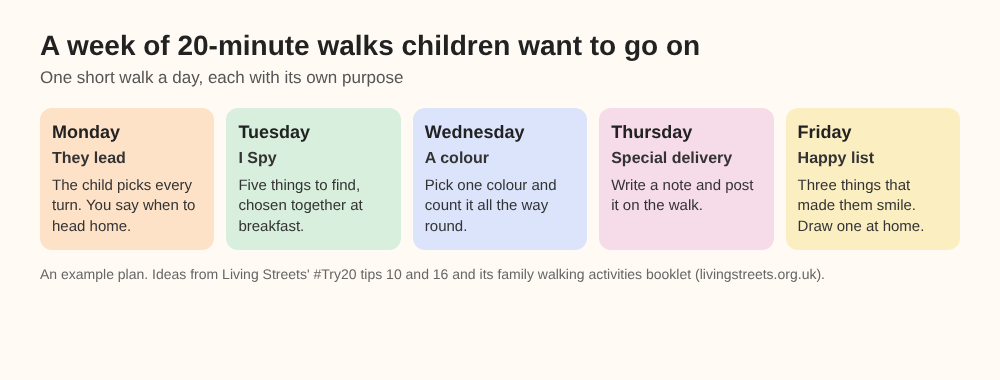
An example week: one short walk a day, each with its own purpose.
Give them a job
Children who have a role on a walk tend to stay in it. Jobs can rotate each day so nobody gets bored:
- Navigator. Chooses the turns, as above.
- Spotter. Calls out things from the day's list.
- Photographer. Takes one picture at each stop, if you are happy to hand over a phone.
- Counter. Keeps a running count of something: dogs, benches, red doors.
- Timekeeper. Says when it is time to turn back.
One rule goes with every job: animals you meet are for looking at. Nobody chases, feeds or touches a dog or cat they do not know.
How to get kids excited about going for a walk every day
Excitement fades if every walk is the same. Short and varied beats long and repeated. The NHS suggests spreading activity through the day and cutting down long periods of sitting, so two short walks fit that advice as well as one long one.
Here is a worked example: a school week of 20-minute walks, in line with Living Streets' #Try20 idea of fitting 20 minutes of walking into your day.
- Monday: they lead. Your child picks every turn. You only say when to head home.
- Tuesday: I Spy. Five things to find, chosen together at breakfast.
- Wednesday: a colour. They choose one colour and count it all the way round.
- Thursday: special delivery. Write a note to a grandparent or friend and post it on the walk.
- Friday: happy list. Note three things that made them smile, then draw one at home.
Living Streets' booklet also suggests that it is sometimes easier to walk and talk, and to use a walk to ask a child how they are feeling. A walk where you are side by side, looking at the same street, can make that easier than a talk across a table.
For a version built around a game, our outdoor walking game plan for families with kids gives each child a role on one phone.
Frequently asked questions
How do I get my child to enjoy walking?
Give them a say and a reason. Let them choose the turns, as Living Streets' tip 10 suggests, and give each walk a small purpose such as a spotting list or a letter to post.
How long should a walk with young children be?
Short is better at first. Twenty minutes, as in Living Streets' #Try20 tips, is enough to make it feel like an outing without tiring them out.
How much activity do children need each day?
The NHS says children and young people aged 5 to 18 should aim for an average of at least 60 minutes of moderate or vigorous activity a day across the week. Walking to school or walking the dog are among its examples.
What if my child still does not want to go?
Try a different purpose or a different job, and keep the walk short. A walk they planned themselves, or one with a letter to post, often lands better than one more "let's go out".
Get started
Tonight, ask your child to choose tomorrow's walk: which way to go, and one thing to find. Agree the time and the limits, then follow their lead.
If spotting cats is what gets them out of the door, Cat Go makes that part a game. It needs your location, to find treat stops on its map and to record where each cat was caught, and your camera. You collect in-game kibble, and sometimes tuna, at treat stops as you walk. When you meet a cat, you take its photo, fitting the whole cat in the frame, then your child says which breed they think it is; "Mixed breed is always a safe pick." The food and the catch stay inside the game, so the real cat is only looked at. You can start under a made-up name, and saving your record with an email is optional.
Play Cat Go in your browser: walk anywhere, photograph a real cat, lure it with food and catch it.
Walk anywhere, find a real cat, and catch it.
Visit catgo.vlvd.net↗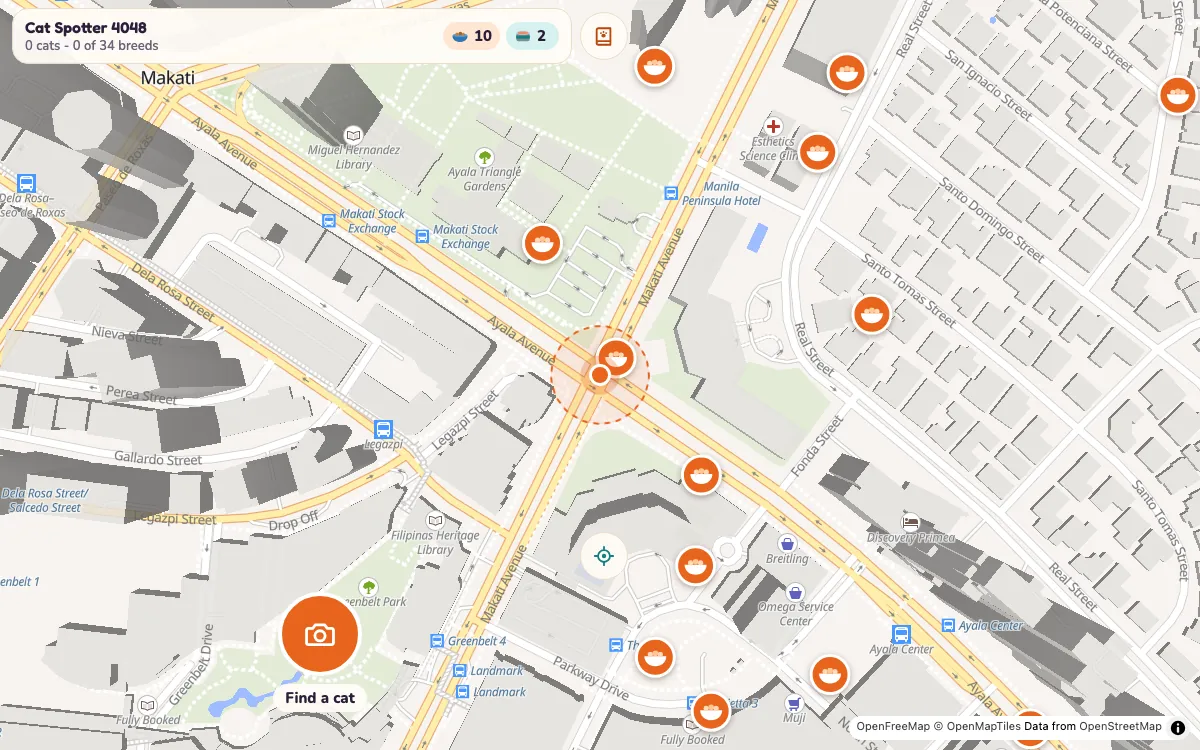
Comments
No comments yet.