How to go on a poetry walk: walk a poem, then write one
Here is how to go on a poetry walk: take a short poem out with you and walk it one line at a time: read a line, walk for a few minutes letting it play in your head, then stop and read the next. That is the method in Living Streets' Walkbook. The other kind of poetry walk works the other way round: you collect your own lines as you walk and shape them into a poem at home. This guide shows you how to do both, with a plan for each.
If cats tend to turn up in your lines, Cat Go keeps a record of them: you photograph a real cat you pass, and the game saves it with its breed, the time and the place you found it.
What is a poetry walk?
A poetry walk is a walk with poetry as its companion. In one version you bring a poem and let the walk change how you read it. In the other, the walk is the raw material, and the poem comes afterwards. Both slow you down and make you notice where you are.
Living Streets, the UK charity for everyday walking, names the poetry walk in tip 11 of its #Try20 tips, "get creative", and points to The Walkbook: Recipes for Walking and Wellbeing, a free collection of recipes by 30 UK artists from the Walking Publics/Walking Arts research project. Its poetry walk is called "Re-composition", by Sonia Overall, a walking writer, psychogeographer and academic.
How to go on a poetry walk with a poem you love
"Re-composition" suits solo walkers, pairs and small groups, and can be done anywhere, indoors or out. Sonia Overall suggests it to re-explore a familiar place, to make walking feel new again, or when you simply need to slow right down.
You need two things: up to an hour of walking time, and one poem of roughly 6 to 14 lines. Carry it however feels comfortable: a printed page, a small book, a copy in your own handwriting, or on your phone.
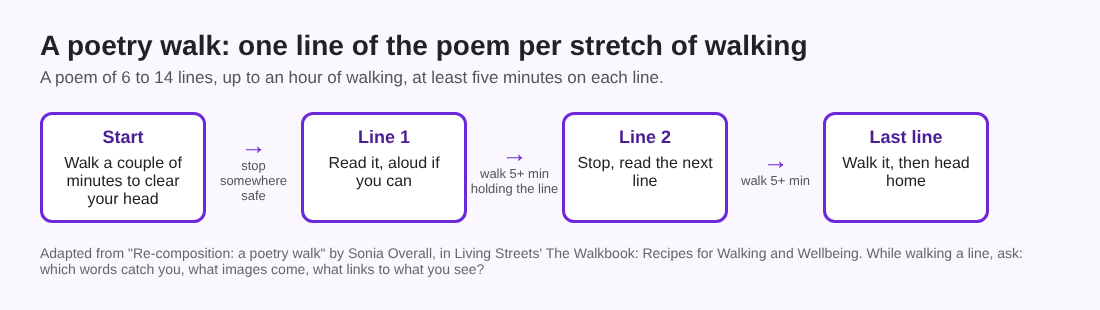
- Clear your head. Walk for a couple of minutes before you start.
- Stop somewhere safe and read the first line. Read it aloud if you can: to yourself, to a tree, or to the people you are walking with.
- Walk on, holding the line. Let it play over in your head. Which words catch your attention? What images come? Do they connect with what you can see? Does the rhythm of the line change the way you walk?
- Stop again and read the next line. Then walk with that one.
- Carry on until you have walked every line.
Her timing tip is the one that makes it work: give each line at least five minutes of walking. If the lines are very short, read two or three together. Scale the poem up for a long walk or down for a short one, and take your time. In her words, give the poem space to breathe.
If you write, you can walk a draft of your own poem the same way, as a way of editing it.
How to go on a poetry walk that writes your own poem
The second kind needs a notebook and a pencil instead of a poem. Here is a plan for a first try: about 30 minutes of walking, then 15 minutes at home.
- Choose a loop. A route that brings you back home means you never have to think about directions. Stick to public paths and pavements.
- Pick a theme, or don't. "Things left behind", "doors" or one colour gives your notes a thread. A colour walk pairs well with this.
- Walk the first few minutes without writing. Let your pace drop.
- Stop every three to five minutes. Look at one thing and write one line about it, under 12 words. Then move on.
- Use your senses in turn. What you see at one stop, what you hear at the next, then smell, touch and something you feel. This stops you writing ten lines about trees.
- Collect, don't judge. A flat line often sits next to the one good word you need later.
- Star your favourites on the way home: the two or three lines that still feel alive.
A poetry walk, worked through
Here is one 30-minute loop past a corner shop, a school gate and a row of terraced houses. The raw notes:
- Corner shop: "bananas going freckled in the window"
- School gate: "a lost glove pinned to the railing like a flag"
- Sound: "someone practising the same three piano notes"
- Smell: "wet leaves and toast"
- A grey cat on a wall: "the cat watches the street like it pays rent here"
- Feeling: "I walk slower when nobody is waiting for me"
At home, copy out only the starred lines. Find the one that holds the rest; here it is "I walk slower when nobody is waiting for me", and the others become what the walker saw while walking slowly. Cut small words like "very" and "just", and swap general words for exact ones: "bird" becomes "magpie". Then try the lines in the order you walked them, ending on the strongest:
Bananas freckling in the shop window. A lost glove pinned to the school railing, a small flag. Three piano notes, again, again. Wet leaves and someone's toast. A grey cat on the wall watches the street like it pays the rent. I walk slower when nobody is waiting for me.
It is not polished, and it does not need to be. Give it a place and a time for a title, such as "Tuesday, Elm Road, 4pm". Seven lines is also the right length to walk as a "Re-composition" poem next week, one line per stretch of road.
Poetry walks with kids and groups
For children, give each one a job, like "find sounds" or "find round things", and let them call out lines while you write them down. Twenty minutes and four stops is plenty. Letting them choose the way helps too, as in how to get kids excited about going for a walk.
For adults, walk the same loop, then have each person read one line aloud and put the lines in a row for a group poem. "Re-composition" also works for a group that cannot meet: agree a poem in advance, each walk it alone, then meet in person or online afterwards, or share your thoughts in a shared document, by email or in a social media thread.
Frequently asked questions
Do I need to be a poet to go on a poetry walk?
No. Walking someone else's poem needs no writing at all, and collecting your own lines only asks you to write one plain sentence about what you see.
How long should a poetry walk be?
Sonia Overall's walk takes up to an hour, with at least five minutes of walking per line, so a 6-line poem makes a walk of about half an hour. A walk that collects lines works well at around 30 minutes.
What poem should I take on a poetry walk?
Any poem of roughly 6 to 14 lines that you would like to know better. A poem about weather, a season or a place gives you plenty to connect with what you see.
How is a poetry walk different from a mindful walk?
A mindful walk asks you to notice things and let them pass. A poetry walk gives your noticing a poem to hold, or asks you to catch a few things in words.
Get started: a poetry walk with Cat Go
Pick a loop for this week and a poem, or a notebook. If you want a record of the cats that end up in your lines, open Cat Go at catgo.vlvd.net before you leave and allow your camera and location, which it uses to find treat stops and to record where each cat was caught.
When you meet a cat, take its photo with the whole cat in the frame, pick its breed from the list ("Mixed breed is always a safe pick") and win it over with the in-game treats. Each caught cat is saved in your Catdex with its photo, the date and time and the place, and you can give it a name. That page holds the details for your poem's title.
Play Cat Go in your browser: walk anywhere, photograph a real cat, lure it with food and catch it.
Walk anywhere, find a real cat, and catch it.
Visit catgo.vlvd.net↗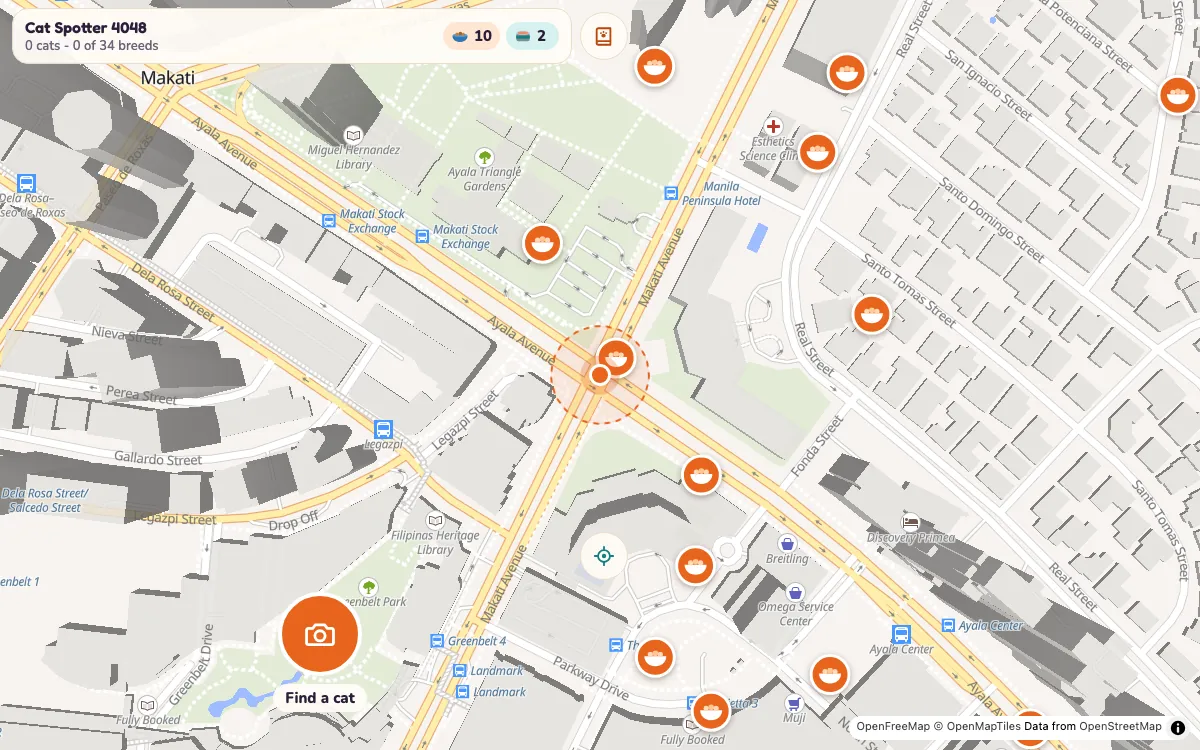
Comments
No comments yet.