How to go on a sound walk: follow your ears near home
To go on a sound walk, step outside, stand still until sounds come to you, then walk slowly and let what you hear, not what you see, decide where you go. It needs no kit, works on any street, and about one kilometre at a very slow pace is enough. Below: how to go on a sound walk step by step, where the idea comes from, a 30-minute plan, and what research can say about it.
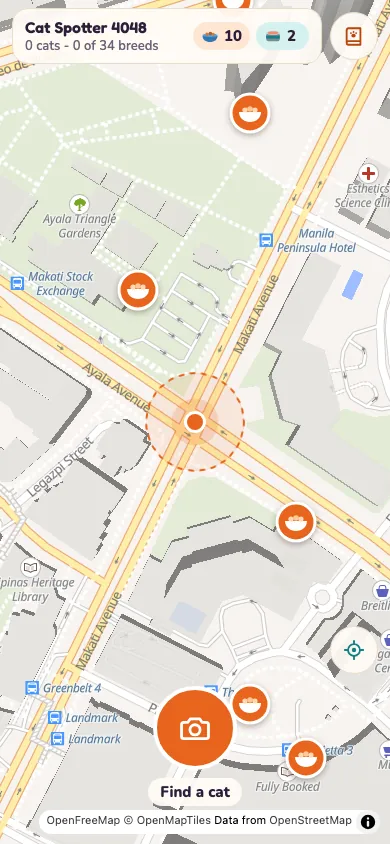
If the sound you most hope to follow is a meow, Cat Spot gives the same walk a second job: you collect treats at stops on a map as you walk, meet real cats outside, and keep each cat friend's photo with the place you met.
What a sound walk is, and where the idea comes from
The plainest definition is still the first one. In 1974 Hildegard Westerkamp wrote in Sound Heritage (Volume III, Number 4), published in Victoria, British Columbia: "A soundwalk is any excursion whose main purpose is listening to the environment." She revised the essay, Soundwalking, in 2001.
She did not mean a nature ramble. Her places to listen include a downtown street, a supermarket and a bus stop. The essay then leads the reader through Queen Elizabeth Park in Vancouver in seven stops, from the car park down to a creek, and ends on one question: "Is this park as attractive acoustically as it is visually?"
A shorter version is easier to follow. Emma Welton, who plays the violin and composes music and sound walks, wrote a nine-step recipe called "Following your Ears" for The Walkbook, a collection of 30 walking recipes by artists from across the UK, supported by Living Streets. It grew out of research on how people walked during COVID-19 restrictions, and one barrier its survey named was being "bored of walking the same route". A sound walk answers that directly: the route stays, and what you notice on it changes.
How to go on a sound walk, step by step
Welton's recipe (page 16 of The Walkbook) comes down to five moves.
- Stop before you start. Go outside, take a breath in and blow it out. Then her instruction is one word: "Wait."
- Let sounds come to you. Let your attention shift from one sound to another, or stay on one. "To catch more, cup your hands behind your ears." You can close your eyes while you stand.
- Open your eyes, then move. The recipe says "(Open your eyes!)" before you walk. Follow your ears round the block: "Pause for interesting sounds. Let sounds change your direction."
- Listen in detail. She names four things to listen for: "rhythm, pitch, texture, volume". Do some sounds conceal others? Notice what you can hear but not see, and how buildings "bounce some sounds closer, and protect you from others".
- Go back the way you came. Revisit the same sounds "with a looser focus".
For distance she says "any length", and likes "about 1 kilometre (very slowly)".
Near, middle, far: the order that makes listening work
Welton tells you what to do. Westerkamp's essay gives the order to listen in: from the sounds closest to you outward, one ring at a time.
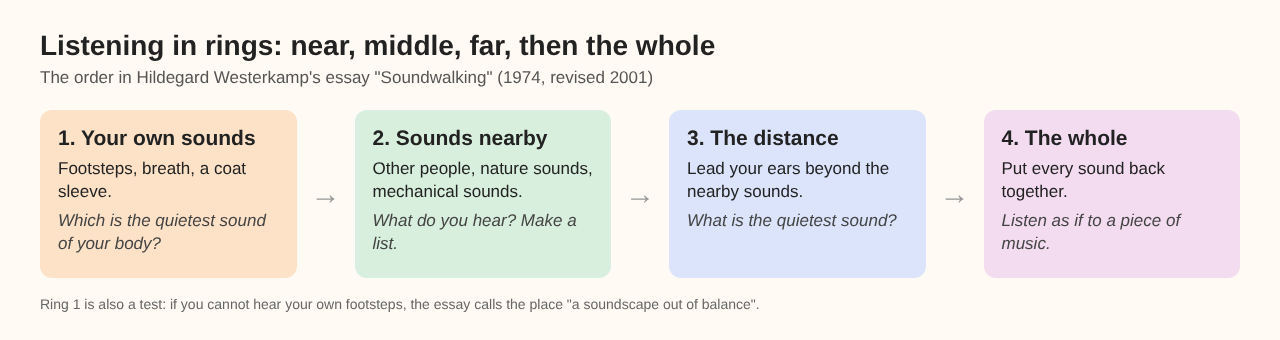
Work outward, then put the sounds back together.
First your own sounds: "Which is the quietest sound of your body?" Then the sounds nearby, which she sorts into other people, nature sounds and mechanical sounds. Then the distance: "What is the quietest sound?" Last, put it back together: "reassemble them all and listen to them as if to a piece of music played by many different instruments."
The first ring is also a test. If you can hear the quietest sounds you make, she writes, "you are moving through an environment which is scaled on human proportions". If you cannot hear your own voice or footsteps, "you experience a soundscape out of balance".
So a sound walk is not a hunt for pleasant sounds, which is the point people most often get wrong. Westerkamp says the first walk is "purposely exposing listeners to the total content" of what is around them. A loud junction belongs on your list as much as a bird does.
A worked example: one kilometre in 30 minutes
Here is Welton's kilometre as a plan for tonight: 500 metres out and 500 back, with a pencil and paper.
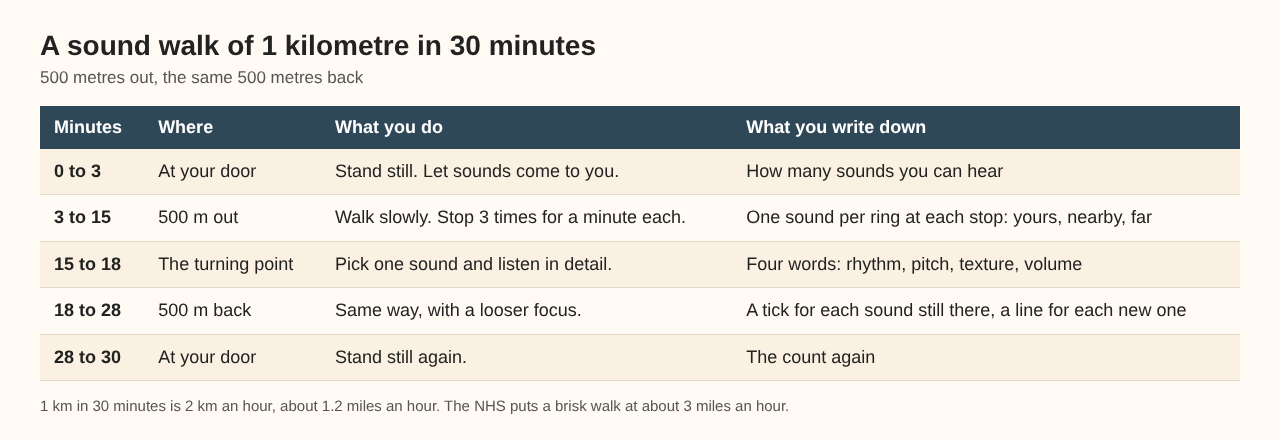
Five stages, one sheet of paper.
You stand at your door for three minutes and count the sounds you can hear. You walk out for twelve minutes with three one-minute stops, naming one sound from each ring at each stop. At the turn you give one sound three minutes and four words, one each for rhythm, pitch, texture and volume. You take ten minutes back, ticking the sounds still there, then count at the door again.
Your record is two numbers and a list. Say you counted 6 sounds at the door before and 9 after. The street has probably not grown busier in half an hour. Westerkamp's phrase for what changed is that it takes time "to remove the initial hearing barriers".
Now follow the numbers through. One kilometre in 30 minutes is 2 kilometres an hour, about 1.2 miles an hour. The NHS walking for health page says "a brisk walk is about 3 miles an hour", so a sound walk moves at less than half that pace. It is not the "brisk 10-minute daily walk" the NHS counts towards your 150 minutes of weekly exercise. If you want both, walk the loop again afterwards at a pace where "you can still talk but cannot sing the words to a song".
The strongest objection: it can be unpleasant
The best case against a sound walk comes from the person who defined it. Westerkamp writes: "Listening in that way can be a painful, exhausting or a rather depressing experience, as our ears are exposed often to too many, too loud or too meaningless sounds." Her reply is an argument, not a proof: "Trying to ignore them, however, makes even less sense. Since we cannot close our ears, we cannot help hearing all sounds."
The NHS gives the opposite tip for a different goal: music or a podcast "can take your mind off the effort" and "help you walk faster". Each fits its own walk.
You do not need to cover a kilometre: Westerkamp says a sound walk can "just centre around one particular place", and The Walkbook's definition of walking "includes wheelchairs, mobility scooters, walking aids". Close your eyes only while you stand still: the Walkbook's curators ask you to "remain attentive to your surroundings" and stay safe.
What the research says, and what is still unsettled
The fullest summary opened for this guide is a 2021 paper in the Proceedings of the National Academy of Sciences by R. T. Buxton and four colleagues, "A synthesis of health benefits of natural sounds and their distribution in national parks". They found 36 publications on the health benefits of natural sound and pooled 18, which showed decreased stress and annoyance (an effect of minus 0.60, with a 95% interval from minus 0.97 to minus 0.23) and improved health and positive feelings (1.63, interval 0.09 to 3.16).
At 221 sites across 68 US national parks, animal sounds were audible for a mean of 59.3% of the time and wind and water for 19.2%. Urban park sites had more human-made sound, "yet natural sounds associated with health benefits also were frequent".
Three things stay open:
- The size of the benefit. An interval from 0.09 to 3.16 runs from almost nothing to very large.
- The practice itself. The paper's summary is about natural sounds in parks. It reports no test of a slow listening walk down a street where traffic is most of what you hear.
- How far to take it. The Walkbook's curators write that they are "not proposing that creative approaches such as those in The Walkbook mitigate systemic inequalities or offer solutions to significant health issues".
Ways to change the walk once the first one works
- Change the hour. Welton's last step asks whether you will choose "the same time of day or night" next time. Her promise: "You'll never hear the same walk again."
- Join in. Welton: "you're part of the music!" Play railings with a stick, and "test gates for creaks and squeaks". Westerkamp admits this may seem "silly and contrived" to adults, and adds: "It is worth a try."
- Listen for cats. A meow from behind a hedge is a fair test of hearing what you cannot see. Our guides to why cats meow and why cats chatter at birds say what those sounds mean. If the cat shows itself, Cat Spot's own screen has the rule: "Keep your distance - let the cat come to you".
For more walks with one job each, see our creative walking ideas.
Frequently asked questions
What is a sound walk?
In Hildegard Westerkamp's 1974 words, "any excursion whose main purpose is listening to the environment". Any length works: Emma Welton likes about 1 kilometre, very slowly.
Should I wear headphones on a sound walk?
No. The walk is about hearing the place itself. Save music for a brisk walk, where the NHS says it can help you walk faster.
Does a sound walk count as exercise?
Not as brisk walking. One kilometre in 30 minutes is about 1.2 miles an hour, and the NHS puts a brisk walk at about 3 miles an hour.
Can I do a sound walk in a city?
Yes. Westerkamp's places to listen include a downtown street, and the national parks study found natural sounds were frequent at urban park sites too.
Get started
Pick a time today, stand at your door for three minutes and count what you hear. Then walk your 500 metres out and back.
If you would like the walk to end with a cat as well as a list, play Cat Spot in your browser: walk your neighbourhood, collect treats at stops on the map, meet real cats and gently earn their trust to become friends. It needs the camera and location allowed in your browser.
Walk anywhere, find a real cat, and catch it.
Visit catgo.vlvd.net↗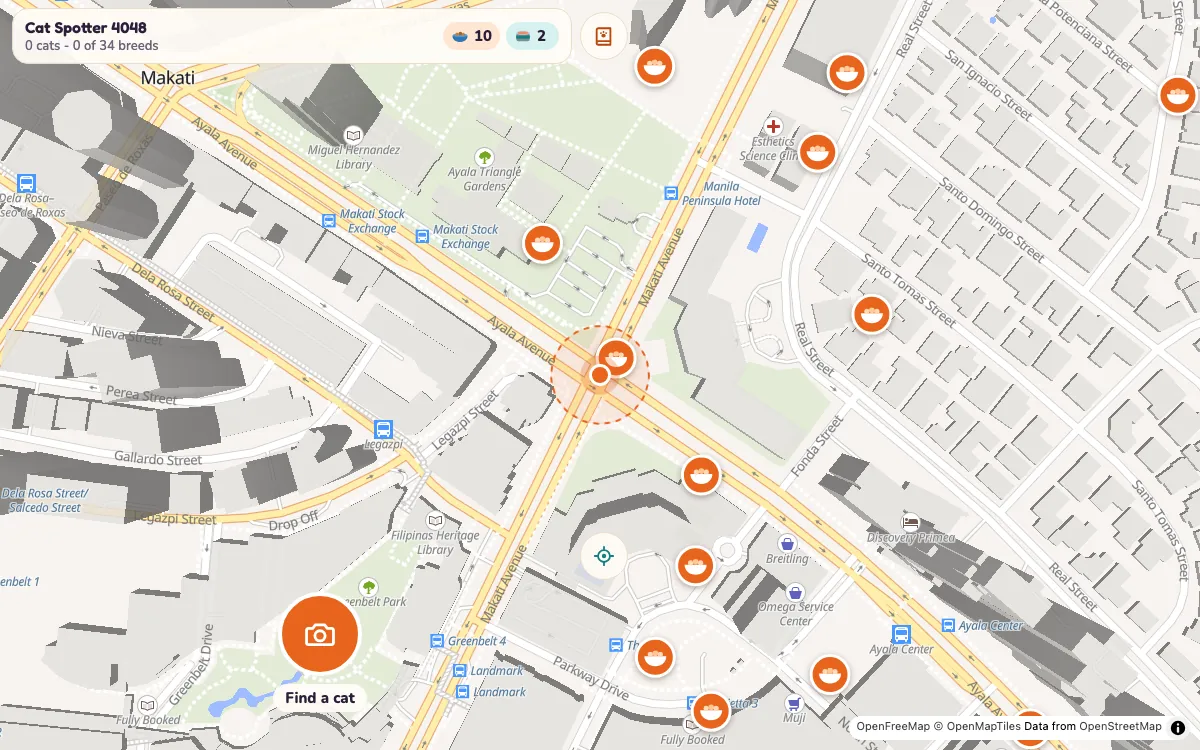
Comments
No comments yet.