Creative walking ideas to try near home: 15 fresh walks
Looking for creative walking ideas to try near home? Give each walk one small job: follow a sound, hunt for a colour, flip a coin at your front door, or spot a cat. A job turns the same few streets into something new. Below are 15 walks you can start from your front door, five of them from a free book of walking recipes by UK artists, plus a simple plan that fits any of them into 20 minutes.
If you want a walk with a built-in goal, Cat Go turns cat spotting into a browser game: you photograph a real cat you meet, say which breed it is, and keep it in a Catdex with the place you found it.
Creative walking ideas to try near home, and why they work
Being bored of walking, and bored of walking the same route, were two of the barriers people named in a 2021 UK public survey by the Walking Publics/Walking Arts research project. Its response was The Walkbook: Recipes for Walking and Wellbeing, 30 walking "recipes" commissioned from artists across the UK. The walking charity Living Streets points to it in tip 11 of its #Try20 tips, "Get creative", which says there is something in it for every fitness level, wherever you live.
You don't need a new place, only a new question to carry for one walk.
Five recipes from The Walkbook
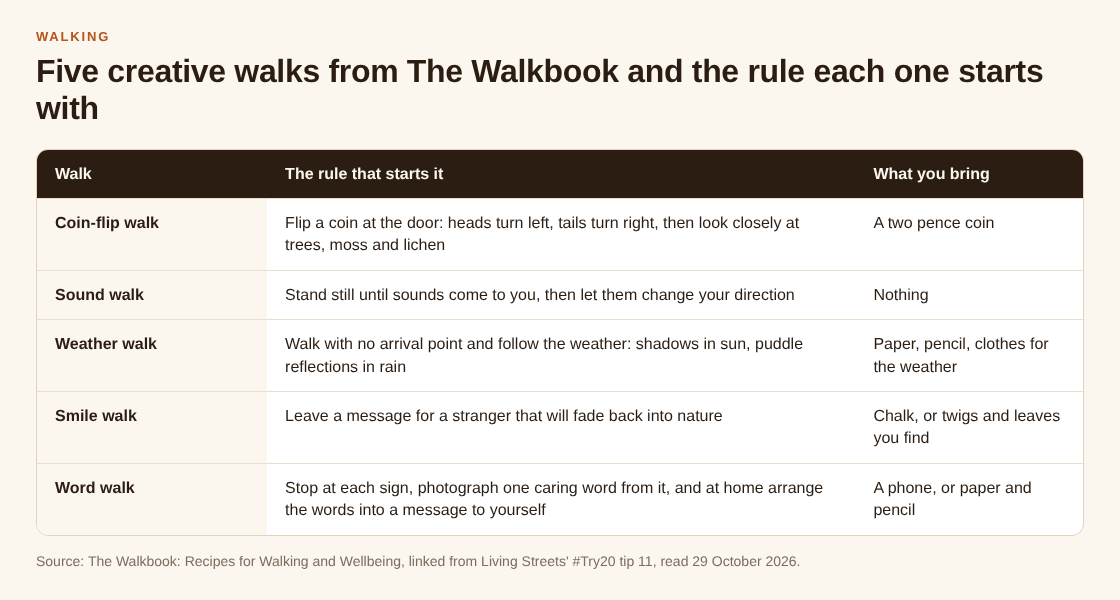
These five come straight from the book. Each one starts with a single rule.
1. The coin-flip close-up walk
Jenson Grant's "Walking in CloseUp" needs one ingredient, a two pence coin. Step outside your door and flip it: heads, turn left; tails, turn right. Then walk slow and steady and look closely at trees. Is the bark smooth or rough? Is there moss on it? In the Northern Hemisphere moss tends to grow on the cooler, northern side. Flat, silvery grey or yellow growth is probably a lichen, and the recipe notes that yellow lichen grows well near traffic fumes while silvery grey lichen does not.
2. The sound walk
In Emma Welton's "Following your Ears", you go outside and wait. Let sounds come to you, and cup your hands behind your ears to catch more. When you are ready, follow your ears around the block, pause for interesting sounds and let them change your direction. Notice what you can hear but not see. She likes about a kilometre, very slowly, and the recipe ends by returning the way you came.
3. The weather walk
Stephanie Whitelaw's "Weather Walks" ask you to walk out of your door with no place to arrive at, and to follow the weather. In rain, listen to it, find a puddle and look at what it reflects. In sun, look for light and for shadows. Bring paper, a pencil and clothes for the weather. The recipe can be done on foot or by wheelchair.
4. The smile walk
Kathryn Welch's "A walk to make others smile" asks you to leave a message for a stranger: chalk on a pavement, words in sand, or twigs and fallen leaves arranged into a heart. A hopscotch or a few words of encouragement both work. The one rule is that it must fade back into nature without a trace.
5. The word walk
In Emily Orley's "Re-write the Rules", you stop at each sign and pick out a word that makes you think of care. Photograph only that word. At home, arrange your words into a message you would like to receive yourself.
Game walks: colour walks, scavenger hunts and dice routes
6. The colour walk
Pick one colour and find ten things in it. Or go through the rainbow in order: something red, then orange, then yellow, and so on. We wrote a full guide on how to walk the rainbow near home if you want rules and variations.
7. The street scavenger hunt
Write a short list before you leave: a house number with a 7 in it, a bicycle, a window with a plant, a letterbox shaped oddly. Tick them off as you go. For a ready-made list and tips on making it fair for kids, see how to plan a walking scavenger hunt in your own street.
8. The dice route
Take a die, or use a dice app. At every junction, roll. One or two means turn left. Three or four means go straight. Five or six means turn right. Set a time limit, then find your way back.
9. The alphabet walk
Find something that starts with each letter, from A to Z, in order. Shop signs help with the hard letters.
Noticing walks: photo walks, door spotting and tiny details
10. The photo walk
Take your phone and give yourself a theme, like shadows, reflections or circles. Limit yourself to ten photos so you choose with care. Our 20-minute photo walk plan breaks this into steps.
11. Door spotting
Doors say a lot about a street. Count colours, knockers, stained glass, house names.
12. The look-up walk
Most of us look at the pavement. On this walk, look up: roof lines, chimney pots, old painted signs fading on brick, dates carved above shop fronts.
Story walks: street names on your own route
13. The street name walk
Write down every street name on your route. At home, look up three of them in your local library's or council's history pages. A plain road name can turn out to have a story behind it, and the next walk past it feels different.
Cat walks: spotting and logging the neighbourhood cats
Cats are part of many streets. A cat walk gives you a reason to slow down and notice them. Watch from the pavement, keep off private property, and leave the cat be.
14. The cat spotting log
Each time you see a cat, write down the time, the place and a short description: "ginger, white socks, on the blue gate." After a week you may start to see the same faces. If you wonder whether a regular is someone's pet, our guide on how to tell if a cat is a stray or has a home covers the signs.
15. The Cat Go catch walk
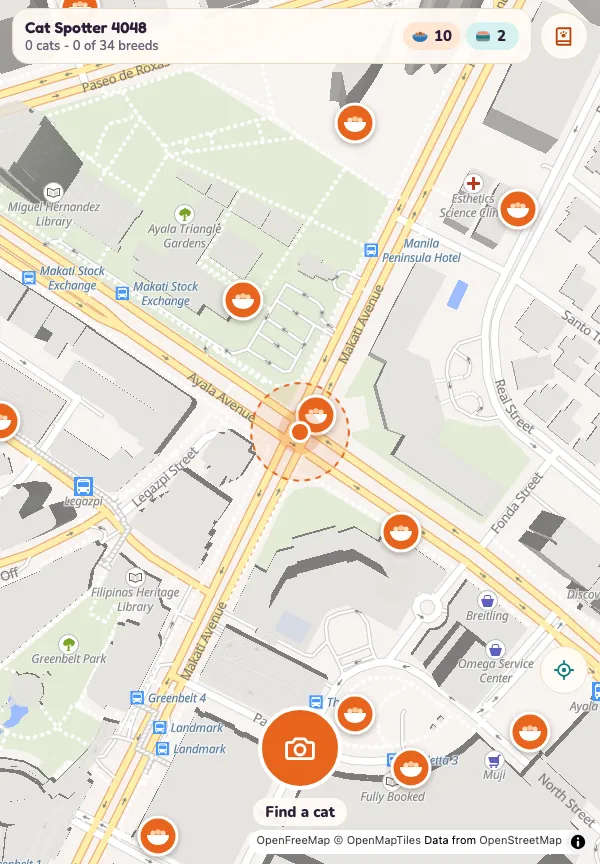
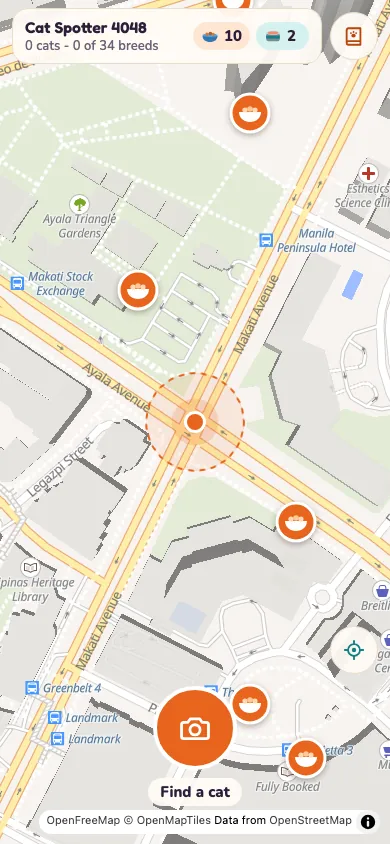
This is the cat log turned into a game. Cat Go runs in your web browser and needs your camera and location allowed. It uses your location to find treat stops and to record where each cat was caught. Here is how a walk goes:
- Stock up. Open the world map. Walk to a treat stop. When you are close, it says "You're here. Grab what's in the bowl." Tap Collect treats to get kibble, and sometimes tuna. These are in-game food only. The stop then shows how many minutes until it refills.
- Spot a cat. When you see one, tap the camera on the map. The screen tells you to "Fit the whole cat in the frame." Cat Go checks the photo for a cat. If it finds none, you get "No catch this time", and no food is used.
- Pick the breed. It asks "Which breed is it?" You choose from a list with a search box. Most cats you meet are mixed breed, and the game says "Mixed breed is always a safe pick." Rarer breeds are warier.
- Lure it. Choose how much kibble and tuna to bring, then toss treats on screen. Tuna works much better on wary cats. Food you don't use comes back. Stay calm with your tosses: a startled cat leaves quickly.
- Keep it. On a catch, you see "Caught!" The cat is saved to your Catdex with its photo, breed, the date and time, and the place as map coordinates. You can give it a name.
Your Catdex shows "Cats caught" and "Breeds found" out of the 34 breeds the game counts, so each walk has a goal.
How to turn any idea into a 20-minute walk plan
Any of the 15 walks fits into 20 minutes with this plan:
- Minute 0 to 2: pick one job. Just one. "Ten yellow things" or "three sounds at three stops." Two jobs split your attention.
- Minute 2 to 8: walk out. Head one way. Start looking straight away.
- Minute 8 to 12: slow down. Stop somewhere. Look closer, take a photo, write a note.
- Minute 12 to 18: walk back a different way. A new return route doubles what you see.
- Minute 18 to 20: log it. Write one line about what you found. A notes app works. For a cat walk, your Catdex does it for you.
Here is a worked example. It's Tuesday, and you have 20 minutes after work. You choose the dice route with a twist: at each stop, you also note one sound. You roll at four junctions, end up on a street you have never walked, and hear a wind chime and a blackbird. You walk home a different way. Your log says: "Tuesday. Dice route. New street. Wind chime, blackbird." That's one walk done, and it was a new one.
Frequently asked questions
What can I do on a boring walk near home?
Give the walk one job, like finding ten things of one colour, following sounds, or flipping a coin at your front door to choose the way. A clear target makes you notice things you walk past every day.
What is The Walkbook?
The Walkbook: Recipes for Walking and Wellbeing is a free collection of 30 walking recipes by UK artists, from the Walking Publics/Walking Arts research project. Living Streets links it in tip 11 of its #Try20 tips.
How do I make walking more fun on my own?
Turn it into a game with a score, such as an alphabet walk, a dice route or a cat spotting log. Keeping a short record of each walk gives you something to look back on and beat.
What are good walking ideas for kids and families?
Scavenger hunts, colour walks and smile walks work well because kids can call out what they find. Keep the list short and the walk under half an hour.
How can I keep a walking habit going every day?
Keep walks short, around 20 minutes, and change the job each day. Logging one line after every walk makes the streak visible and easier to keep.
Get started: log your first cat walk with Cat Go
Pick a 20-minute window today. Open Cat Go, allow your camera and location, and walk to the nearest treat stop to collect some kibble. Then keep your eyes open for the first cat on a wall or a doorstep. You start with a made-up player name, and you can save your record with an email later if you want to sign in on another device.
Play Cat Go in your browser: walk anywhere, photograph a real cat, lure it with food and catch it.
Walk anywhere, find a real cat, and catch it.
Visit catgo.vlvd.net↗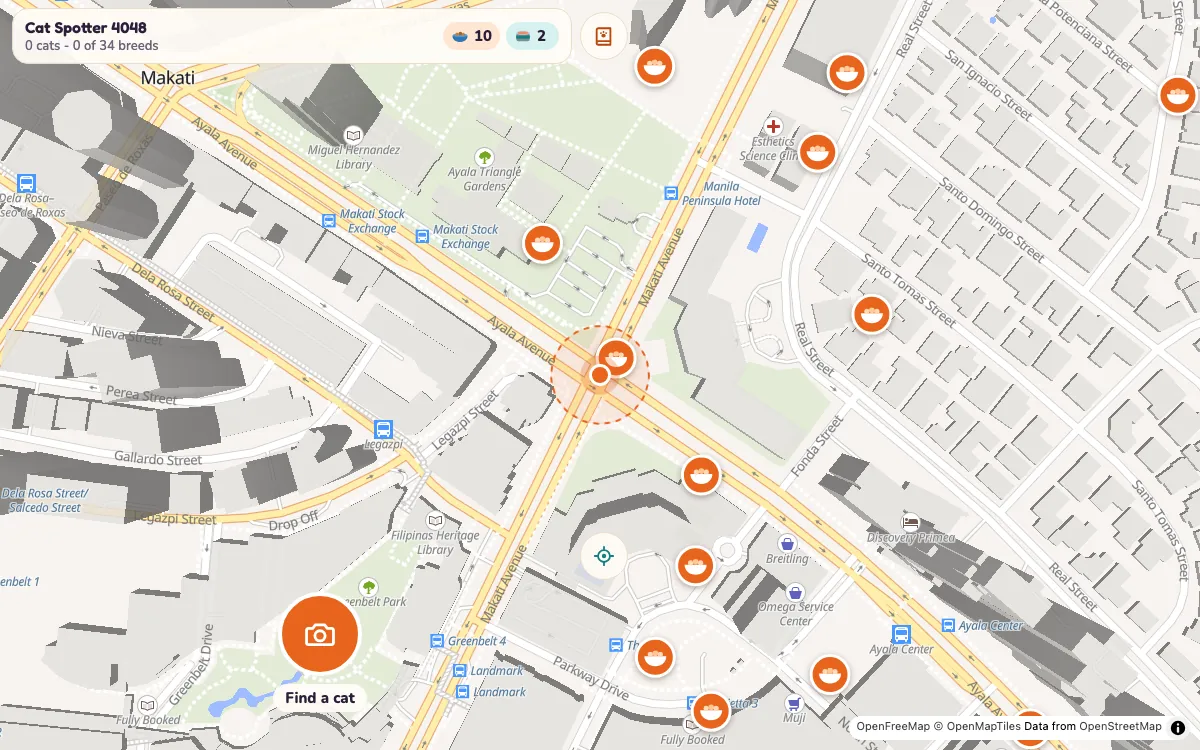
Comments
No comments yet.