How to go on an autumn walk: to a view, a rest, and back
How to go on an autumn walk: pick a nearby place with a view, walk there slowly, rest and watch the season move around you, then wander home a different way. That shape comes from "Hidden Ballets", a recipe by the artist Laura Fisher in Living Streets' Walkbook, which pairs the rest with the matching part of Vivaldi's Four Seasons. This guide gives you the three parts, what to notice in autumn, and a 30-minute walk to try this week.
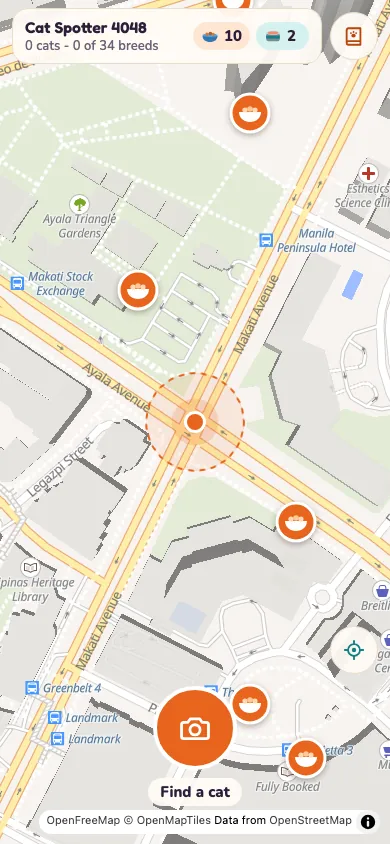
If you like a target on the way, Cat Go marks treat stops on a map of your area and lets you photograph and keep the real cats you meet, each with its breed and the place you saw it.
Why a walk with a shape helps in autumn
The Walkbook: Recipes for Walking and Wellbeing came out of a research project on how people in the UK walked during COVID-19. Its 2021 public survey asked what got in the way of walking, and bad weather and being bored of the same route were both on the list. The team then asked 30 artists to write walking recipes for those barriers.
A recipe gives an ordinary walk a beginning, a middle and an end, which helps on a grey afternoon when the usual loop feels flat. The authors keep the promise small: they do not claim a creative walk fixes health problems, only that it gives people a way to keep walking. The book also counts wheelchairs, mobility scooters and walking aids as walking.
The Hidden Ballets walk in three parts
Laura Fisher describes it as a short walk to and from a place with a view, with a rest halfway. You can do it alone or in pairs. You need earphones, something to play the Four Seasons on (download it first if your signal is poor), and clothes for the weather.
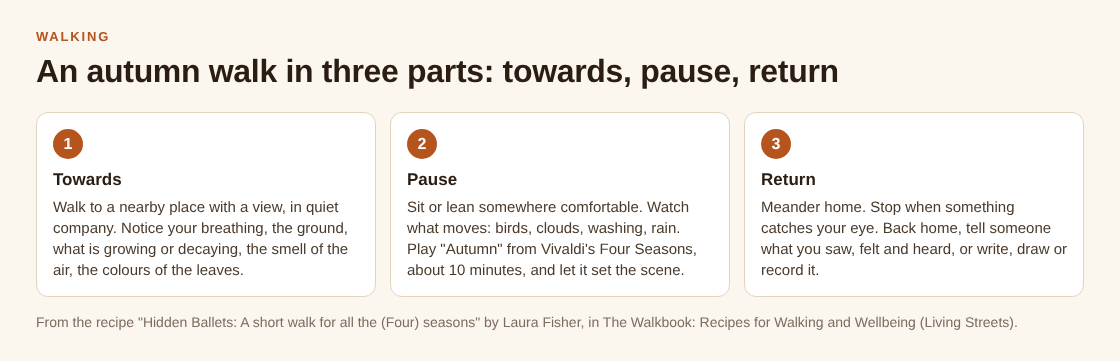
- Towards. Walk to your place in quiet company, with yourself or a partner. Notice your breathing, the feel and sound of the ground, what is growing or decaying, the smell of the air and the colours of the leaves.
- Pause. Find a comfortable spot with a pleasing view and let your body lean or rest. Watch what moves: rain running down a bus stop, washing on a line, birds, clouds. Play the season that matches the time of year, so in autumn, "Autumn". Fisher calls what you see "a dance, a ballet". The music lasts about 10 minutes; rest as long as you like after it.
- Return. Let the way home meander. When something catches your eye, stop for a moment. At home, tell someone what you saw, felt and heard, or write, draw or record it.
The place does not need to be far. Fisher suggests a window in your home, the bench of a bus stop, the top of a hill or a footbridge. If you cannot go yourself, you can ask someone to do the walk for you and tell you what they saw.
What to notice on an autumn walk
Three other recipes in the same book add details that suit this time of year.
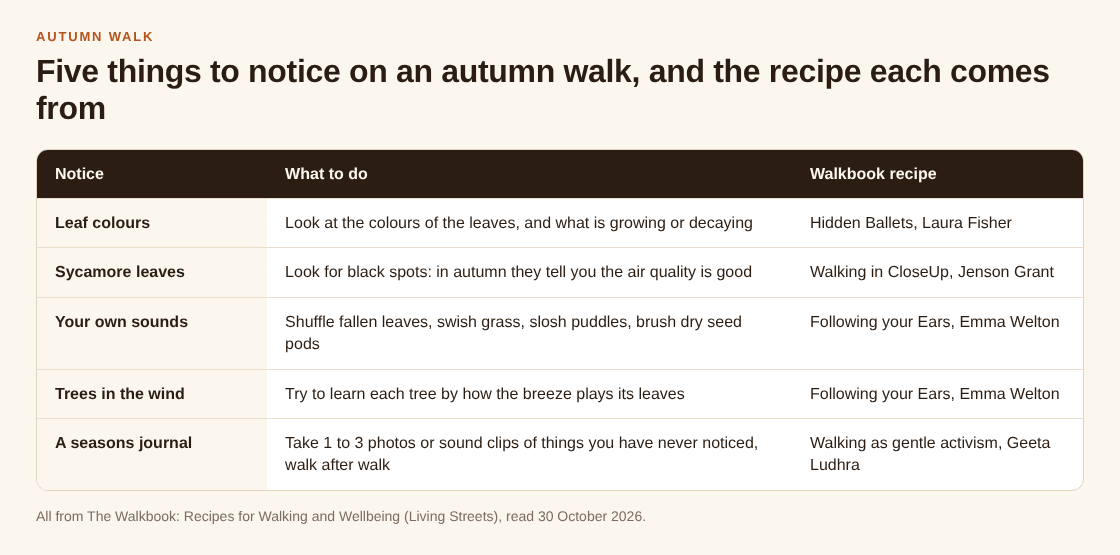
- Black spots on sycamore leaves. In "Walking in CloseUp", Jenson Grant says black spots on sycamore leaves in autumn tell you the air quality is good.
- Your own sounds. Emma Welton's sound walk, "Following your Ears", says to enjoy the noise you make: shuffle fallen leaves, swish grass, slosh puddles, brush dry seed pods with your fingers.
- Trees in the wind. On a windy day, the same recipe suggests trying to learn each tree by how the breeze plays its leaves.
- A seasons journal. In "Walking as gentle activism", Geeta Ludhra suggests taking 1 to 3 photos or sound recordings on each walk of things you have never noticed or find beautiful, and building a journal that follows nature across the seasons.
For more ways to change a walk you know well, see creative walking ideas to try near home, and for a walk built around colour, what a colour walk is.
How to go on an autumn walk this week: a 30-minute plan
Here is the recipe worked through on a Saturday afternoon, with a bench at the top of the local park as the view.
- Get ready (2 minutes). Shoes and a layer for the weather. The NHS Walking for health page says any comfortable shoes that support your feet and do not cause blisters will do. Check "Autumn" from the Four Seasons is on your phone.
- Walk towards the bench (10 minutes). No music yet. Count the leaf colours you see, look for black spots on any sycamore leaves, and shuffle through one patch of fallen leaves.
- Pause (12 minutes). Sit, put the earphones in, and play "Autumn". Watch the trees, the birds and the people crossing the park, and let the music set the scene.
- Return a different way (6 minutes). Take a side path. Stop once when something catches your eye, and take one photo of it for your seasons journal.
- At home. Write three lines: what moved you, what amused you, and what you noticed in your body and in the land. These are Fisher's own questions.
The walking parts add up to about 16 minutes, and the NHS says a brisk 10-minute daily walk already counts toward your 150 minutes a week. You are walking briskly if you can still talk but cannot sing a song. If you are not very active, the NHS says to build up your distance gradually, so pick a nearer view first. On darker evenings, read how to walk safely after dark before you go.
Walking it together
The recipe works well with a partner. On the way out, Fisher suggests tuning into the other person's rhythm and what they are noticing, and walking in companionable silence. At the end, you each say what you saw, felt and heard. If you walk alone, a short note or recording does the same job and gives you something to look back on as the season changes.
Frequently asked questions
What is a good autumn walk for beginners?
A short walk to a nearby view and back, with a rest in the middle, like Laura Fisher's "Hidden Ballets" walk. The view can be as close as a bus stop bench or a window at home.
What should I look for on an autumn walk?
The colours of the leaves, what is growing or decaying, and black spots on sycamore leaves, which the Walkbook says mean good air quality. Listen to fallen leaves underfoot and to trees in the wind.
Which music goes with an autumn walk?
The recipe uses the part of Vivaldi's Four Seasons that matches the time of year, so "Autumn" for this season, played during the rest at your view.
How long should an autumn walk be?
As long as suits you. The music in the recipe lasts about 10 minutes, and the NHS says a brisk 10-minute daily walk already counts toward your weekly activity.
Get started: an autumn walk with Cat Go
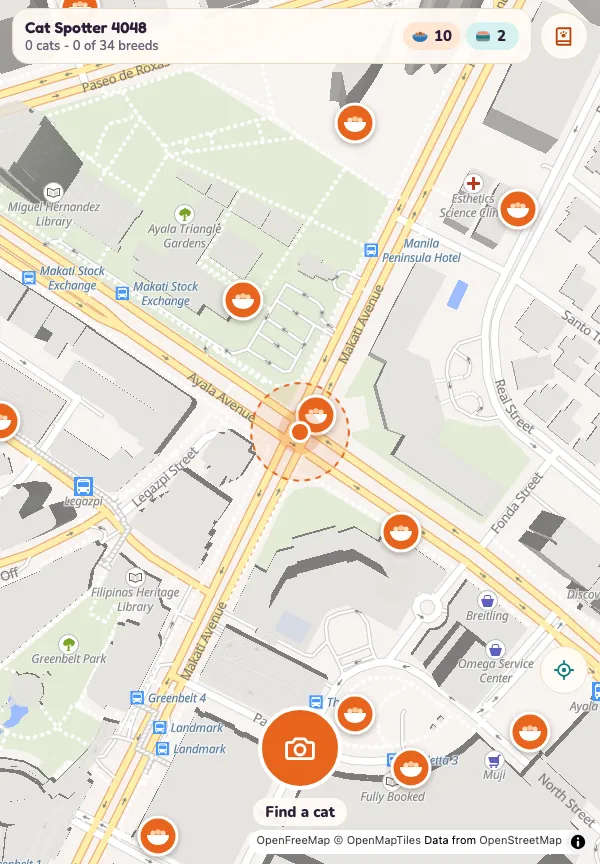
Cat Go gives your autumn walk a few more things to notice. Open it at catgo.vlvd.net and allow your camera and location, which it uses to find treat stops and to record where each cat was caught. Choose a treat stop on the way to your view, and collect the kibble, and sometimes tuna, waiting there for the game.
If a real cat is sitting among the leaves, take its photo with the whole cat in the frame, pick its breed from the list ("Mixed breed is always a safe pick") and toss the in-game treats. The cat stays in your Catdex with its breed and the place you met it, a small entry for your seasons journal.
Play Cat Go in your browser: walk anywhere, photograph a real cat, lure it with food and catch it.
Walk anywhere, find a real cat, and catch it.
Visit catgo.vlvd.net↗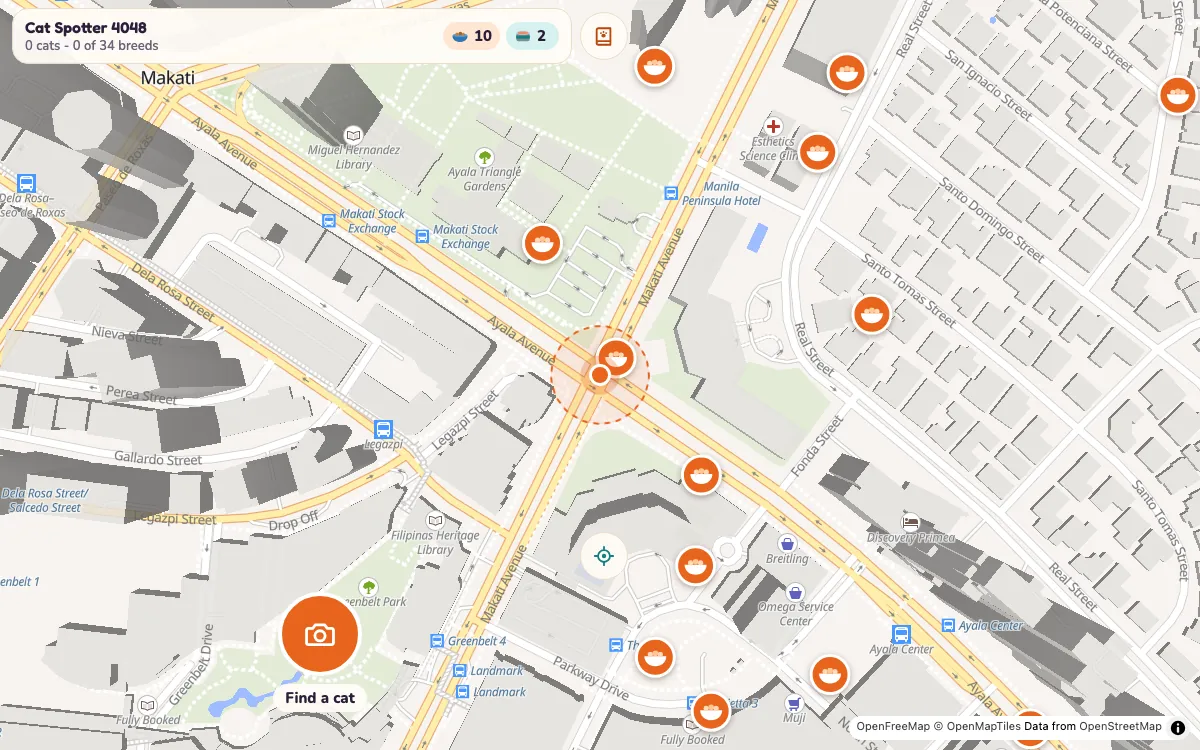
Comments
No comments yet.