Hurst Castle history: a Tudor fort rebuilt for 400 years
Hurst Castle stands at the end of a long shingle spit on the Hampshire coast, and its story shows how one fort can change with every new gun. This Hurst Castle history follows the Tudor fort from its building in 1541 to 1544, through a royal prisoner and a Napoleonic rebuild, to the huge Victorian batteries and the Second World War.
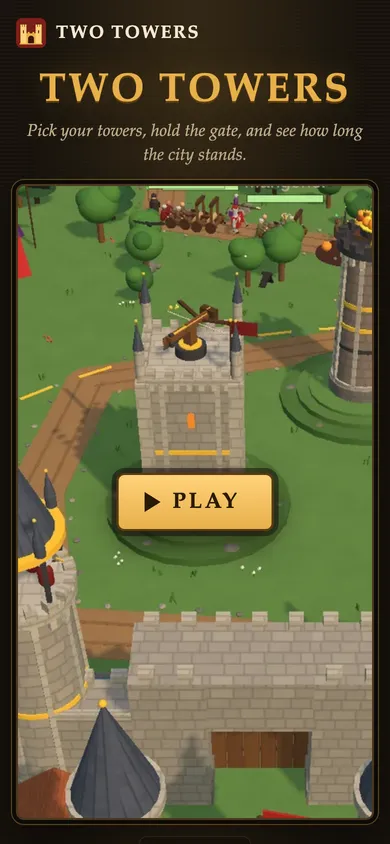
If you like asking what a defence needs to hold off an attacker, Two Towers is a free browser game where you pick the two towers that guard a city gate and spend gold on upgrades as every stage comes harder.
Hurst Castle history: Henry VIII's fort on the spit
English Heritage says Hurst Castle was built between 1541 and 1544 by Henry VIII, as part of a chain of artillery fortresses protecting key ports and landing places around southern England. This one guarded the Needles Passage, the way into the Solent and on to Southampton and the growing naval base at Portsmouth. The passage between the spit and the Isle of Wight is only about 1,280 metres wide at this point.
In 1539 the king dreaded an invasion by the united Catholic powers of Europe, after his break with the Roman Catholic Church. The result was the first centrally planned system of coastal defence since a chain of Roman forts more than 1,200 years earlier, from Hull around to Milford Haven. By 1540 the fear had eased, but Henry pressed on, and Hurst began in 1541.
In 1542 a permanent garrison was set up under Thomas Bertie, who had been master mason at Calshot and at the two forts at Cowes. For the story of a gun fort on the Isle of Wight that was designed together with Hurst, read the Yarmouth Castle post.
What the Tudor castle looked like
The Tudor castle, finished in 1544, was largely built of stone. At its heart is a gun tower of two storeys and a basement. The ground and first floors held the garrison's rooms, divided by timber and plaster partitions, and the first floor and the roof also carried guns. A courtyard wall with three projecting semicircular bastions surrounds it, each with more gun openings and living rooms.
Until the 1860s a moat surrounded the castle, and a drawbridge led to the gatehouse. English Heritage says the low profile and very thick walls are typical of Henry VIII's coastal forts. They were meant to survive bombardment while giving enemy guns a smaller target, and to allow fire in every direction. The parapets had curved tops to deflect shot, and the gun openings were splayed wide for the widest field of fire. The castle had 71 gun positions on six levels, though after it was finished it was armed with about 20 guns of varying size under a master gunner.
A castle that held a king and a priest
For the rest of the 16th century life at Hurst was largely uneventful, and the castle stayed little changed from 1544 until 1793. A peacetime garrison probably numbered a couple of dozen men, with local militia in wartime. One master gunner served for 37 years from 1625, and the castle was not always kept in good repair. The spit was known for smugglers, who sometimes included members of the garrison.
During the Civil War, from 1642 to 1651, Hurst was held for Parliament. English Heritage says it was never attacked, but it became famous soon afterwards. After the Parliamentary army ordered Charles I's arrest, he was moved from Carisbrooke Castle on the Isle of Wight and imprisoned in Hurst's keep from 1 to 19 December 1648. On 19 December he left for London, and for his execution six weeks later.
In 1700 Hurst was chosen again as a secure prison, this time for anyone convicted of spreading the Roman Catholic faith. Only one prisoner was ever sent, Father Paul Atkinson, who stayed for 30 years until he died at the age of 74. For other castles that were used as prisons, see the castle prisons post.
Napoleon's threat: a vault on top of a Tudor tower
War with Revolutionary France in 1793 sent Britain's coastal fortresses back to work, and Hurst, then more than 250 years old, was seen as one of the weakest. After hasty repairs in 1794 the castle was given 18 captured French 9-pounder guns, probably the heaviest the Tudor stonework could carry. Two five-gun batteries on the beach, with captured French 36-pounders and furnaces for heating shot, flanked the castle.
The threat of invasion by Napoleon in 1803 led to a much bigger job. The Board of Ordnance authorised the Royal Engineer Colonel John Evelegh to remodel the keep. He put a substantial brick vault at the old roof level to support six powerful 24-pounder guns on the roof above, and a second vault below to protect the basement gunpowder store. The work was probably finished early in 1807.
The guns saw no action. In February 1809 every spare space became a temporary military hospital for survivors of Sir John Moore's army, brought home by the Royal Navy after its retreat to Corunna.
Victorian armour and the last guns
The early 1850s brought new fears of French intentions. The moat at Hurst was deepened in 1851, and between 1852 and 1854 the bastions and curtain walls were rebuilt so that a second tier of guns could be mounted. Two large earthwork batteries for 29 heavy weapons went up outside. Rifled guns and engine-driven warships made such works old almost as soon as they were done, and a Royal Commission of 1859 recommended a ring of fortresses to protect Portsmouth.
Hurst's part began in 1861. The earthwork batteries were replaced by two huge armoured wing batteries, largely complete by 1874. They held 31 of the new guns, firing shells that weighed more than 360 kg, in granite casemates (vaulted chambers), with quarters for a peacetime garrison of 143 officers and men. English Heritage says these two wings give the castle its defining shape: seen from the Needles Passage they almost swamp the Tudor castle in the middle.
A battery of three 6-pounder quick-firing guns was built outside the east wing in 1893, and searchlights were fitted. Those, and Bofors anti-aircraft guns in the Second World War, armed the castle until 1945, and it played a key role in both world wars in protecting the western entrance to the Solent. Care of the Tudor castle began in 1933. In 1956, after the army's coastal artillery was abolished, Hurst came to the Ministry of Works, the predecessor of English Heritage. That makes it unusual for a Tudor castle: it stayed in military use until 1956.
A worked example: read a fort by what its walls can carry
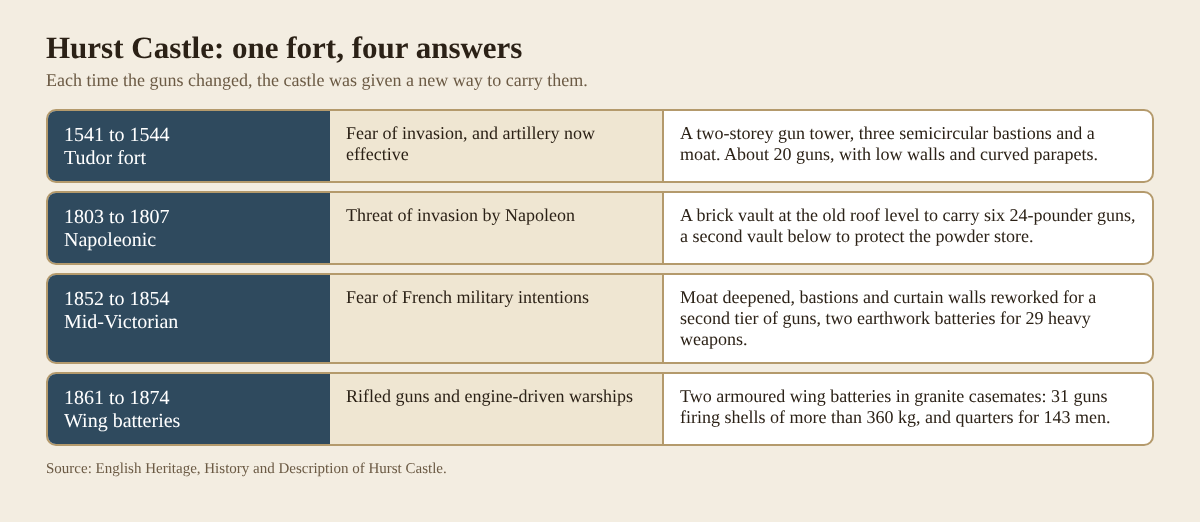
Hurst is a good place to practise reading a fort, because the changes are easy to list. Ask three questions of each rebuild, using only what English Heritage says.
- What was feared? Invasion in 1539 to 1541, Napoleon in 1803, France again in the early 1850s, then rifled guns and engine-driven warships from 1859.
- What could the old walls carry? In 1794 the castle took 18 French 9-pounders, which English Heritage calls probably the heaviest the Tudor stonework could support. In 1803 the answer was Evelegh's vault, which carried six 24-pounders on the roof.
- Did the answer go inside the old fort, or beside it? The 1803 vaults and the 1850s second tier of guns went inside the Tudor castle. By 1861 the answer was built beside it: two wing batteries in granite casemates, with guns firing shells of more than 360 kg.
The same questions work on a medieval castle. The bombard post shows the first guns that tested old walls, and the Dartmouth Castle post follows another coastal fort across several centuries.
The same choice in Two Towers
Hurst's rebuilders faced a choice you meet in Two Towers, with gold in place of money. You can put gold into a tower you already have: click or tap it and buy damage, fire rate, range or its special. Or you can buy a tower for one of the two hills, 150 gold for the first and 300 for the second, and choose any of the four kinds. The game gives no verdict between them. Its own tip says: "Spend your gold on Damage between stages, and Reinforce the gate."
Try Hurst's three questions on a stage you lost: what did it bring, what could your towers carry, and did the fix belong in a tower you had or beside it? The game's attacker tips help with the first. "Crossbowmen shoot from afar: Range upgrades and a Trebuchet reach them." is a small answer to a specific threat, much like Hurst's 1794 guns.
Frequently asked questions
Who built Hurst Castle and when?
Henry VIII built it between 1541 and 1544, as part of a chain of artillery forts along England's south coast. It guarded the Needles Passage into the Solent.
Was Charles I held at Hurst Castle?
Yes. After his arrest he was moved from Carisbrooke Castle on the Isle of Wight and held in Hurst's keep from 1 to 19 December 1648, then taken on the journey to London.
Was Hurst Castle ever attacked?
English Heritage says it was held for Parliament in the Civil War and was never attacked then. Its guns saw no action in the Napoleonic years either, but it played a key role in both world wars in protecting the western entrance to the Solent.
How long was Hurst Castle used by the military?
Until 1956, when the army's coastal artillery was abolished and the castle passed to the Ministry of Works, the predecessor of English Heritage.
Get started
Hurst Castle shows that a defence is never finished. To test the thinking yourself, play Two Towers: pick your two towers, spend your gold between stages, and see which stage your gate fails at.
Defend the castle gate, stage after stage.
Visit twotowers.vlvd.net↗

Comments
No comments yet.
Sign in or make an account to comment.