Napoleon's Legacy: What He Changed in Europe and What It Cost
Napoleon's legacy is one of the most argued over in European history. Napoleon Bonaparte, a Corsican-born general, ruled France as First Consul and then as Emperor of the French, and by 1807 his authority reached across most of Western and Central Europe. This post sets out what he changed, what it cost and why historians still disagree, using World History Encyclopedia's article on him.
If you would rather learn this as a short lesson, Learn 100 Influential People puts Napoleon in its Age of Revolutions course next to Washington, Jefferson, Bolivar, Toussaint Louverture and Lincoln, in lessons of about 9 minutes with questions that check what you remember.
Who was Napoleon Bonaparte?
The encyclopedia gives his life as 1769 to 1821. He was born Napoleone di Buonaparte in Ajaccio, Corsica, on 15 August 1769, into a family of minor Corsican nobility. His father Carlo was a lawyer. A year before his birth Genoa had sold Corsica to France, and after the French beat the Corsican fighters under Pasquale Paoli, Carlo swore allegiance to France and the family received titles and honours.
At nine Napoleon went to the Royal Military School of Brienne-le-Château. The article says his strong Corsican accent and name set him apart there, that he was gifted at mathematics, and that he came to view religion as a political tool. He later graduated from the École Militaire as an artillery lieutenant. When Paoli's supporters fell out with the Bonapartes over the Revolution, the family fled to mainland France in 1793. The encyclopedia says that exile made him a committed Frenchman and no longer a Corsican nationalist.
How he rose to power
His break came at the Siege of Toulon, where his cannons were crucial to the French victory on 19 December 1793 and he was made a brigadier general at 24. On 4 October 1795 he defended Paris against a royalist rising and, in the encyclopedia's words, his troops "fired grapeshot into the crowd". That brought him to the attention of Paul Barras, a leader of the Directory, who secured him the command of the Army of Italy.
There he beat the Austrians in a string of battles and forced the Treaty of Campo Formio in October 1797. His troops called him "the Little Corporal". In 1798 he led an army to Egypt. It was halted at the Siege of Acre in 1799 and the encyclopedia calls it a military failure, though it greatly advanced Egyptology through the discovery of the Rosetta Stone.
On 9 and 10 November 1799 he overthrew the government in the bloodless Coup of 18 Brumaire. The encyclopedia says his rise to power marked the end of the French Revolution and began the Napoleonic era. He proclaimed the French Empire on 18 May 1804 and was crowned at Notre-Dame on 2 December, where he took the crown and placed it on his own head.
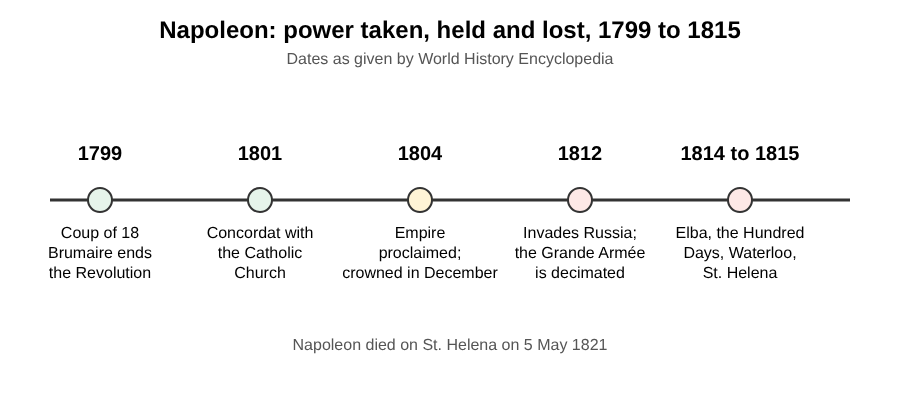
The diagram shows the shape of his career: a few years to take power and make it permanent, then a decade of war that ended in two defeats and exile.
Napoleon's legacy in law and the state
The article names two lasting achievements of his time as First Consul. The first was the Concordat of 1801, which reconciled France with the Catholic Church. The second was the Napoleonic Code, a set of civil laws that echoed some of the liberal reforms of the Revolution. The encyclopedia says the Code was adopted across much of continental Europe and influenced the judicial systems of many modern nations.
He also changed the map. After his victory at Austerlitz on 2 December 1805 he reorganized several German states into the Confederation of the Rhine under his protection, which directly led to the dissolution of the Holy Roman Empire in July 1806. As First Consul he also made the Louisiana Purchase, which the encyclopedia says doubled the size of the United States.
Not every part of his state-building was liberal. He had himself confirmed First Consul for life by a plebiscite and then made himself emperor, because, the article says, he knew his regime would not be secure without a hereditary empire. He put his brothers on thrones in Naples, Holland and Westphalia, and the encyclopedia notes he has often been criticized for giving too much power to his less competent brothers. And he sent a force to reclaim Haiti and restore slavery there; it failed and Haiti became independent in 1804.
What changed in warfare
The encyclopedia says he fought 60 battles and lost only seven, and that his military innovations changed European warfare. He used conscription, he popularized the corps as an army's largest unit, and he pioneered tactics that have been studied ever since. His Grande Armée was split into eight semi-autonomous corps so that it could move with more speed and flexibility. The article notes he is often ranked beside Alexander the Great and Julius Caesar as one of history's most brilliant generals.
What it cost: Spain, Russia and Waterloo
The Treaties of Tilsit in July 1807 were, the article says, arguably the peak of his power: Russia became his ally, joined his embargo on British trade (the Continental System) and Prussia lost half its territory. After that the costs added up.
- Spain. In 1808 he used a quarrel in Spain's royal family to put his brother Joseph on the throne. The Peninsular War followed, with brutal guerrilla warfare, and it tied down 200,000 French soldiers.
- Russia. On 24 June 1812 over 615,000 French and allied troops crossed the Niemen, the largest invasion force Europe had yet seen. The Russians refused to give battle and used scorched-earth tactics, and the French lost over 100,000 men to attrition before the first major battle. Moscow was deserted and burning when he entered it. By December the French had lost half a million men.
- Defeat. After Leipzig in October 1813 the coalition invaded France and he abdicated on 11 April 1814. He returned to France on 1 March 1815, entered Paris on 20 March and began the Hundred Days. He was beaten at Waterloo on 18 June 1815, exiled to St. Helena and died there on 5 May 1821, aged 51.
Reformer or autocrat? A worked example
The encyclopedia itself says he is "alternatively viewed as a reformer and an autocrat, a warmonger and a defender of liberties". You can test each claim yourself. Pick one verdict and check it against the facts above in four steps:
- State the claim. For example, "Napoleon was a reformer".
- List the evidence for it. The Code, the Concordat and the end of the Holy Roman Empire.
- List the evidence against it. A plebiscite for life office, an empire he crowned himself, the Haiti expedition to restore slavery, and wars that killed hundreds of thousands.
- Write the verdict with its limit. "The Code spread across Europe, but it came with conquest."
Then repeat for "autocrat". The same method works for any historical figure; see how to analyze a written document in history and primary vs secondary sources. This post is itself a secondary source, a summary of one encyclopedia article, so for an essay read the books the article lists, such as Andrew Roberts's Napoleon and David Bell's Napoleon: A Concise Biography.
Frequently asked questions
What is Napoleon's biggest legacy?
World History Encyclopedia points to the Napoleonic Code, which was adopted across much of continental Europe and influenced the legal systems of many modern nations, and to his changes to how wars are fought.
Was Napoleon good or bad for Europe?
The encyclopedia presents both views: reformer and autocrat, warmonger and defender of liberties. Decide by weighing the reforms against the cost of the Napoleonic Wars.
What was the Napoleonic Code?
It was a set of civil laws that echoed some of the liberal reforms of the Revolution, set up while he was First Consul.
How did Napoleon end the French Revolution?
The encyclopedia says his rise to power, beginning with the bloodless Coup of 18 Brumaire in November 1799, marked the end of the Revolution.
Why did Napoleon lose?
The article stresses the failed invasion of Russia in 1812, after which most of Europe turned against him, then defeat at Leipzig in 1813 and at Waterloo in 1815.
Get started
If you want more than a summary, Napoleon sits in the Age of Revolutions course, one of 15 courses made of short lessons. You read, study the diagrams, try a hands-on activity and answer questions. Every lesson lists its sources, and cards set out where researchers disagree, which matters for a figure whose reputation is still split.
You sign in with your email and an emailed sign-in code. It is a web app, so you can open it in a browser.
Start Learn 100 Influential People: short hands-on lessons on the people who shaped history, with every side of the debate and the sources to read next.
100 people who shaped history, from Moses to the web.
Visit influentialpeople.vlvd.net↗
Comments
No comments yet.
Sign in or make an account to comment.