Net Revenue Retention: Formula and an AI Product Example
Net revenue retention tells you how much recurring revenue you keep from the customers you already had, after upgrades, downgrades and cancellations. If you started a year with $10,000 a month from a group of customers and those same customers now pay $10,500, your net revenue retention is 105 percent. It is one number that shows whether your existing customers are growing your business or quietly shrinking it.
The Business Basics for Builders course on Age of AI Entrepreneur covers revenue, costs, unit economics and growth in short lessons that list their sources; sign in with your email and an emailed code to open it. This post gives the formula, a worked example for an AI product, and the mistakes that make the number look better than it is.
The net revenue retention formula
Pick a group of customers and a period, usually 12 months. Then:
NRR = (starting recurring revenue + expansion - contraction - churn) / starting recurring revenue
- Starting recurring revenue: what that group paid you each month (or year) at the start of the period.
- Expansion: extra recurring revenue from the same customers: upgrades, more seats, more usage.
- Contraction: revenue lost when customers move to a smaller plan or use less.
- Churn: revenue lost from customers who cancelled.
The rule that matters most: new customers who joined during the period are left out. NRR only follows the group you started with. If you mix in new customers, you are measuring overall growth, not retention.
The number is usually based on monthly or annual recurring revenue. If those terms are new, MRR vs ARR explains both.
Net vs gross revenue retention
Gross revenue retention (GRR) uses the same group but leaves out expansion:
GRR = (starting recurring revenue - contraction - churn) / starting recurring revenue
GRR can never go above 100 percent. It answers "how much do we lose?" NRR answers "how much do we lose, after what we gain back from upgrades?" A business can have a high NRR thanks to a few big upgrades while many customers leave, so look at both. The same split exists for customer counts, where people speak of gross churn and net churn, as the churn rate page on Wikipedia sets out.
A worked example for an AI product
Say you run an AI tool that writes product descriptions for online shops. You sell a monthly plan and charge more when a shop goes over its included usage. These numbers are made up for the example.
- Pick the group. On 1 January you had 20 paying shops, together paying $10,000 a month. That is your starting monthly recurring revenue.
- Track expansion. By 31 December, six of those shops have grown their catalogues and pay more for extra usage, and two moved to a bigger plan. Together they add $1,800 a month.
- Track contraction. Three shops cut back to a smaller plan, losing $400 a month.
- Track churn. Two shops cancelled. They had paid $900 a month together.
- Ignore new shops. You signed 15 new shops in the year. They do not count here.
- Work it out. Ending revenue from the original 20 is $10,000 + $1,800 - $400 - $900 = $10,500. NRR is $10,500 / $10,000 = 105 percent. GRR is ($10,000 - $400 - $900) / $10,000 = 87 percent.
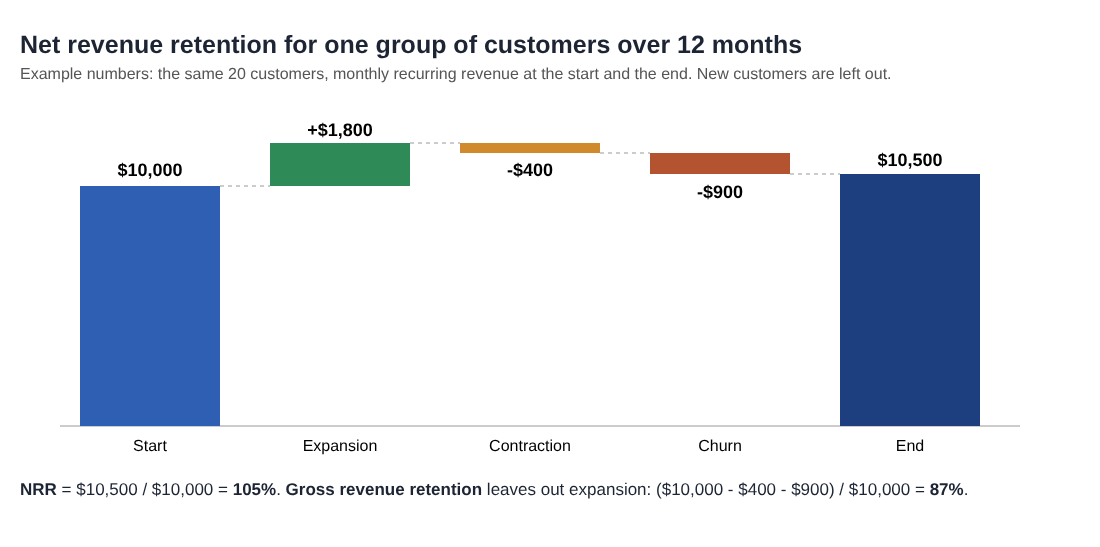
Read the two numbers together. The 105 percent says your existing shops, as a group, pay you more than a year ago, so growth from new shops adds on top instead of filling a hole. The 87 percent says you still lose 13 percent of the starting revenue to downgrades and cancellations. Expansion is covering that loss, not removing it.
Why NRR matters so much for AI products
Many AI products charge partly by usage, because each request costs the company money in model fees. That makes expansion and contraction move more than in a simple seat plan: a customer who uses your tool more pays more, and one who uses it less pays less. The trade-offs are covered in usage based pricing vs subscription.
Two things follow. First, NRR can swing with your customers' seasons, so compare the same months year on year. Second, expansion revenue from heavier use also brings heavier model costs. A customer who doubles their usage may double their bill and your costs at the same time. Check that the new revenue still leaves a margin, using contribution margin and LLM token pricing.
NRR also shapes what your other numbers mean. If existing customers grow, each one is worth more over time, which makes it easier to earn back what you spent to win them. That link is the subject of CAC payback period.
Common mistakes that inflate the number
- Counting new customers. Including revenue from customers who joined during the period makes almost any business look like it retains more than 100 percent.
- Counting one-off charges. Setup fees or a single large usage month are not recurring revenue. Leave them out, or the number jumps and then falls.
- Choosing a flattering window. Measuring from your weakest month to your strongest makes expansion look larger. Use a fixed period, such as the same date a year apart.
- Hiding churn behind expansion. Report GRR next to NRR so a few big upgrades cannot hide many cancellations.
- Too few customers. With 20 customers, one large account can move NRR by many points. Look at the list of who expanded and who left, not only the percentage.
How to raise net revenue retention
There are only two levers: lose less and expand more. To lose less, find out why the two shops in the example left, ideally by asking them, and fix the most common reason first. To expand more, make the next step up a natural one: a bigger plan for a customer who keeps hitting the usage limit, or a feature that a growing team needs. Avoid pushing upgrades a customer does not need; that turns into contraction or churn a few months later.
Frequently asked questions
What is a good net revenue retention?
Above 100 percent means your existing customers, as a group, pay you more over time. What counts as good depends on your market and customer size, so track your own number over time and compare like with like.
Can net revenue retention be over 100 percent?
Yes. When expansion from existing customers is larger than what you lose to downgrades and cancellations, NRR goes above 100 percent. Gross revenue retention cannot.
Is net revenue retention the same as net dollar retention?
The two names are used for the same idea: recurring revenue kept from an existing group of customers, after expansion, contraction and churn. Check how each company defines it before you compare numbers.
How often should a startup calculate NRR?
Work it out monthly for a rolling 12-month group once you have a year of customers. Before that, follow each month's group of new customers and watch what they pay over time.
Get started
Open Age of AI Entrepreneur, sign in with your email and an emailed code, and take the Business Basics for Builders course: problems worth paying for, revenue, costs and unit economics, and the growth number a startup lives by, in lessons of about 9 minutes that list their sources.
Building a business in the age of AI, from a first project to a company.
Visit aientrepreneur.vlvd.net↗


Comments
No comments yet.