Premeditatio Malorum: How to Practise Negative Visualization
Premeditatio malorum is Latin for "the forethought of evils." It is the Stoic habit of picturing what could go wrong before it does, so that a setback finds you prepared instead of stunned. It sounds like worrying on purpose. Done properly, it is closer to a pilot's pre-flight check: you look at the risks calmly, decide what you will do, and then get on with the day.
If you want to practise this with short guided lessons, How to Find Your Meaning is a free web app whose Stoic Exercises course includes a lesson called Seeing Trouble Coming. You sign in with your email and an emailed code.
What is premeditatio malorum?
What matters is the practice, not the label: you take a thing you dread or could lose, you think it through in concrete detail, and you ask what you would do and what would still be yours.
Modern writers often call it negative visualization. It is a rehearsal, not a prediction. You are not saying the bad thing will happen. You are saying it could, and you would rather meet the possibility with a plan.
What Seneca and Marcus Aurelius actually wrote
Seneca: nothing ought to be unexpected
In Letter 91 (Gummere translation), written after a fire destroyed the city of Lyons, Seneca makes the case plainly: "it is the unexpected that puts the heaviest load upon us. Therefore, nothing ought to be unexpected by us." His advice is to "summon to our minds beforehand, not as great an evil as oftentimes happens, but the very greatest evil that possibly can happen."
Seneca again: but do not ruin the present
The same Seneca adds a warning. In Letter 24 he asks why anyone would "anticipate trouble and ruin the present through fear of the future," and says it is foolish to be unhappy now because you may be unhappy later. So the Stoic practice has a brake built in. The rehearsal is meant to be short, to end in a plan, and then to be put down.
Marcus Aurelius: expect the people you will meet
In Meditations 2.1 (Long translation), the emperor tells himself to begin the morning by saying that he will meet "the busy-body, the ungrateful, arrogant, deceitful, envious, unsocial." He then reminds himself that none of them can injure him, because people are "made for co-operation, like feet, like hands, like eyelids." The rehearsal here is not about disaster. It is about an ordinary difficult day, met with a steady temper.
Why would imagining a setback help you?
The claim is modest. A vague fear tends to feel larger than one you have described in plain words, and a plan you made calmly is easier to follow than one you invent in a shock. Epictetus begins his handbook by sorting what is in our control (opinion, pursuit, desire, aversion, our own actions) from what is not (body, property, reputation). Premeditatio malorum is that sorting applied to a particular fear: the part you can influence becomes a task, and the part you cannot becomes something to accept ahead of time. You can see the same sorting in our post on things you can't control.
It does not remove fear, and for some people it stirs it up. That is a reason to keep it short and to stop if it does not settle. Our post on Stoic exercises for anxiety sets this one beside five others for when worry is the main trouble.
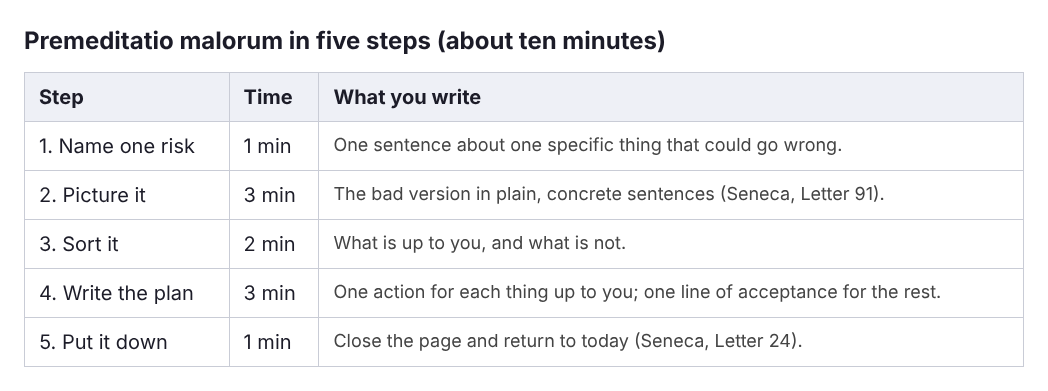
How to practise premeditatio malorum in ten minutes
You need a page, a pen and a timer. Choose one specific thing, not your whole life.
- Name one risk (1 minute). Write a single sentence: "This week I might lose a client," or "The meeting with my manager might go badly."
- Picture it concretely (3 minutes). Following Seneca, picture the bad version, not the mild one. What exactly happens? Who says what? What does a normal Tuesday look like afterward? Write it down in plain sentences.
- Sort it (2 minutes). Draw a line down the page. On one side write what is up to you: your preparation, your reply, your next step. On the other write what is not: the other person's decision, the market, luck.
- Write the plan (3 minutes). For each item that is up to you, write one action and, if it applies, when you will do it. For each item that is not, write one sentence of acceptance, such as "If that happens, I will still have my skills and my friends."
- Put it down (1 minute). Close the page. This is Letter 24's brake: the rehearsal is over, and you return to today.
A worked example. Say you have a presentation on Thursday. Step one: "The presentation might go badly." Step two: you picture the projector failing, your notes in the wrong order, and a senior colleague frowning. Step three: the projector and the room are partly not up to you; your notes and your rehearsal are. Step four: "Print the notes in order, bring a backup of the slides, and run through it once aloud on Wednesday. If it still goes badly, I will ask for feedback and present again." Step five: you close the page. You have lost nothing and gained a checklist.
Common mistakes with negative visualization
Turning it into rumination
If you are replaying the worst case with no plan at the end, you have slipped from the exercise into worry. Go back to step three and find one action.
Picturing only the mild version
Seneca's advice is to imagine the very greatest evil that could happen, not a comfortable version. A soft rehearsal lets your fear stay vague. The aim is to see the real size of the thing so you can see what remains.
Doing it for everything at once
One risk at a time. A list of ten fears is a mood, not an exercise.
Using it when you need other help
This is a reflective exercise, not treatment. If your worry is constant, disturbs your sleep or feels too heavy to face alone, talk to a doctor or a counsellor about your own case instead of working through it with a philosophy exercise.
Making the habit stick
Premeditatio malorum works best as a small, regular habit instead of an occasional ordeal.
- Do it in the morning, like Marcus. Name one difficult thing you may meet today and one way you will answer it.
- Pair it with the evening. Seneca's nightly questions, set out in our post on evening reflection questions, let you check afterward what you actually did.
- Add the other side. Pairing it with the memory of loss, which our post on memento mori covers, keeps it from being only about work and money.
The app's daily Stoic practice puts this in a frame of about ten minutes: in the morning, a question for the day ahead and one of the four Stoic virtues to practise; during the day, a short passage from Epictetus, Marcus Aurelius or Seneca and one thing to try; in the evening, the three questions Seneca learned from Sextius. You can keep notes on each day of the practice, which is a good home for your rehearsal pages. You can read more on the about page.
Frequently asked questions
Is premeditatio malorum the same as negative visualization?
They name the same idea. Premeditatio malorum is the Latin phrase for it, and negative visualization is the modern name for picturing what could go wrong in order to prepare.
Will it make me more anxious?
It can, especially if you are already anxious or if you keep going after the plan is written. Keep it to ten minutes, end with an action, and stop if it does not settle. If worry is constant, speak to a doctor or counsellor.
How often should I do it?
Use it when a particular risk is on your mind, or once a week as a short review. Daily, one sentence in the morning is enough.
Does it predict that something bad will happen?
No. It is a rehearsal for the possibility, not a forecast. Most of what you picture will not happen, and the plan costs you ten minutes either way.
Get started
You can try the ten-minute version today with nothing but a page and a pen. If you would like guided lessons, a daily practice and a place to keep your notes, start How to Find Your Meaning. The lessons are free with an account, and you sign in with your email and an emailed code. It is a web app you install from the site, as the get the app page shows.
Find what your life is for.
Visit findyourmeaning.vlvd.net↗


Comments
No comments yet.
Sign in or make an account to comment.