St Catherine's Castle at Fowey: a Tudor gun tower and a Dutch ship
St Catherine's Castle at Fowey is a small Tudor gun tower on a rocky headland at the mouth of the river Fowey in Cornwall. English Heritage says it was one of a chain of defences built under Henry VIII against an expected invasion from France and Spain, with one job: to stop seaborne attacks on the busy port of Fowey. It fought one known action, against a Dutch warship, and was rearmed twice after that.
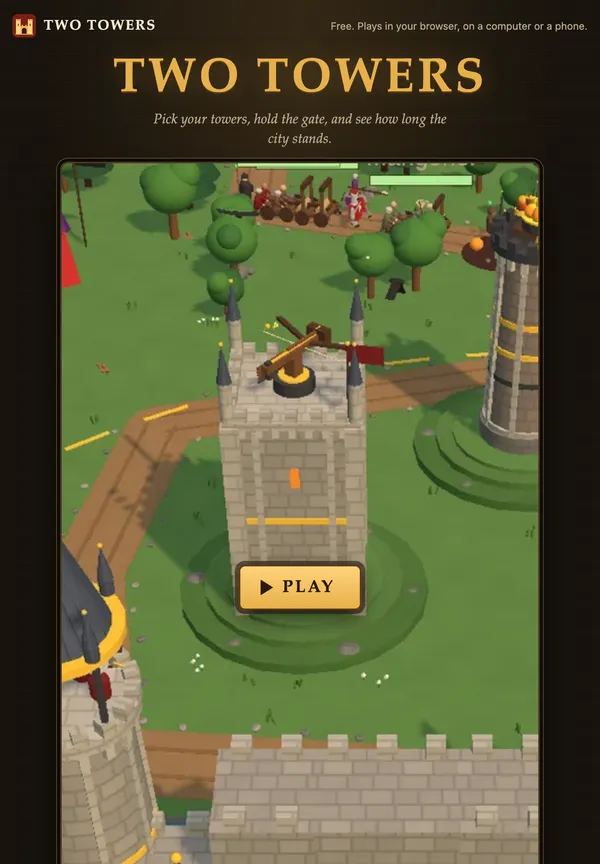
If you like working out how a few defences guard one entrance, Two Towers is a free browser game where you pick the two towers that guard a city gate and spend the gold you win on upgrades.
Why a Tudor fort went up at Fowey
The date that sets the scene is early 1539. English Heritage says Pope Paul III arranged a treaty between Francis I of France and the Holy Roman Emperor Charles V, ending years of hostility for a while, and urged them to invade England to punish Henry VIII for divorcing Katherine of Aragon, taking control of the Church and closing the monasteries. The castle was part of Henry's national programme of defence against that invasion, but it was not a royal project in the usual sense. A leading townsman paid for it and supervised it: Thomas Treffry of nearby Place House, who was also involved in building St Mawes Castle shortly afterwards at the mouth of the river Fal.
The site does the work. Treffry built on a steep, rocky site on the west side of the river where it meets the sea. The river is only about 230 metres wide there, so any ship trying to enter was an easy target for the castle's guns.
What stood on the point before the castle
The headland is named after a medieval chapel of St Catherine, which stood at its highest point and was still standing in 1539 when the castle went up. English Heritage says St Catherine was a martyr venerated throughout the Middle Ages, and suggests the chapel may have been a place where seafarers could pray and give thanks, and may also have had a navigation light and bell to help ships find the river entrance in bad weather. It no longer survives. A Victorian mausoleum now stands on its site, holding William and Catherine Rashleigh and their daughter Edith.
The Tudor gun tower, the lower battery and the wall
The builders cut away areas of bedrock to make platforms, and the fort has three main parts: an upper gun tower (the "castle"), a gun platform below it called the lower battery, and a defensive wall. The wall reaches right across the headland to the north-east and south-west from the gun tower, so that the whole fort could be defended against an attack from the land as well as the sea. It is built on steep slopes and ends on rock faces too severe to climb, and a rectangular projection near its middle probably let defenders fire along its faces.
The gun tower is D-shaped and has three floors. The ground floor has a pointed arched doorway, three arched embrasures for guns at floor level (one now blocked) and a fireplace. The first floor has seven more arched openings. One is like the ground-floor ones, for a gun at floor level, and the others are taller and narrower, suited to muskets and to heavier guns on swivels that could be aimed. A winding stair in the wall climbs to the second floor, which was open to the sky and has a stone-flagged sentry walk. English Heritage says it may have had a crenellated parapet, and its floor was probably planked and covered in lead. From there watchers had a wide view of the sea, and soldiers could fire handguns and longbows.
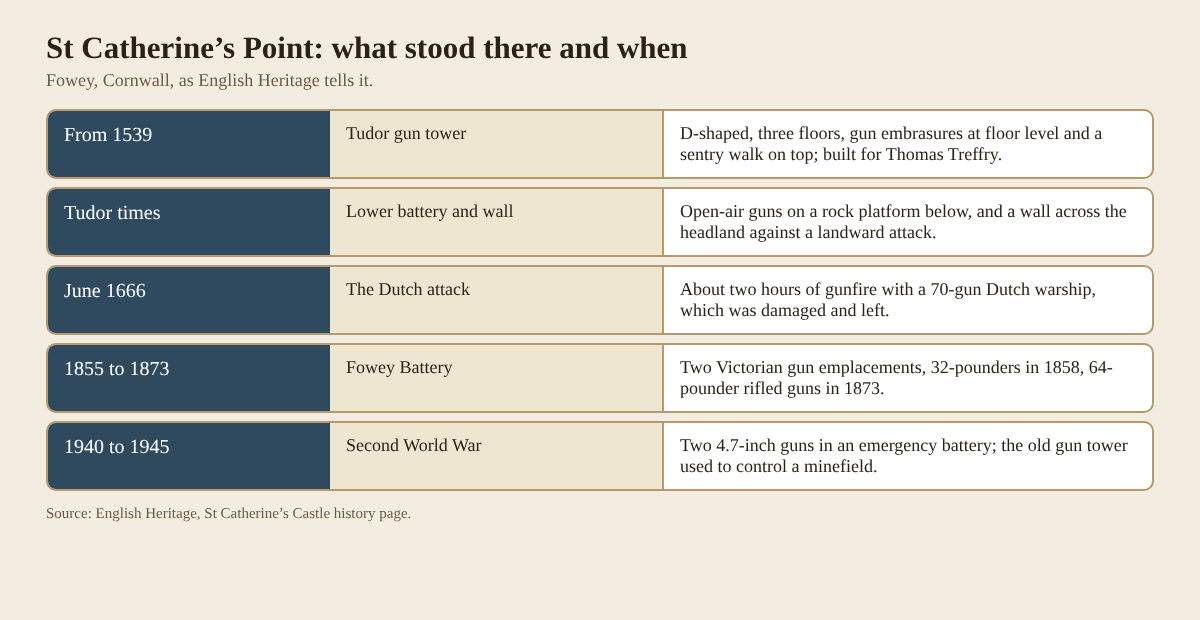
Light and medium guns were all the tower could hold. English Heritage says the real punch came from the open-air lower battery on a platform below it. It could carry heavy guns with a wider field of fire, "capable of sinking ships", and the battery that fought in 1666 must have been here. The same split between small guns up high and a few big guns down low shows in other forts, such as Portland Castle and Hurst Castle.
St Catherine's Castle at Fowey in action: the Dutch warship of 1666
The castle was probably armed in Tudor emergencies and again in the First Civil War, from 1642 to 1646, when Fowey was held in turn by Parliament and the Crown. As far as English Heritage knows, though, its gunners saw action only once. In June 1666, during the Second Anglo-Dutch War, a 70-gun Dutch warship sailed into the river in pursuit of a convoy of English merchant ships that had crossed the Atlantic from Virginia. The castle guns, with others across the river at Polruan, traded fire with the warship for about two hours. The defence worked: the ship was damaged and forced out to the open sea.
English Heritage reasons that the fight must have been with cannon on the lower battery, since guns in the tower were too small and too restricted in their field of fire to take on a 70-gun ship. The following year the Dutch entered the Medway in south-east England and destroyed part of the English fleet, so Fowey's fight is the same threat meeting a defence that held. The Yarmouth Castle post shows another Tudor fort built for exactly that kind of day.
Fowey Battery: the Victorian guns
About 1793, after Britain went to war with Revolutionary France, a group of around 60 "Battery Men" formed and practised on ten old guns. In 1796 the guns were grouped in three batteries on the west side of the river, five of them on the lower battery at St Catherine's. A formal Fowey Volunteer Artillery Corps followed in 1797 and was disbanded, with all the batteries disarmed, in 1815.
Renewed fear of French expansion in the early 1850s changed things again. In 1855 the War Department bought the land on St Catherine's Point, and in 1856 began building emplacements for two guns on the site of the lower battery. By 1858 two 32-pounder smooth-bore guns were in place, and from 1859 the 3rd (Fowey) Cornwall Artillery Volunteers manned them. Heavier 64-pounder rifled guns were installed in 1873. From 1890 it was a drill and practice battery, and the guns were withdrawn in 1899 to 1900. The two emplacements survive, with low curving granite-capped walls and sloping aprons built to deflect incoming shot over the gunners' heads, and a steel pivot with rails that let the gun carriage turn. A small magazine was built inside the old gun tower.
The Second World War: a battery and a minefield
In June 1940 a front line ran along the British coast. Fowey got an emergency battery, armed and ready by mid-August, as part of defences at the southern end of a "stop line" across Cornwall to Padstow. The military engineers built gun houses, magazines, shelters, an observation post and searchlights, all camouflaged. One of the Victorian emplacements was adapted for one of the battery's two 4.7-inch guns. About 75 men served in each of two Royal Artillery units, 364 Coast Battery until September 1942 and 379 Coast Battery afterwards. Neither saw action, and the battery closed by the end of October 1945.
The Tudor tower had a new job too. Royal Navy staff used it to control a minefield just outside the river entrance: tethered mines in known positions could be set off by an electrical signal sent down a cable from the observing station in the tower if an enemy vessel came near. The novelist Daphne du Maurier lived nearby and, English Heritage says, walked to the castle as a girl; in 1941 to 1942 she rented Readymoney Cottage close to it.
A worked example: match the tower to the threat
Fowey's builders gave each part of the fort one job: small guns in the tower, heavy guns on the open battery, a wall against landward attack. You can practise the same sorting in Two Towers, where the title screen says "Arrows, stones, bolts or fire: each answers a different foe."
- List the threats. Two attackers from the game's own tips: "Knights' armor turns arrows: Ballista bolts and fire go straight through it." and "Peasants win by numbers: a Trebuchet or Fire Tower hits the whole crowd at once."
- Match each to a tower. Knights point to the Ballista or the Fire Tower, and peasants to the Trebuchet or the Fire Tower. The Fire Tower answers both, which makes it a safe first pick for one side of the gate.
- Give the other side a different job. Pair it with a Ballista and you have one tower for crowds and fire and one for armor, instead of two that fail against the same thing.
- Leave the hills for later. You can buy a tower for each hill, at 150 gold for the first and 300 for the second. Get the pair at the gate working before you spend on the hills.
- Change one thing after a loss. Read which attacker the gate fell to, apply its tip, and replay.
Frequently asked questions
When was St Catherine's Castle at Fowey built?
It was built from 1539, when the threat of a French and Spanish invasion led Henry VIII's government to set up coastal defences. A Tudor map of about 1539 to 1540 shows it marked "half made".
Who paid for St Catherine's Castle?
English Heritage says it was funded and supervised by a leading townsman, Thomas Treffry of Place House, as part of the king's national programme of defence.
Did St Catherine's Castle ever fire at an enemy?
As far as English Heritage knows, once: in June 1666 its guns and others at Polruan exchanged fire for about two hours with a 70-gun Dutch warship, which was damaged and had to retreat to sea.
What was it used for in the Second World War?
The headland held an emergency battery with two 4.7-inch guns, and the Tudor tower was used by Royal Navy staff to control a minefield outside the river entrance.
Get started
St Catherine's shows how a small fort can hold an entrance when each part has its own job. To try it yourself, play Two Towers: pick your two towers, match them to what is coming, and see which stage your gate falls at.
Defend the castle gate, stage after stage.
Visit twotowers.vlvd.net↗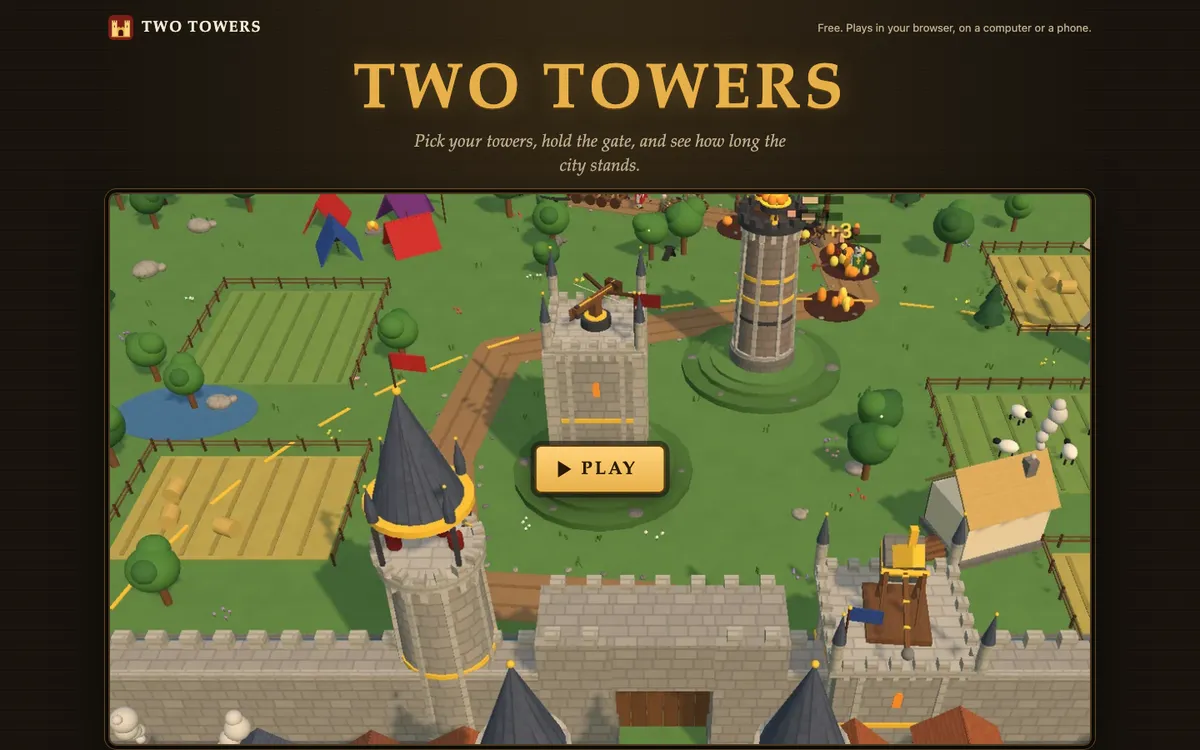
Comments
No comments yet.
Sign in or make an account to comment.