Theory of Constraints at Home: Find the One Bottleneck
The theory of constraints at home comes down to one idea: your routine moves only as fast as its slowest step, so you find that step and fix it before touching anything else. If you want to find the one bottleneck in a messy morning, a slow dinner, or a weekly chore load, you do not need a factory or a spreadsheet. You need a short list of steps and an honest look at where things pile up.
Problem Graph is a free journal drawn as a map. You write each problem in one line, attach what you try and whether it worked, and link problems that belong together. That makes it a good place to see which one problem sits in the middle of the others.
What the theory of constraints means at home
The theory of constraints says every process has one step that limits the whole output. The Lean Enterprise Institute traces it to the physicist Eliyahu Goldratt and his 1984 book The Goal, and describes it as managing the constraints that keep a system from reaching its goals. The old saying behind it, noted in the Wikipedia article on the theory, is that a chain is no stronger than its weakest link. In a factory it might be one slow machine. At home it might be one bathroom, one car, one adult who does all the cooking, or one hour of the day when everyone needs the same thing.
Speed up any other step and nothing changes. The queue just forms somewhere else, or the same queue gets longer. Speed up the limiting step and the whole routine moves.
That is the useful part. You stop asking "what is wrong with our mornings?" and start asking "what is the one thing everything else waits for?"
Why fixing everything at once fails
When a routine feels broken, the natural move is to change five things on Monday. You buy a new lunch system, set a stricter bedtime, move the alarm, and write a chore chart. By Thursday you cannot tell which change helped, and two of them added friction.
There are three problems with this approach.
- You cannot see cause and effect. Five changes at once means no clear result from any of them.
- Most changes hit a step that was never the limit. The effort is real, the gain is zero.
- You burn out your own willpower. People drop the whole plan when it asks too much.
One bottleneck, one change, one result you can read. That is easier to keep going.
The five focusing steps in plain household terms
The theory has five steps. Here is each one without the jargon.
- Identify the constraint. Name the one step everything waits for.
- Exploit it. Make sure that step is never idle and never wastes its time. Remove anything unnecessary from it.
- Subordinate everything else. Arrange the other steps to serve the bottleneck. They should not push more into it than it can take.
- Elevate it. If steps two and three are not enough, add capacity. This is the step that may cost money or effort, so you do it last.
- Repeat. Once the bottleneck loosens, another step becomes the limit. Go back to step one.
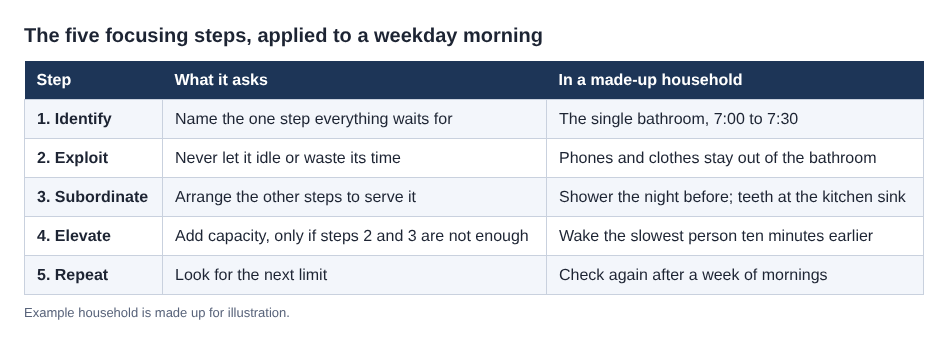
Most home gains come from steps two and three. They are free. People tend to jump to step four, buying a second something, before checking whether the first one is used well.
Theory of constraints at home: how to find the one bottleneck in your routine
Pick one routine that annoys you. Not your whole life, just one stretch, like weekday mornings or the dinner-to-bedtime block. Then do this for a week.
- List the steps in order. Wake, bathroom, dress, breakfast, pack bags, shoes, out the door. If you want a fuller method for this, the post on a value stream map for a daily routine at home walks through it.
- Note where people wait. Waiting is the signal. The step with a person standing next to it, holding something, is usually the constraint.
- Note where work piles up. A heap of laundry, a full sink, or a stack of unpacked bags sits in front of the slow step.
- Ask the downstream question. If this step were instant, would the whole routine finish sooner? If yes, it is your bottleneck. If no, keep looking.
Write your answer as one line. "Everyone needs the bathroom between 7:00 and 7:30" is a bottleneck. "Mornings are chaotic" is not, because you cannot act on it.
Worked example: the weekday morning rush
Imagine a household of four. The goal is to be out the door at 7:40. Most days they leave at 7:55 and everyone is cross. This is a made-up example, but the pattern is common.
The steps are wake up, bathroom, dress, breakfast, pack bags and lunches, shoes, leave. For a week, someone notes where people stand and wait.

The notes show the same thing every day. Between 7:00 and 7:30, two people queue for the single bathroom. Breakfast is ready on time. Bags are mostly packed. Shoes are the usual hunt, but it takes two minutes. The bathroom is the step everything else waits for.
Now the focusing steps.
- Exploit. Nobody does non-bathroom tasks in the bathroom. Phones, hair products, and clothes all stay out. Time in there drops without anyone rushing.
- Subordinate. The teenager showers the night before. The younger child brushes teeth at the kitchen sink after breakfast. The bathroom now serves fewer people at the peak.
- Elevate, only if needed. If it still queues, shift the first wake-up by ten minutes for the person who needs the longest slot. That costs nothing. A second sink or a bigger change comes after that, if ever.
Notice that moving the alarm for everyone, buying a lunch gadget, or a chore chart would not have touched the queue. Those are fixes for steps that were never the limit.
Record it in Problem Graph
In the app, you could write "We leave the house late on weekdays" as a problem in the personal lane. Add a second problem, "One bathroom queue at 7:00", and link the two. Under the bathroom problem, add solutions as ideas: "Teen showers the night before" and "Teeth at the kitchen sink". Mark the ones you are trying, then record the outcome as worked, partly, or failed.
If "alarm 15 minutes earlier for everyone" is on the map as a failed solution, it stays there. That is useful the next time someone suggests it.
How to elevate the bottleneck without spending much
Before you buy anything, try these in order.
- Remove work from the bottleneck. Anything that can happen elsewhere or earlier should. Prepare the night before. Move tasks to a different place.
- Protect its time. A bottleneck that is waiting on a missing item is wasting the one resource you cannot spare. Keep what it needs within reach.
- Spread the load in time. Stagger who uses it and when. This is often enough.
- Share the job. If one adult does all the cooking, the constraint is that person. Splitting one meal prep task is elevation in practice.
- Add capacity last. A second kettle, a bigger fridge, a second car. Only after the free options are used up.
The same logic applies to shared spaces outside the home. A single booking system can be the limit for a team, as in meeting room booking problems, and one shared appliance can be the limit in an office, as in shared office kitchen problems.
If the bottleneck is a person other than you, the fix has to be agreed, not imposed. In Problem Graph you can mark one problem as a main node and share it into a private network, such as a family. You give the invite code to the people you choose, and members of that network see the problem, its solutions, and their outcomes. Keep in mind that anyone with the invite code can join, so only hand it to people you trust. Problems you merely linked to that main node stay in your own graph.
When the bottleneck moves: check again
Fix the bathroom queue and something else becomes the slowest step. Maybe it is now the shoe hunt, or breakfast. That is not failure. It means the first fix worked and you have a new constraint to study.
Run the routine for a week after each change, then look again. Ask the same question: what does everything else wait for now?
Patterns also show up when you link problems. If three separate complaints all connect to "no time between 7:00 and 7:30", the map makes that visible in a way a flat list does not. Problem Graph lets you link problems across lanes, so a work problem and a home problem can share a cause. A problem with several attempts and mixed outcomes is worth keeping on the map, and the post on logging what you tried at home shows how to keep that record.
Frequently asked questions
What is the theory of constraints in simple words?
It says a process can only go as fast as its slowest step. Find that step, improve it first, and ignore improvements elsewhere until it loosens.
How do I know which step is the bottleneck at home?
Look for where people wait and where work piles up. Then ask whether the whole routine would finish sooner if that step were instant. If yes, you have found it.
Do I need to spend money to fix a home bottleneck?
Usually not at first. Remove unneeded work from the step, protect its time, and spread who uses it when. Add capacity only after those options are used up.
What if fixing one bottleneck creates another?
That is expected. Once one step speeds up, a different step becomes the slowest. Repeat the same process on the new one.
Get started: log your bottleneck in Problem Graph
Pick one routine this week. List its steps, watch where people wait, and write the bottleneck as a single line.
Try Problem Graph: it is free, and you can look around the public network without an account. Write one problem down in a line and attach the first thing you will try.
Every problem you carry, on one map. Solved together.
Visit problemgraph.vlvd.net↗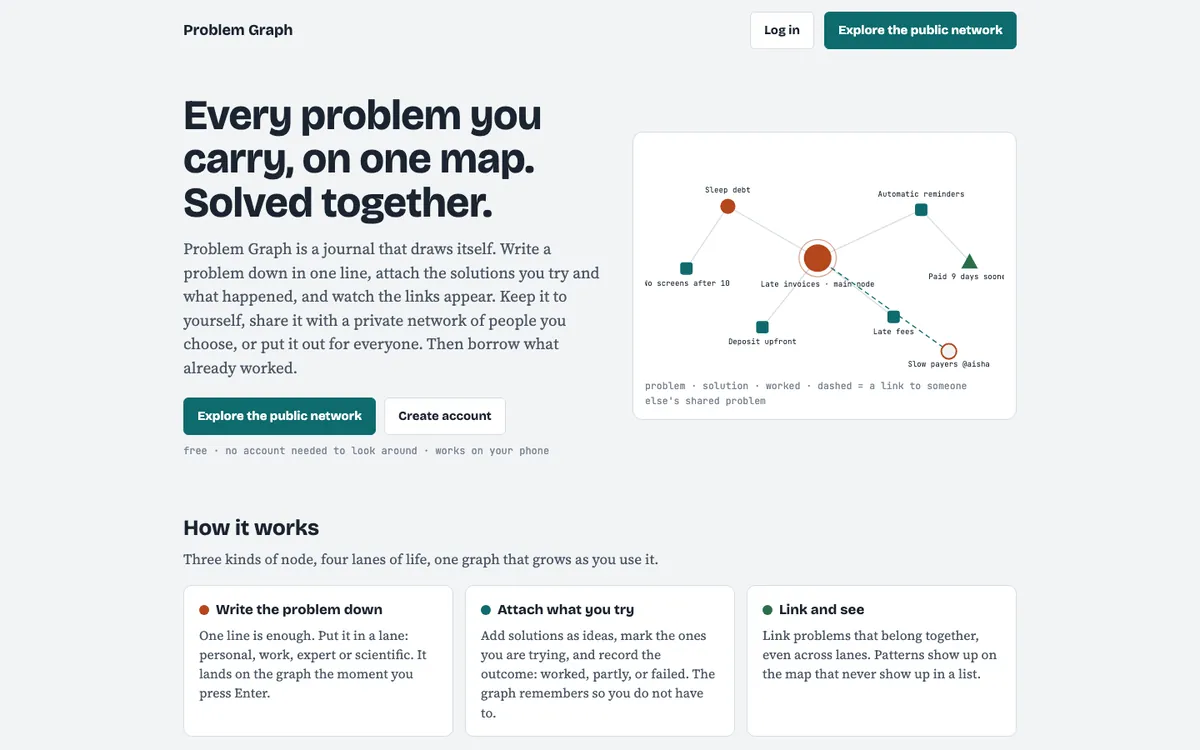
Comments
No comments yet.