Tilbury Fort history: a Thames fort no enemy ever tested
Tilbury Fort, on the north bank of the Thames in Essex, is a lesson in what a fort is for. English Heritage says its defences were never tested by any enemy, and yet it was armed, rebuilt and used for almost 400 years. This Tilbury Fort history follows the fort's jobs in order, from a Tudor gun tower to a gunpowder store, then gives you a short way to read any fort you visit.
If you like asking what a defence is really for, Two Towers is a free browser tower defense game where you choose which two towers guard a city gate and spend gold to hold it against stronger attackers every stage.
Tilbury Fort history: the Tudor blockhouse
The fort began as West Tilbury blockhouse. English Heritage says it was one of five gun forts built along the Thames in 1539 and 1540, under Henry VIII, at a time of international tension. Each was a D-shaped tower with heavy guns and rooms for its gunners, and each had one aim: to sink enemy ships sailing upstream to attack London and the naval dockyards at Woolwich and Deptford.
The site was chosen with care. Gravesend, on the south bank, and West Tilbury, on the north, guarded an important ferry crossing next to a good anchorage, at a point where the river was about 730 metres across. Guns on both banks covered the same water. West Tilbury had 23 guns, under a captain and nine men who formed a peacetime garrison, to be reinforced in time of war.
For another Tudor gun fort that crossed its fire with a partner, see the Portland Castle post.
1588: Elizabeth I and the Armada camp
The blockhouse was neglected after Henry's reign, then repaired and extended during the war with Spain, which began in 1585. With the Spanish Armada expected in 1588, an English army gathered at West Tilbury village, about two miles north. On 7 August Elizabeth I landed at the blockhouse and met the Earl of Leicester, who commanded the camp. The next day she returned to the camp and gave the speech with the lines "I have the heart and stomach of a king, and of a king of England too".
The defences around the blockhouse were extended too, to a plan by an Italian military engineer, Federigo Gianibelli. They were made of earth and timber: a rampart and a double moat laid out in outward-facing angles, so soldiers could fire across the marsh at an enemy coming by land. The bastion idea was already at work here; for how it spread through English forts, read the Yarmouth Castle post.
De Gomme's fort of 1670 to 1685
By the mid 17th century the blockhouse had been neglected for 30 years. Its garrison was a captain and five men, Gianibelli's earthworks were in ruins and cattle grazed the inside. It was held by Parliament through the Civil Wars as a checkpoint where ships on the Thames had to submit to inspection.
The push for a new fort came from a humiliation. In July 1667, during a war with the Dutch, the Dutch navy raided the Medway, burned the fort at Sheerness and destroyed or captured several English warships. English Heritage says this exposed the weakness of England's coastal defences, and the Thames became a priority. In 1668 Sir Bernard de Gomme, military engineer at the Board of Ordnance, drew plans for a much larger fort. Work began in 1670 and lasted almost 15 years, troubled by the difficulties of building on wet marshland and by unreliable contractors.
The result was a pentagon with a brick rampart and a powerful gun battery along the river. It was meant to have an angle bastion at each corner, but the tidal conditions of the Thames stopped the builders from projecting a fifth into the water, so it has four. Two deep concentric moats, filled from the river, ran outside, with a defensible rampart between them. Two gates led in: the Water Gate from the landing, and the Landport Gate from the marsh. Inside were barracks for around 186 soldiers, a storehouse, a gunpowder magazine, guard houses and a chapel. The old blockhouse got an extra storey so it could carry guns on its roof in place of the missing bastion. In 1691 the fort held 272 heavy guns.
A fort that kept finding new work
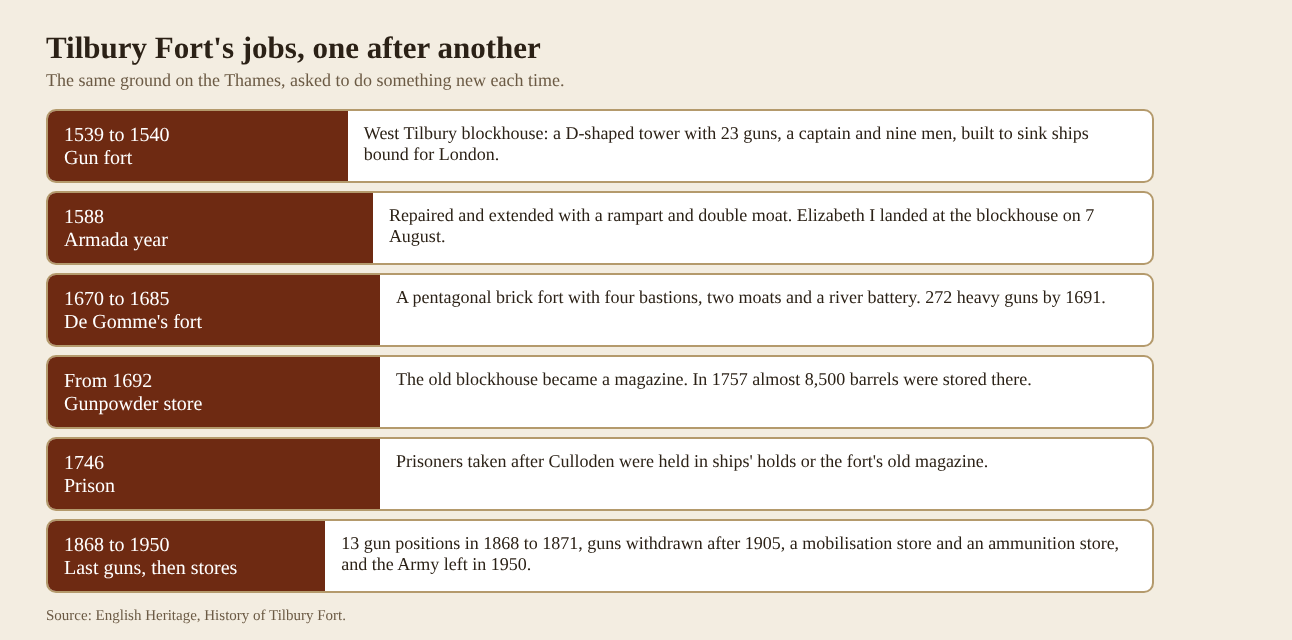
Once the guns were in place, Tilbury took on a second role. By 1677 a civilian storekeeper looked after a store for the Board of Ordnance, which supplied all the army's equipment of war. In 1692 the old blockhouse was converted into a gunpowder magazine, and two purpose-built magazines were added in 1716 and 1717. The barrels supplied Royal Navy warships and troop transports. In 1757 almost 8,500 barrels were stored there, more than at any other stores in Britain, and the capacity reached almost 20,000 barrels during the wars with France between 1793 and 1815.
Tilbury also served as a prison. After the defeat at Culloden in 1746, around 3,500 Scottish prisoners were taken to England, including 564 in one convoy of seven ships that sailed to the Thames. Most were bound for Tilbury, where they were held in the ships' holds or in the fort's old magazine. English Heritage says conditions, food and treatment were appalling and many died of typhus. A granite boulder from Culloden Moor stands outside the fort in their memory. For other castles that held prisoners, see the castle prisons post.
How Tilbury Fort ended
The last gun positions came from a royal commission of 1859, which found the nation's defences neglected. Rifled guns had greater range and power, and new forts were built further downstream, while Tilbury was reshaped as a second line. Thirteen new gun positions went up in 1868 to 1871, with rifled guns of 9-inch calibre, each weighing 12 tons, and a single 11-inch gun of 25 tons, all facing downriver, with a range of up to three miles.
The change was short-lived. By 1900 those guns were obsolete, new lighter ones were installed in 1902 to 1904, and a national review in 1905 judged an attack by sea up the Thames to Tilbury extremely unlikely. All the guns were withdrawn. The fort was a mobilisation store from the 1890s, and an ammunition and explosives store from October 1915. English Heritage says it was redundant by 1925, and the Army left in 1950, after almost 400 years.
A worked example: read a fort by its jobs
Tilbury is a good fort to practise on because the jobs are easy to list. Use three questions, and only what the history page says.
- What was it built to stop? In 1539 and 1540, ships sailing upstream to London. In 1670, after the Dutch raid on the Medway, the same ships again, with a bigger answer.
- What was it ever asked to do? Never fight an enemy, according to English Heritage. It held guns, a queen's army camp nearby, a gunpowder store, prisoners and stores for troops.
- When did the answer to question one stop being true? By 1900 the guns were obsolete, and in 1905 the review took them away.
Compare it with a castle that was attacked. The castle constable post follows the man who had to hold one when the enemy really came. At Tilbury, the whole value of the fort lay in the fact that nobody tried.
The same question in Two Towers
Tilbury's builders put guns on one bank of the river and another battery across the water so that a ship passing between them was covered from both sides. Two Towers asks you for something similar, in a smaller space. On the title screen you pick the tower for each side of the gate from four kinds: Archer Tower, Trebuchet, Ballista or Fire Tower. You click or tap a tower to upgrade it, and you can buy two more towers for the hills, 150 gold for the first and 300 for the second. Gold in the game is in-game gold, never money.
The game's own tips tell you what is coming. One reads: "Crossbowmen shoot from afar: Range upgrades and a Trebuchet reach them." Another gives the general rule: "Spend your gold on Damage between stages, and Reinforce the gate." A short plan in the spirit of Tilbury: before each stage, ask what the next attackers are built to do, find the tip that answers it, and spend on that rather than on what served you last stage. Tilbury's guns were obsolete within decades of being installed; your upgrades stay useful only while they answer who is actually coming.
The game is free, with no ads, and plays in your browser on a computer or a phone. Signing in is optional.
Frequently asked questions
When was Tilbury Fort built?
A Tudor gun fort, West Tilbury blockhouse, was built in 1539 to 1540. The larger fort that stands today was designed by Sir Bernard de Gomme, begun in 1670 and substantially complete by 1685.
Did Tilbury Fort ever fight a battle?
English Heritage says its defences were never tested by any enemy. It was famous for the army camp nearby in 1588, where Elizabeth I gave her speech, not for a fight at the fort.
What did Elizabeth I do at Tilbury?
On 7 August 1588 she landed at the blockhouse and met the Earl of Leicester. The next day she returned to the army camp at West Tilbury and gave her rallying speech while the Armada was expected.
Why is Tilbury Fort shaped like a pentagon?
De Gomme's plan was a pentagon with a bastion at each corner, to give lines of fire over the river and the land. The tide prevented a fifth bastion projecting into the water, so there are four.
Get started
Tilbury teaches one habit: ask what a defence was built to stop, and when that stopped being the question. Try it in Two Towers, free in your browser. Pick your two towers, read the tip for each attacker, and spend your gold where the next stage will hit.
Defend the castle gate, stage after stage.
Visit twotowers.vlvd.net↗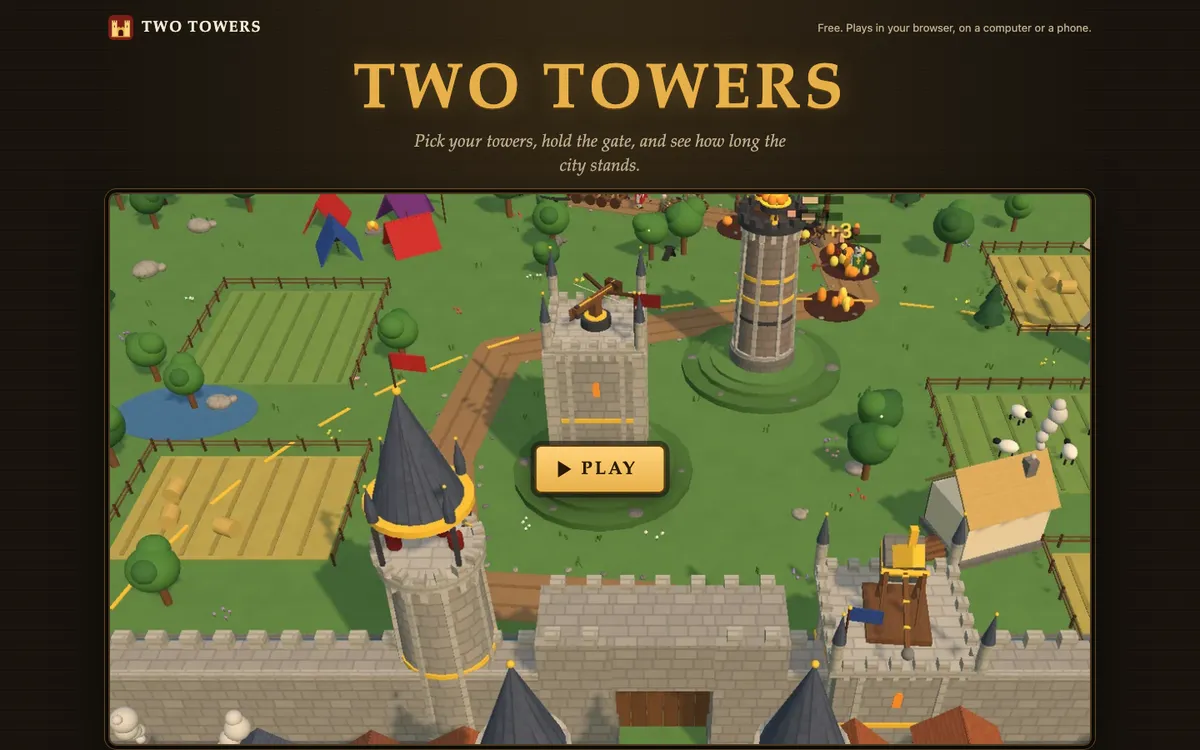
Comments
No comments yet.
Sign in or make an account to comment.