What is a Cornish Rex cat? Marcel waves, origin, traits
What is a Cornish Rex cat? It is a lean, long-legged cat with a short coat set in tight, even waves. The Cat Fanciers' Association (CFA), a cat breed registry, lists its coat as "Soft, wavy, curly" and its personality as "Active, racy, affectionate". This guide follows the CFA's Cornish Rex breed page and its breed standard, opened for this post, and then shows how Cat Go handles the question "Which breed is it?"
Cat Go is a game you play in your browser: walk anywhere, photograph a real cat, lure it with food and catch it, and pick its breed from a list that has a mixed breed answer too.
What is a Cornish Rex cat? The short answer
The Cornish Rex is a pedigreed shorthair breed with a curly coat. The CFA opens its page with a picture in words: "the racy elegance of a greyhound paired with playful personality of a clown", dressed up in curls. It calls the Cornish Rex "one of the most unusual and charming felines to ever enchant cat lovers".
The CFA says the marcel-waved coat is simple to care for and prone to only minimal shedding. It adds that these cats are active, alert and insistent on sharing every aspect of your life. The breed comes in many colors and patterns, and the standard has a long list of them, from white and black to silver shaded coats.
Where the Cornish Rex comes from
The CFA tells the story from a farm. In 1950, in Cornwall, England, a curly-coated cream male kitten turned up in a litter of barn cats on Nina Ennismore's farm. She saw that he was something special, and she asked her vet and a noted geneticist about him.
She then bred the kitten, named Kallibunker, back to his mother, and the litter held two more curly-coated kittens. Mrs. Ennismore had experience with Rex rabbits, so she used the same word for her new breed of cat. Later breedings with Burmese, Siamese and British Shorthair cats showed that the curly coat is a recessive mutation, which means a kitten needs the gene from both parents to show it. Those breedings also gave the breed a diverse foundation.
A California breeder bought a pair from Mrs. Ennismore in 1956 to start the breed in the United States. The CFA accepted it for registration in 1962, and it achieved Championship status two years later. The CFA says it is also bred in Europe and Asia.
The look: a racy body and an egg-shaped head
The CFA describes a lean, statuesque cat with an arched back, an egg-shaped head, large high-set ears, huge luminous eyes and a prominent Roman nose. It says you can never mistake the Cornish Rex for any other breed.
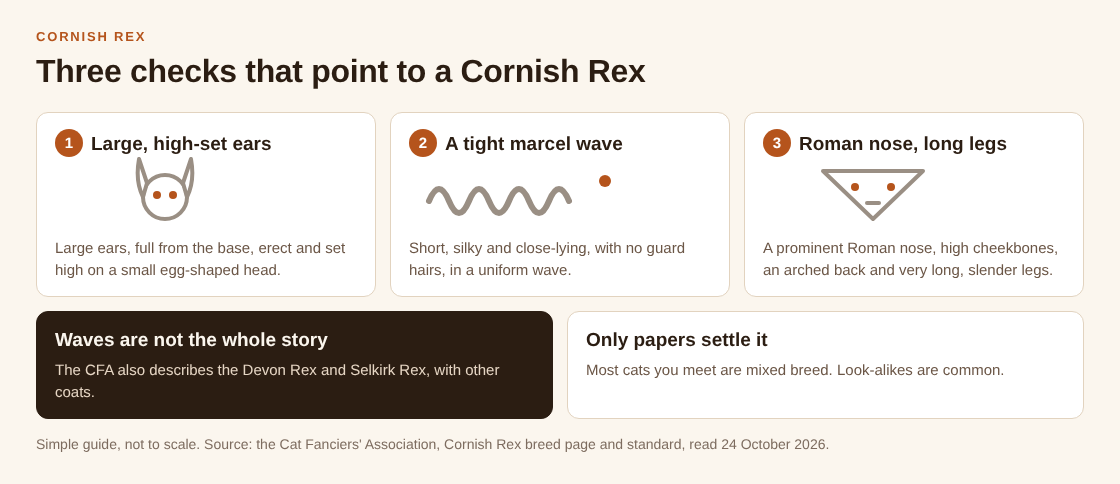
Three checks that point to a Cornish Rex, from the CFA's description.
The breed standard, which is the written ideal the CFA judges against, adds detail:
- Head: comparatively small and egg shaped, about one-third longer than it is wide, with high, well-chiseled cheekbones and a strong chin.
- Eyes and ears: medium to large, oval eyes that slant slightly upward. The ears are large and full from the base, erect and set high on the head.
- Body: small to medium, with a long, slender torso, a deep but not broad chest and a naturally arched back. The waistline looks tucked up.
- Legs and tail: very long, slender legs, so the cat "stands high on its legs", with dainty oval paws. The tail is long, slender, tapering and extremely flexible.
The standard also says the breed is "surprisingly heavy and warm to the touch". It calls the bone fine and delicate.
The coat: tight waves and no guard hairs
The coat is the breed's defining feature. The CFA says it is short, close-lying and covered with tight marcel waves, meaning a regular, even wave. It is completely lacking in guard hairs, the longer outer hairs most cats have, and that gives it an unbelievably soft, silky feel. It must still feel dense to the touch.
The standard gives the coat 40 of its 100 points: 20 for the wave itself, 10 for texture, 5 for length and 5 for how close it lies. The wave should run from the top of the head across the back, sides and hips to the tip of the tail, and the fur under the chin and on the chest and belly is short and noticeably wavy. The standard penalizes a sparse coat or bare spots, and disqualifies a cat with any coarse or guard hairs.
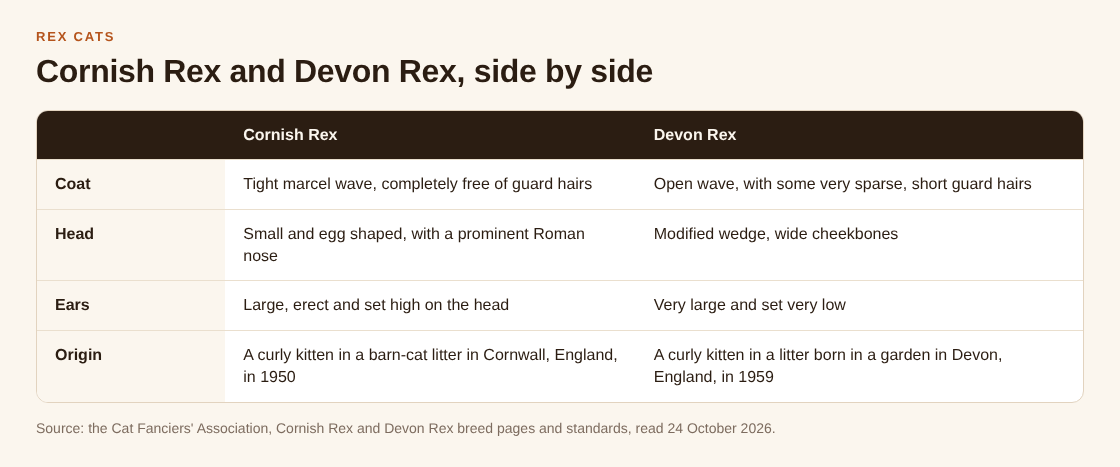
Two rex breeds side by side, from the CFA's breed pages.
The CFA's Devon Rex page draws the same line from the other side: the Cornish Rex has no outer guard hairs, while Devons have some that are very sparse and short, with an open wave. Our post on the Devon Rex covers that breed, and our post on the Selkirk Rex covers a third curly breed. Our guide to cat breeds with curly fur sets them side by side.
Temperament: a "Velcro kitty" with an appetite
The CFA calls today's "Corneys" extremely intelligent, adaptable and adventurous, and says they love to travel. They are also devoted to their people. The CFA says they are often called "Velcro kitties" because they need to stay in physical contact with that special person.
High activity is the other side of it. The CFA says they are in constant search of new things to play with, "which may not actually be appropriate things for them to play with". Its advice is to child-proof the house and keep fragile objects behind closed doors. Their antics amuse children and adults alike, and dogs find them ready playmates.
When a Cornish Rex is not seeking attention, giving affection or playing, the CFA says it is most likely looking for food. Despite slim builds and fine bones, these cats have enormous appetites and will often eat vegetables, fruits and other things most cats ignore. They will "engage in conversation" but are not given to unnecessary or loud vocalizing. The standard adds that the breed is intelligent, alert and generally likes to be handled.
Grooming, sun, cold and health, as the CFA describes them
Because of the coat, the CFA says regular combing is not needed. Two things do need attention:
- Ears: they may collect waxy buildup faster than other breeds, and the CFA says to clean them often with a cotton ball or Q-tip.
- Baths: bathing may be needed occasionally, as some cats become greasy over time. The CFA calls them "wash-and-wear" cats that need only a good shampoo and a thorough towel dry. It warns never to use a blow dryer, because it will ruin the curls.
On health, the CFA calls this a sturdy, vigorous breed with no inherited health issues. It then names two cautions that come from the coat. The lack of guard hairs makes the coat fragile, and it may not give enough protection from the sun, since cats can get sunburned. These cats are also easily chilled in cold weather, so the CFA suggests you may want to provide a sweater. For questions about your own cat, ask your vet.
On finding one, the CFA says it is unusual to find a CFA cat show in the United States without a Cornish Rex or two, and that a show is the best way to meet a breeder. Finding a kitten should not be a challenge, though a particular color or sex may mean a wait.
How to check a wavy-coated cat on a walk
Here is a worked example. On a walk you see a slim cat with a short, wavy coat, and you wonder whether it is a Cornish Rex.
- Look at the coat first. A short coat set in tight, even waves that lie close to the body fits the standard. A coat that is merely fluffy or messy does not.
- Look at the ears. Large ears that stand erect and sit high on the head are part of the description.
- Look at the head. A small egg-shaped head with a prominent Roman nose and high cheekbones is the CFA's picture.
- Look at the frame. Very long, slender legs, an arched back and a tucked-up waist fit the standard.
- Do not stop at the wave. The CFA also describes the Devon Rex and Selkirk Rex, which have other coats. Our post on telling whether a cat is mixed breed gives the longer checklist.
- Watch from where you are. Let the cat go about its day.
At the end, you have a guess, not an answer. A wavy coat and a slim frame do not prove a breed, and only papers can settle it.
Where Cat Go comes in
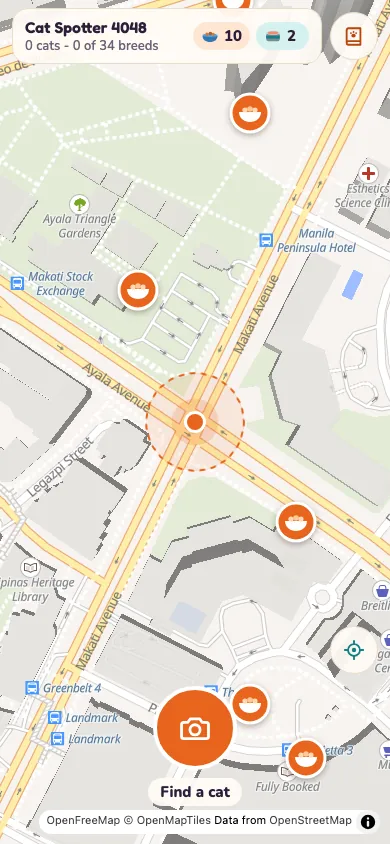
After a cat is spotted, Cat Go asks "Which breed is it?" and gives you a list with a search box, so you can type something like "Siamese" or "curly". The game also says "Most cats you meet are mixed breed" and "Mixed breed is always a safe pick."
That fits what you just read. A slim cat with a wavy coat can be a Cornish Rex or something else, and you choose the breed yourself. The game counts 34 breeds, and every catch is saved to your Catdex with its breed and the place you found it. It needs the camera and location allowed in your browser, and says to fit the whole cat in the frame.
Frequently asked questions
What is a Cornish Rex cat known for?
It is known for its tight, silky marcel-waved coat, its lean greyhound-like build and its playful, people-loving nature. The CFA says the breed began with a curly kitten born on a farm in Cornwall, England, in 1950.
Does a Cornish Rex shed?
The CFA says the coat is prone to only minimal shedding, and that regular combing is not needed. It does not make any claim about allergies on its breed page.
How is a Cornish Rex different from a Devon Rex?
The CFA says the Cornish Rex has no outer guard hairs and a tight marcel wave, while Devons have some very sparse, short guard hairs and an open wave. The Cornish's ears are set high, and the CFA's Devon Rex page describes ears set very low.
Does a Cornish Rex need a sweater?
The CFA says these cats are easily chilled in cold weather, so you may want to provide one. It also says the thin coat may not protect from the sun.
Can you tell a Cornish Rex from a photo?
Not reliably. A tight wave, big high ears and long legs are clues, but they are not proof of a breed, and most cats you meet are mixed breed.
Get started
You do not need a pedigreed cat to enjoy looking at cats. Play Cat Go in your browser: walk anywhere, photograph a real cat, lure it with food and catch it. The game needs your camera and location allowed in the browser. Each catch is saved to your Catdex with its breed and the place you found it.
Walk anywhere, find a real cat, and catch it.
Visit catgo.vlvd.net↗

Comments
No comments yet.
Sign in or make an account to comment.