What is an American Curl cat? Curled ears, origin
What is an American Curl cat? It is a medium-sized cat whose ears curl backwards, away from the face. The Cat Fanciers' Association (CFA), a cat breed registry, lists its coat length as "Longhair and Shorthair", its characteristics as "Ears curl back, away from the face" and its personality as "Energetic and affectionate". This guide follows the CFA's American Curl breed page and its breed standard, opened for this post, and then shows how Cat Go handles the question "Which breed is it?"
Cat Go is a game you play in your browser: walk anywhere, photograph a real cat, lure it with food and catch it, and pick its breed from a list that has a mixed breed answer too.
What is an American Curl cat? The short answer
The American Curl is a pedigreed breed known for one feature: ears that sweep back in a smooth arc. The CFA calls them "swept-back, tufted ears" and the breed standard says the distinctive feature of the American Curl is their attractive, uniquely curled-back ears.
The CFA says the breed comes in two coat lengths and in any genetically possible color, so color will not tell you the breed. So look at the ears first.
Where the American Curl comes from
The CFA tells the story from a doorstep. In 1981 a stray kitten appeared on a doorstep in California. The curve of her ears and her alert expression captured the heart of a woman who went on to found the breed.
The kitten was a black female named Shulamith, and she became the breed's foundation cat. Her offspring showed that the curled ears were an autosomal dominant trait, which the CFA explains means only one copy of the gene is needed to produce the shape. Joe and Grace Ruga, the original breeders, asked CFA judges whether her kittens could be the start of a new breed. The standard says selective breeding began in 1983.
The CFA draws a line between nature and breeders here. A standard was drafted, and curl-eared cats were crossed to domestic shorthairs and longhairs with characteristics that matched it. In its words, the original cat was designed by Mother Nature, but the breed was carefully built by dedicated breeders over time.
The ears: straight at birth, set at 16 weeks
The ears are the whole point, so the CFA is specific about them. American Curl kittens are born with straight ears. Within three to five days the ears start to curl backwards, and they unfurl gradually until they are permanently set at around 16 weeks. Only then, the CFA says, can breeders easily tell pet quality from show quality.
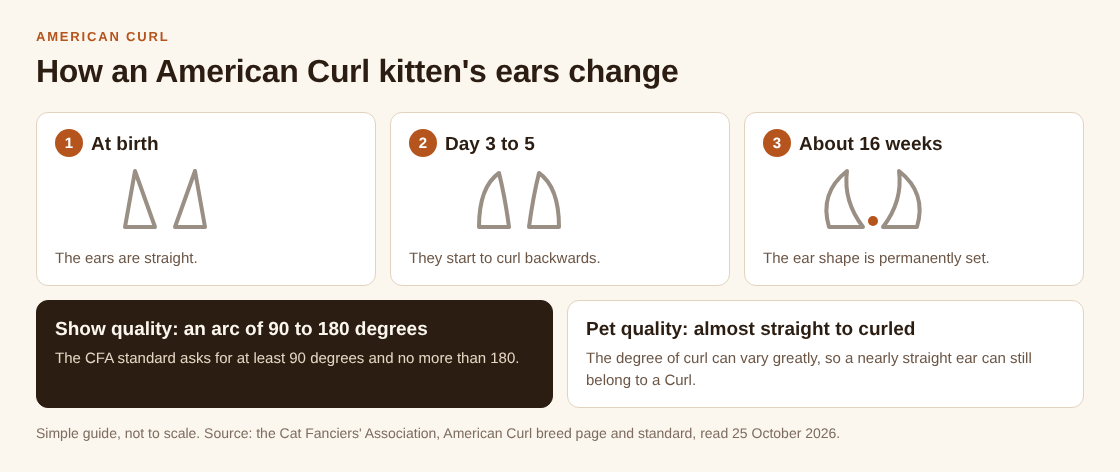
An American Curl kitten's ears over time, from the CFA's breed page.
The degree of curl can vary greatly. The CFA says it ranges from almost straight, which it calls pet quality, to a show quality ear with an arc of 90 to 180 degrees. The standard asks for a minimum of 90 degrees and no more than 180, and it gives the ears 30 of the breed's 100 points.
- Cartilage: firm from the ear base to at least a third of the ear's height.
- Shape: wide at the base and open, curving back in a smooth arc when seen from the front and the rear. The tips are rounded and flexible.
- Size and placement: moderately large, erect, and set equally on the top and side of the head.
- Furnishings: the tufts of hair on the ears are described as desirable.
The standard also lists faults. It penalizes low-set ears, a crimp or pinch in the ear, and an abrupt change of direction. It disqualifies an adult with an extreme curl where the ear tip touches the back of the ear or head.
The look and the coat: wedge head, walnut eyes, silky fur
Beyond the ears, the CFA describes a cat that is "elegant, well balanced, moderately muscled, slender rather than massive in build". Here is what the standard lists:
- Head: a modified wedge without flat planes, moderately longer than wide, with a rounded muzzle and a firm chin.
- Eyes: moderately large and walnut shaped, oval on the top and round on the bottom. The color has no relation to coat color, except that blue eyes are required in the colorpoint class.
- Body: a medium-sized rectangle, and the standard says the length is one and a half times the height at the shoulder.
- Tail: flexible, wide at the base and tapering, about equal to the body length.
- Size: females weigh 5 to 8 pounds and males 7 to 10 pounds.
The coat comes in two lengths. Both are silky and lie flat, and both have minimal undercoat. The two lengths differ mainly in the tail and the length of the hair:
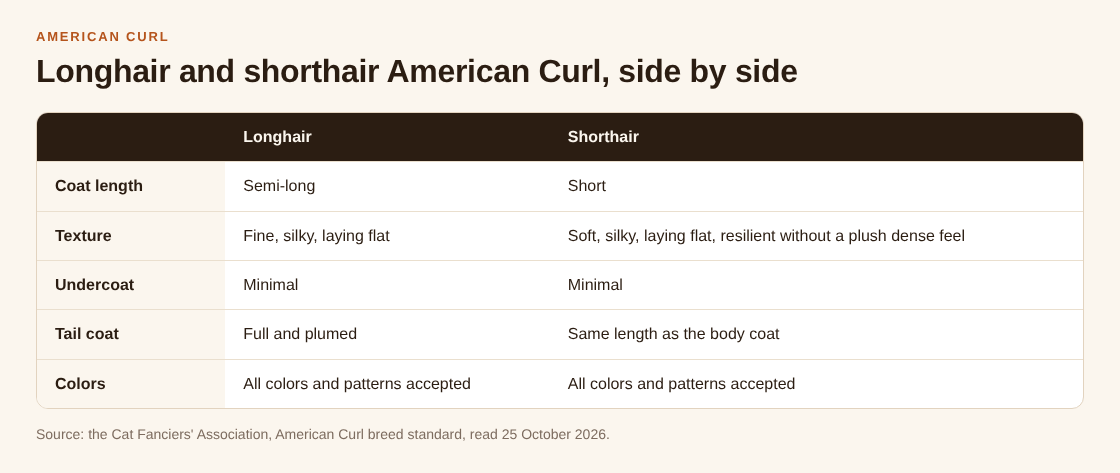
Longhair and shorthair American Curl side by side, from the CFA's breed standard.
All colors and patterns are accepted in both, so the coat is not a clue. If you want to see how a different breed uses its coat as its main feature, our posts on the LaPerm and the Cornish Rex cover two cats where curls are in the fur, not the ears.
Temperament: people-oriented, easygoing and playful
The CFA calls the American Curl "exceptionally people-oriented". It describes a cat torn between helping you put dinner together, assisting with the day's mail and chasing your shoelaces. It calls the breed affectionate, easygoing and adaptable, and intelligent and curious. The CFA says they express themselves by making chirping little comments on your activities, or gently inquiring when dinner will be served.
The activity level is described as energetic enough to be amusing and engaging, but never annoying. The CFA says Curls keep a kitten-like personality well into adulthood, so they typically do well with children of all ages and look forward to regular play sessions. It adds that they tend to have an inherent respect for other pets, which makes them quite compatible with dogs, other cats or any other type of pet.
Grooming, ear care and health, as the CFA describes them
Because the coat lies flat and there is minimal undercoat, the CFA calls it relatively easy to groom. It recommends combing or brushing two or three times a month to keep shedding to a minimum.
- Ears: the CFA says it is important to keep them clean, but with extreme care. Work up and away from the ear canal opening with a cotton swab soaked in ear cleaner, and avoid pulling on the delicate cartilage.
- Health: the CFA says outcrossing to domestic random-bred cats was allowed until 2015, so the gene pool is one of the most diverse available, and no breed-linked health issues have come to light. Many breeders still test regularly for recessive issues from the wider cat population. For your own cat, ask your vet.
- Finding one: the CFA says American Curls are still relatively rare in the U.S. but far more popular elsewhere. It suggests asking exhibitors with other breeds for referrals, being ready to wait for a kitten or travel, and using its Find-A-Breeder website.
How to check a curly-eared cat on a walk
Here is a worked example. On a walk you see a cat with ears that turn back, and you wonder whether it is an American Curl.
- Look at the ear arc. A show quality Curl has an arc of 90 to 180 degrees, curving back in a smooth line.
- Look at the tips. The standard says they are rounded and flexible, and it penalizes a pinch or crimp in the ear.
- Look at the build. The CFA describes a slender cat with a long tail about as long as the body, not a cobby one.
- Look at the coat. It should be silky and flat. Either length counts, so a flat silky coat narrows nothing.
- Do not stop at the ears. The CFA says the degree of curl varies, and kittens' ears are straight at first. Our post on telling whether a cat is mixed breed gives the longer checklist, and our post on the American Bobtail covers another American breed.
At the end you have a guess, not an answer. Ears that curl back do not prove a breed, and only papers can settle it.
Where Cat Go comes in
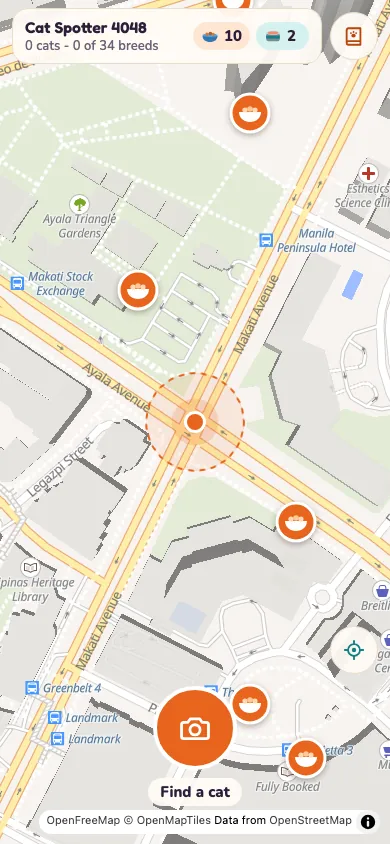
After a cat is spotted, Cat Go asks "Which breed is it?" and gives you a list with a search box. Its hint in the box reads "Search breeds, like Siamese or curly", so a word like "curly" is the natural way to narrow the list. The game also says "Most cats you meet are mixed breed" and "Mixed breed is always a safe pick."
That fits what you just read. A cat with turned-back ears can be an American Curl or something else, and you choose the breed yourself. The game counts 34 breeds, and every catch is saved to your Catdex with its breed and the place you found it. It needs the camera and location allowed in your browser, and its camera screen says to fit the whole cat in the frame, which helps here, since the ears are the clue and they need to be in the photo.
Frequently asked questions
What is an American Curl cat known for?
It is known for its ears, which curl back away from the face. The CFA says the breed began with a stray kitten found on a California doorstep in 1981.
Are American Curl kittens born with curled ears?
No. The CFA says the ears are straight at birth, start to curl backwards in three to five days and are permanently set at around 16 weeks.
Do American Curls have health problems?
The CFA says no breed-linked health issues have come to light so far, and that many breeders still test for recessive issues. Ask your vet about your own cat.
How do you clean an American Curl's ears?
The CFA says to work up and away from the ear canal opening with a cotton swab soaked in ear cleaner, using extreme care and avoiding pulling on the delicate cartilage.
Can you tell an American Curl from a photo?
Not reliably. A smooth 90 to 180 degree curl is a clue, but it is not proof of a breed, and most cats you meet are mixed breed.
Get started
You do not need a pedigreed cat to enjoy looking at cats. Play Cat Go in your browser: walk anywhere, photograph a real cat, lure it with food and catch it. The game needs your camera and location allowed in the browser. Each catch is saved to your Catdex with its breed and the place you found it.
Walk anywhere, find a real cat, and catch it.
Visit catgo.vlvd.net↗

Comments
No comments yet.
Sign in or make an account to comment.