What is an American Bobtail cat? Look, history and care
What is an American Bobtail cat? It is a medium to large, muscular domestic cat with a naturally short tail and a wild-looking face. The Cat Fanciers' Association (CFA), a cat breed registry, says it is "100% domestic". This guide follows the CFA's American Bobtail breed page and its breed standard, opened for this post, and then shows how Cat Go handles the question "Which breed is it?"
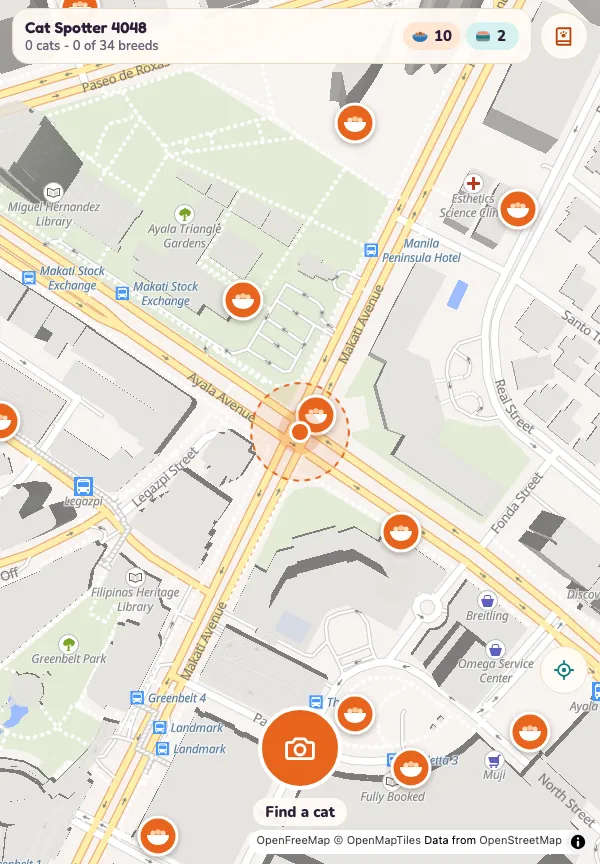
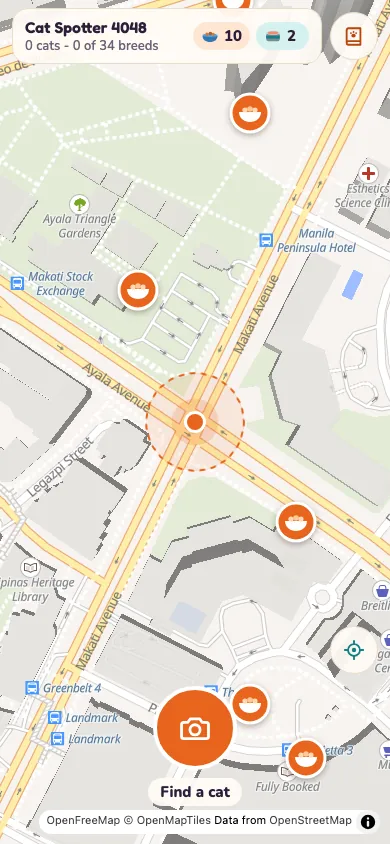
Cat Go is a game you play in your browser: walk anywhere, photograph a real cat, lure it with food and catch it, and pick its breed from a list that has a mixed breed answer too.
What is an American Bobtail cat? The short answer
The CFA lists the breed as a medium to large, naturally occurring, bobtailed cat, in longhair and shorthair coats, with a loving and intelligent personality. Its page says the breed combines the untamed, exotic look of a hunting cat with a mellow, adaptable personality and a very high level of intelligence.
Three things make it stand out:
- A hunting gaze: a fleshy brow over large, almost almond eyes.
- A bobtail: a short, flexible tail that comes from a natural mutation.
- A powerful build: athletic and well muscled, with the look and feel of power.
The CFA says the head and body, more than the tail, are what stand out.
Where the breed comes from
The CFA says the breed was inspired by the discovery of one unique bobtailed cat in Arizona in the late 1960s. American Bobtails are classified as a mutation breed because of their short tails. Unlike most other mutation breeds, though, they do not trace their ancestry back to one or more foundation cats.
The breed's "concept cat" was a brown tabby bobtailed stray named Yodie, who was bred to a seal point Siamese. The short-tailed kittens showed that a dominant bobtail gene existed in the feral cat population. Breeders then worked with feral bobtailed cats from all over the United States and Canada, selecting for the slightly wild look that has become the breed's trademark.
The CFA adds that cats from thousands of miles apart, with no common ancestry, were found to look strikingly alike. That is why it calls this one of its most diverse breeds. Other bobtailed breeds have their own stories: see the Japanese Bobtail and the Manx.
The look: hunting gaze, broad head, rectangular body
The CFA's standard says the American Bobtail is noticeably athletic and well muscled, with an expression of intelligence and alertness. It says type matters more than size or tail characteristics. Here is what it asks for:
- Head: a broad modified wedge without noticeable flat planes, with apparent cheekbones.
- Brow: distinctive and fleshy, which creates the top line of the eye.
- Eyes: large, almost almond in shape and deep set. The brow above them produces the natural hunting gaze.
- Ears: medium, wide at the base with slightly rounded tips, upright with a slight outward tilt.
- Body: moderately long and substantial, with a rectangular stance, a full, broad chest and hips slightly higher than the shoulders.
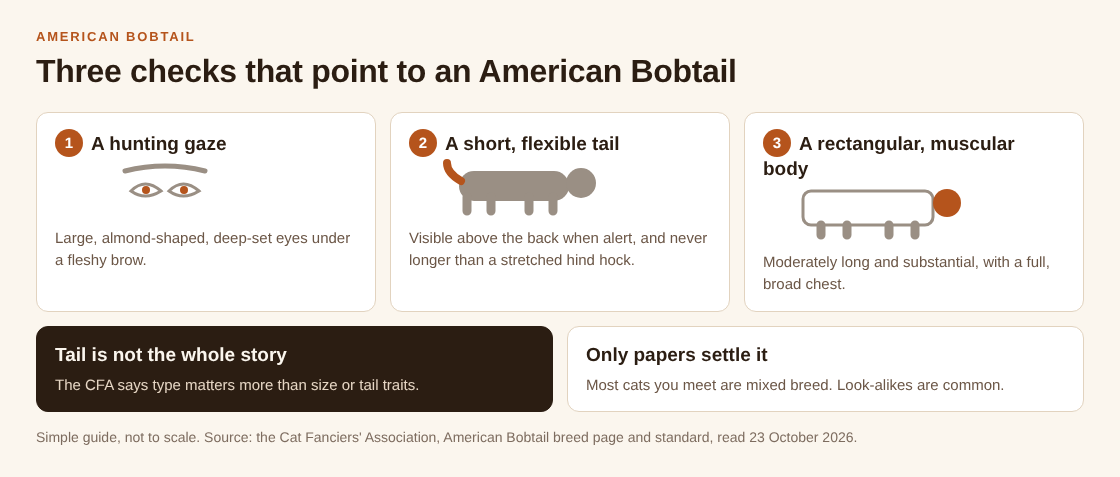
Three checks that point to an American Bobtail, from the CFA's description.
The point score shows what the CFA weighs most: head is worth 45 points, body 40 and coat and color 15. The tail carries 15 of the body's 40.
The bobtail itself
The standard calls the tail short, flexible and expressive. It may be straight, slightly curved, slightly kinked, or have bumps along its length. It should be broad at the base, strong and substantial to the touch, and never fragile. The CFA's page says the tail is about half the length of a normal tail.
There is no single ideal length. The standard says the tail must be long enough to be clearly visible above the back when the cat is alert, and must not extend past a stretched hind hock. It penalizes a tail that is too long or too short, one kinked or knotted out of shape, one that is rigid or fragile, or one set low. If tails are a favorite subject, our post on why cats have tails explains what a tail does for a cat.
Two coats: shorthair and longhair
The breed is shown in two divisions. The standard describes the shorthair coat as medium in length and semi-dense, with a hard topcoat over a soft, downy undercoat. The longhair coat is medium-longhair and slightly shaggy, with longer hair on the ruff, britches, belly and tail. In both, the standard says seasonal variations of the coat should be recognized.
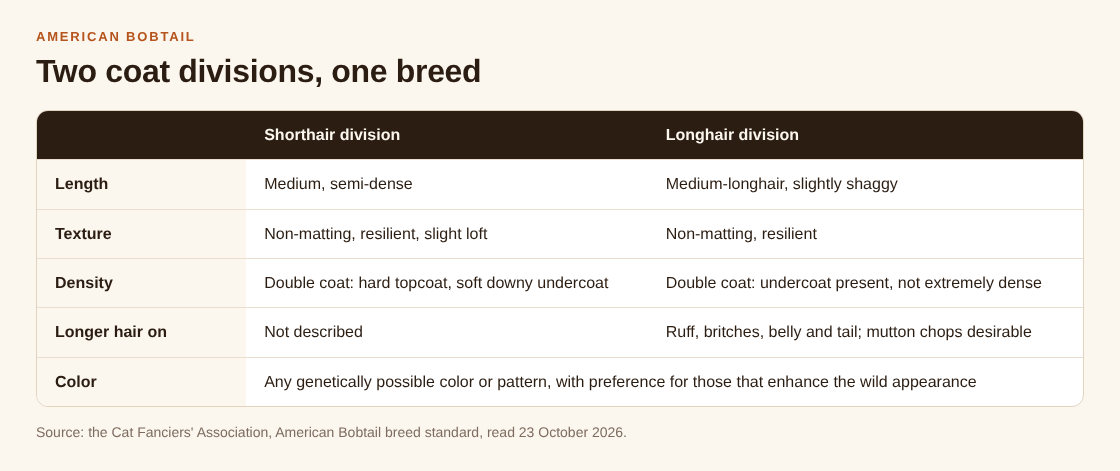
The two coat divisions, as the CFA's American Bobtail standard sets them out.
On color, the standard allows any genetically possible color or combination, with preference for those that enhance the breed's wild look. For tabby patterns, see the four tabby patterns.
Temperament: intelligent, easygoing and playful
The CFA says American Bobtails have an unusually high level of intelligence because their ancestors had to fend for themselves in a variety of environments.
- Independent but affectionate: they form strong bonds with their human families.
- Hunters at play: they develop their own interactive games, most of which revolve around hunting. They stalk and then pounce on a toy, and often carry the captured "prey" around in their mouths.
- Easygoing: the CFA calls the breed an excellent companion for children and says it has proven quite compatible with dogs.
- Voice: relatively quiet, but they will trill, chirp or make clicking sounds when intrigued or engaged.
- Leash training: the CFA says they are easily leash trained and love to go for walks with their people.
These are the CFA's words about the breed in general; a mixed breed cat may act quite differently.
Grooming and health, as the CFA describes them
The CFA says this is not a breed that needs a major time commitment in grooming. The coat, even the longhair version, is easily maintained with weekly brushing or combing. Like all cats, they benefit from an occasional bath, but bathing is not essential as long as the brushing is kept up. Brushing may also help reduce shedding, which happens to some degree with all cats.
On health, the CFA says that given the breed's diverse genetic background, you would not expect significant health problems. It adds one note about the tail:
- The tail mutation: typically harmless, but it could make a cat susceptible to spine and hip problems, some of which can be heritable.
- Completely tailless cats: these occur occasionally and may have issues with incontinence.
- Breeders: the CFA says responsible breeders quickly remove cats with such issues from their breeding programs.
- Tailed kittens: they may appear in litters and cannot be shown, but the CFA calls them excellent pets.
If you are thinking of getting one, ask a breeder what they screen for, and ask your vet about anything to do with your own cat.
How to check a bobtailed cat on a walk
Here is a worked example. On a walk you see a cat with a short tail and a wild look, and you wonder whether it is an American Bobtail.
- Look at the tail. A short, flexible tail that rises above the back when the cat is alert fits the standard. The standard wants the tail clearly visible above the back, so a cat with no tail at all is outside what it describes.
- Look at the face. A fleshy brow over deep-set, almond eyes gives the "hunting gaze".
- Look at the body. It should be long and rectangular, muscular and broad in the chest, perhaps heavier than it looks.
- Do not use the tail as proof. The CFA says type matters more than tail characteristics. Our post on telling whether a cat is mixed breed gives the longer checklist.
- Leave the cat alone. Look from a distance and let it go about its day.
At the end, you have a guess, not an answer. Many cats with a short tail are mixed breed, and only papers can settle it. The CFA adds that the breed is relatively rare and that a cat show with one entered may be hard to find.
Where Cat Go comes in
After a cat is spotted, Cat Go asks "Which breed is it?" and gives you a list with a search box, so you can type something like "Siamese" or "curly". The game also says "Most cats you meet are mixed breed" and "Mixed breed is always a safe pick."
That fits what you just read. A short-tailed, wild-looking cat can be an American Bobtail or a mixed breed cat, and you choose the breed yourself. The game counts 34 breeds, and every catch is saved to your Catdex with its breed and the place you found it. It needs the camera and location allowed in your browser, and says to fit the whole cat in the frame.
Frequently asked questions
Is an American Bobtail a wild cat?
No. The CFA says it may look as though it came straight out of the forest, but the breed is 100% domestic.
Are American Bobtails born with short tails?
Yes. The CFA classes the breed as a mutation breed because of its short tails, and says the short-tailed kittens of its first crosses showed that a dominant bobtail gene existed in the feral cat population.
Do American Bobtails need a lot of grooming?
The CFA says no. Weekly brushing or combing keeps the coat easily maintained, even the long-haired version.
Are American Bobtails good with children and dogs?
The CFA calls the breed an excellent companion for children and says it has proven quite compatible with dogs.
Can Cat Go tell me if a cat is an American Bobtail?
No. In Cat Go you choose the breed yourself from a list, and "Mixed breed is always a safe pick." The game does not name the breed for you.
Get started
Ready to try the "Which breed is it?" question on a real cat? Play Cat Go in your browser: walk anywhere, photograph a real cat, lure it with food and catch it.
Walk anywhere, find a real cat, and catch it.
Visit catgo.vlvd.net↗
Comments
No comments yet.
Sign in or make an account to comment.