What Is an Extra Life in Video Games? How Lives and Score Work
If you have ever asked what is an extra life in video games, and how lives and score work together, the short answer is this: a life is one attempt, an extra life is one more attempt, and score is how the game measures how well you used them. This guide explains each part in plain terms, then shows how it plays out in a real game.
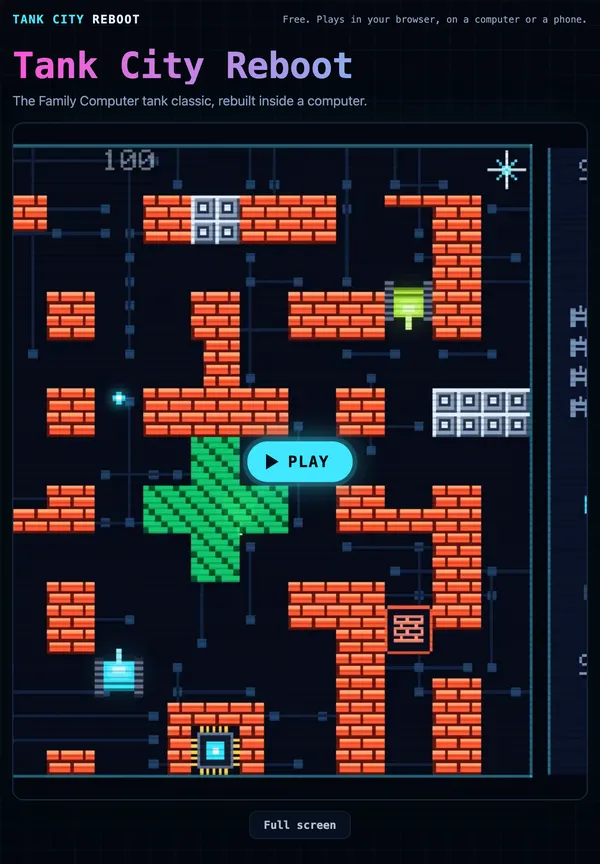
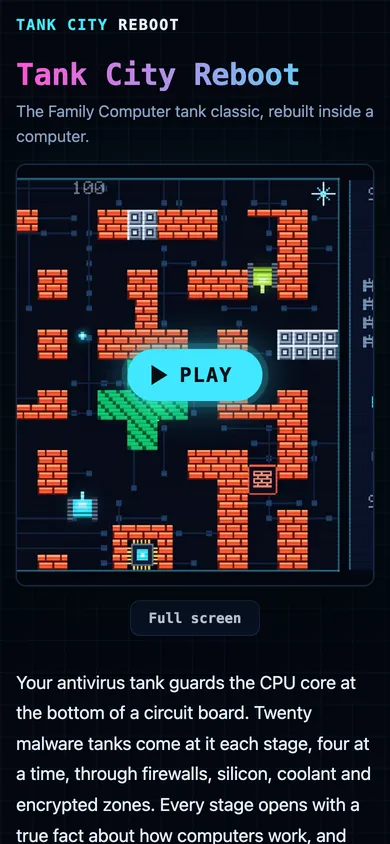
If you would rather see it than read about it, Tank City Reboot is a free tank game that plays in your browser and shows lives, score and extra lives on one screen.
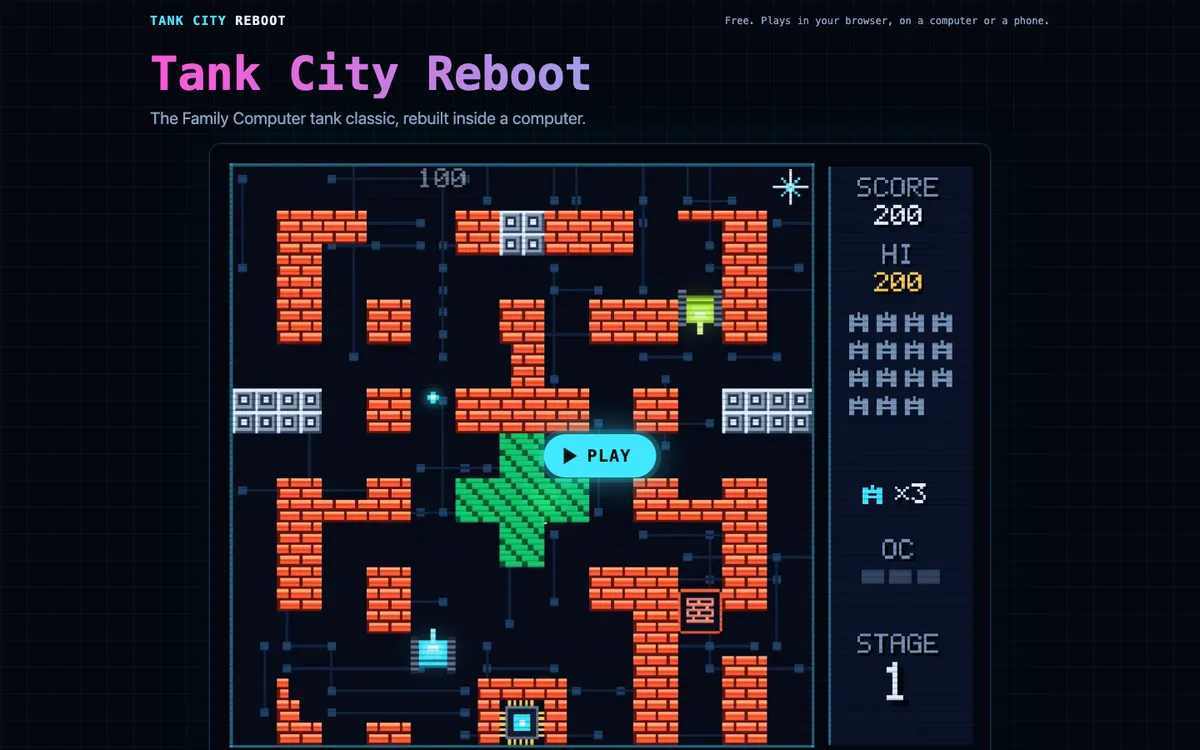
What is an extra life in video games?
An extra life is a bonus attempt. You start a game with a set number of lives, often three. Each time your character is destroyed, you spend one and try again. An extra life adds one to that count.
Lives give a game a clear place to stop: you play until they run out. An extra life is a reward for playing well, a way to say "you earned a longer run."
Not every game uses lives. Some give you a health bar, and some let you restart a level as often as you like. But lives are still common in action games, arcade games and anything that wants a run to feel tense.
How the lives system works
Most lives systems follow the same loop:
- You start with a fixed number of lives.
- When your character is destroyed, the game takes one life.
- If you still have lives left, you come back, usually at a safe spot with a short period where you cannot be hurt.
- If you have none left, the run ends.
The comeback step matters more than it looks. The place where you reappear is called a spawn point, and if you want the basics of how that works, there is a good explainer on what a spawn point is in a video game, and one on what respawning means. The short protection window after you return keeps you from being destroyed again before you can even move.
Losing a life often costs you more than the life itself. Many games take away something you built up, like a weapon upgrade or a combo. That is the real price of a mistake.
How score connects to lives
Score and lives are two separate counters that push on each other.
- Lives measure how long you can keep going.
- Score measures how well you play while you do.
They connect in three ways. First, a higher score can earn you a life, because many games hand one out at a set score. Second, lives let you keep scoring, so a careful player who loses fewer lives usually ends up with a higher total. Third, some games tie score to how you survive, such as a bonus for finishing a level while still in good shape.
A saved best score ties it together. Once you have a number to beat, losing your last life is not only an ending. It is also a result you can compare with your last run. When the last life goes, the game over screen is where that comparison happens.
Common ways to earn an extra life
Games hand out extra lives in a handful of familiar ways:
- Score milestones. Reach a certain number of points and the game gives you a life.
- Pickups. An item on the field, often with a clear icon, adds one when you collect it.
- Collecting enough of something. Fill a meter or gather a set number of items.
- Beating a hard section. A bonus for clearing a boss or a tough stage.
- Choosing it. Some games let you pick a life as a reward after a level.
Each method pushes you to play in a different way. A score milestone rewards steady scoring. A pickup rewards taking a risk to reach it.
Why games limit lives (and what happens at zero)
Limits give your choices weight. If you could never run out, there would be no reason to be careful. A fixed number of lives turns every shot and every move into a small decision.
The limit also shapes how a game feels over time. Three lives make a run short and sharp. Many lives make it relaxed. A game can also give you lives but end the run in other ways, for example if something you must protect is destroyed. In that case you can have lives left and still lose.
When you hit zero, the game shows a game over screen. A good one tells you why the run ended, shows your score and often shows your best. That last part is what makes you press the button for another try.
How lives and score work in Tank City Reboot
Tank City Reboot has two games, and both use lives in slightly different ways. Here is how each one handles them.
The first game
In the first game, your antivirus tank guards the CPU core at the bottom of a circuit board. Twenty malware tanks come at it each stage. You start with 3 lives.
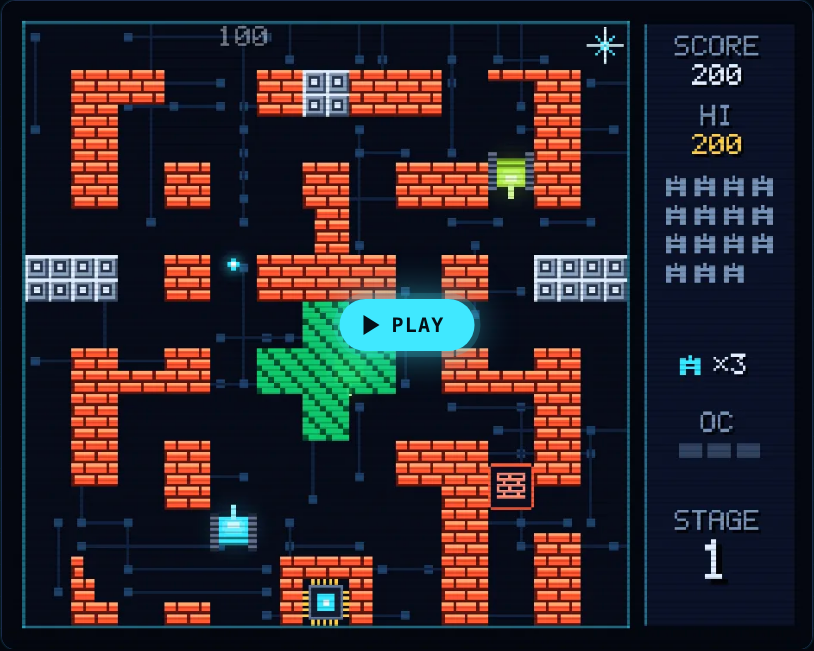
The side panel of the first game: score, best score, the enemies still to come, and your lives (x3) at the start.
Score comes from kills. A worm is worth 100, a trojan 200, spyware 300 and a rootkit 400. Picking up a power-up scores 500.
There are two ways to gain a life:
- You get one extra life the first time your score reaches 20,000 in a game. It happens once.
- The Backup power-up gives one extra life. It is one of six power-ups, and it drops when you hit a flashing enemy tank that carries one.
When you lose a tank, a life is spent. You come back about 1.2 seconds later, and the new tank cannot move or be hit while it arrives. After that you have a shield of about 4 seconds. Be aware that your Overclock level goes back to 0 when you lose a life, so you lose the upgraded cannon too. That is the hidden cost of dying.
The run ends in one of two ways: EVERY TANK WAS LOST or THE CPU CORE WAS BREACHED. The second one means you can have lives left and still lose, because a single shot that reaches the core ends the game.
Zero Day
The second game, Tank City Zero Day, adds a second counter. You start with 3 lives and also a core integrity of 3, which can rise to 5. The run ends if either one hits zero.
Here the connection between lives and score is built into the rules. Clearing a wave gives a core bonus of 250 times the wave number times the share of core integrity you have left. Take wave 4 as an example:
- With the core at full integrity, the bonus is 250 x 4 x 1, which is 1,000.
- With 2 of 3 integrity left, it is about 667.
So protecting the core is worth real points, not just survival.
Kills also build a chain. Every kill within 2.5 seconds of the last one adds to it, and the multiplier rises from x1 up to x8. Losing a life resets the chain, so dying costs you the multiplier, not only a life. The combo meter post explains how chains and multipliers work.
After each wave, you pick one of three upgrades. The Two-factor upgrade is the extra life: it adds one life. RAID is the other safety net, adding 1 to core integrity and repairing it fully, and you can take it twice.
Both games keep your best score on your device, and playing never needs an account.
Tips for making your lives last longer
These come straight from how the games work:
- Treat the core as your real life. In both games, the core can end the run on its own. Defend it before you chase kills.
- Use the shield window. After you come back, you have a few seconds of protection. Use that time to get into position, not to rush forward.
- Dash through shots in Zero Day. You cannot be hit during a dash, which lasts a fifth of a second. It recharges in 1.5 seconds.
- Shoot enemy shots. In both games, your shots cancel enemy shots.
- Grab Patch when you see it. In the first game it gives a 10 second shield.
- Chain kills fast. In Zero Day, a quick chain raises your multiplier, so a clean stretch is worth far more than a slow one.
- Change one thing at a time. If a run keeps ending in the same place, adjust one habit and try again. Then see whether the run gets longer.
Frequently asked questions
What is an extra life in a video game?
It is a bonus attempt that adds one to the number of times you can be destroyed before the game ends. Games hand them out for reaching a score, collecting an item or beating a hard section.
Does a higher score give you more lives?
In many games it does. In Tank City Reboot's first game, you get one extra life the first time your score reaches 20,000 in a game.
Can you lose a game with lives still left?
Yes, if the game has another way to end the run. In Tank City Reboot, the run also ends if the CPU core is destroyed, even when you still have tanks in reserve.
What happens to my upgrades when I lose a life?
That depends on the game. In the first Tank City Reboot game, your Overclock level goes back to 0 when you lose a life. In Zero Day, losing a life resets your kill chain.
Get started with Tank City Reboot
The fastest way to understand lives and score is to watch them change as you play. Play Tank City Reboot: it is free, plays in your browser on a computer or a phone, and needs no account. Try to reach 20,000 points for the bonus life, then move on to Zero Day and see how much the core bonus adds to your total.
Comments
No comments yet.
Sign in or make an account to comment.